Showing posts with label ranting. Show all posts

Saturday, March 29, 2014

The World Vision Thing

h/t to the Millennial Pastor for
the great image (& responses)
You heard about this, right?

On Monday, World Vision announced in Christianity Today that it was changing its hiring policy so that gay Christians in legal marriages could be hired. Rich Stearns, president of World Vision, explained the policy change this way:
"It's easy to read a lot more into this decision than is really there," he said. "This is not an endorsement of same-sex marriage. We have decided we are not going to get into that debate. Nor is this a rejection of traditional marriage, which we affirm and support." "We're not caving to some kind of pressure. We're not on some slippery slope. There is no lawsuit threatening us. There is no employee group lobbying us," said Stearns. "This is not us compromising. It is us deferring to the authority of churches and denominations on theological issues. We're an operational arm of the global church, we're not a theological arm of the church."
The shit immediately hit the fan with close to 5,000 people canceling their sponsorships of children. In less than 48 hours, Stearns announced that the board reversed the decision, saying it was a mistake.
"We made certainly in retrospect was a bad decision, but we did it with the right motivations. We weren’t trying to harm, or trying to find revenue, we weren’t doing it for wrong motives. We were trying to find some kind of solution to a divisive issue that would create some space of togetherness around differences within the church. Our regret is that we caused more division instead of finding a place of more unity."
So by Wednesday, I had a fair number of thoughts going through my head. Let me see if I can set them out in any sort of coherent order.

First of all, I'm hugely disappointed by how this whole thing played out. And although I'm upset at those who decided to withdraw their sponsorship of children, I have to admit I understand it. I have not been a financial supporter of World Vision in part because of its conservative Christian background (not the only reason, but one of them). So I'm certainly in the same boat as people who don't want to support an organization that they think represents values counter to their own.

I'm much more disappointed with World Vision, for a few reasons:
  • They (apparently) didn't anticipate this. Really? Knowing the political climate we live in, knowing the reactive nature of our current Christian culture, knowing that homosexuality is THE hot button topic...they hadn't thought through the plan? 
  • They didn't give this any time. Rachel Held Evans had begun rallying the troops to solicit new donors. I suspect many other church leaders would have done the same. I'd come home on Tuesday, after learning about the reaction, planning to donate to World Vision as a show of support for this change, knowing they were getting a beating. But they reversed the decision so quickly, I hadn't gotten to it yet. 
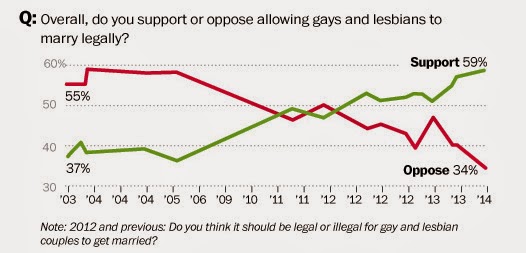
  • It seems tremendously short-sighted. They said they weren't trying to find revenue, and that may be true, but I think they lost a great deal of revenue in the long run by the reversal. Look at these charts, people! Do you see which way these lines are trending? 


  • It's inconsistent. Of course, if opposition to the marriage of same-sex couples truly were one of the fundamental principles under which World Vision operates, then looking at the approval rates would be irrelevant. However, one post I read this week noted that World Vision Canada has had a non-discriminatory hiring policy for over 15 years. Which leads me to believe
  • This is a failure of leadership, not a principled decision. Was it based on the financials? It certainly could be. Their latest 990 (financial reporting) shows that expenses were higher than income in 2011 and 2012, at an increasing rate, so there may be serious financial pressures at work. But I am reminded of Friedman's book A Failure of Nerve, which explains that leadership means holding fast in the face of conflict, rather than immediately reacting to loud and negative voices. 
I was appalled at this particular statement in Stearns' retraction: "We’re learning that a number of people are calling back since the reversal to reinstate their sponsorship. They’re forgiving; they’re saying, ‘Hey we stand with you.’” That, sir, is not forgiveness, any more a child stopping a tantrum after you buy him a toy means the child has forgiven you.

I wish them the best, but I continue to believe this was a huge mistake.

***
FWIW, here are some of the international aid organizations to which I contribute, in case you're looking for other organizations to support:

Against Malaria Foundation: www.againstmalaria.com
CA Bikes: cabikes.org
Evidence Action: www.evidenceaction.org
Kiva: www.kiva.org
Partners in Health: www.pih.org

Saturday, August 17, 2013

A Postcard Postmortem Post

Note: This is total Episcopal Church inside baseball. If that's not your thing, I'd advise you to skip this post entirely.

So there was a kerfuffle in the Episcopal Church over the past couple of days -- not the usual kerfuffle, about human sexuality and/or property disputes. This was a much gentler and intimate kerfuffle about how we want to represent our denomination to those outside our immediate circle through outbound marketing materials.

The materials in question took the form of slogans that could be printed off as postcards. As noted by Adam Trambley and others, these materials were problematic. And by "problematic" I mean very bad. I'll talk more about them below.

To our denomination's great credit, the church center responded to the criticism by taking down the postcards and putting up this message:


That said, there isn't actually a way for someone to direct feedback about this campaign to the people or department in charge that I could find. As an initial suggestion, I would love it if the church center would include a link on this page to allow people to give feedback or answer a survey -- or something.

But I am going to take them up on their encouragement to share ideas and criticisms, which I think are still appropriate. This is not in order to beat a horse that's already been put out of its misery, but because I think it will be helpful to analyze what went wrong in order to consider what needs to happen next.

But first a few more general comments:

1) We need to move beyond print media. This campaign was designed for "postcards, ads, and billboards." Why limit ourselves to these forms of media when there are so many easy ways for people to share online? There's no mention of using these on Facebook, even though people did indeed share the visuals that way. There's no mention of embedding the graphics in the church's website, or encouraging people to use it as a badge on their blogs with, say, a link to their local congregation. There are lots of creative ways to make content shareable. Which leads to the next point:

2) We need to move beyond ads coming from the institution itself. The hard truth is people don't trust ads coming from brands or companies saying "buy me!"; they trust their friends. This is not news. And this holds true for The Episcopal Church as a "brand" as well. Sending out a postcard -- even a good one -- that comes from the institutional church saying "Hey, we're great! You should totally check us out!" is not going to be nearly as effective as helping the members of church talk positively about its place in our lives. I mean, look at this chart.


Speaking of the church...

3) We've got to stop talking about the church as "a place people go to on Sundays."  Or at least as if that were its only manifestation. What I hope we mean by "The Episcopal Church welcomes you" is that we who worship God as part of the church in the Episcopal tradition will love you and care for you whether or not you ever darken the doors of one of our buildings. We welcome you by our prayers for the world, by our advocacy efforts, by our service projects, by the Christian formation that we bring to the work that we do day by day. And of course we invite you to share in this way of being the church because we think it has a lot to offer.

Speaking of which...

4) What do we have to offer? One of the real problems and turn-offs of the recent ad campaign is that it sent the message that the only thing desired was to get butts in pews. And it makes me wonder: is there, in fact, any other outcome we actually want? What do we have to offer? Because "you should join us" is not actually telling me anything.

So. Let's take a look at those ads:

Ad #1: Aside from the tinge of the guilt trip about this ("you never call, you never write..."), my other big complaint about the text is that it tells a person absolutely nothing about the Episcopal Church. Is the Episcopal Church 2,000 years old? No? So what are you talking about? What is it? Where is it? What does it stand for? Why on earth should I show up? If you're surprised to see me, are you really welcoming me?

This one also exemplifies complaints 3 and 4, above. Is there any welcome outside of Sunday? What if I work on Sunday? What if my kid has soccer? What do you have for me then? What do you have to offer me?

Ad #2: Oy vey. "Priests play golf too"? First of all, I don't play golf. I'm trying to think of any priest I know who plays golf. Most priests I know have neither the time nor the money to play golf. Most priests I know finish services on Sundays and go take a nap. So there's that. It's just plain weird and has no relationship to the church I know.

And then consider: You send this to a household with a single mom, what does this say to her? You send this to a household where someone lost his job, what does this say to him? It says (for one thing) that I, as a priest, feel most connected to (to use an unfair shorthand) the country club set. Yes, here in the Episcopal Church, we priests like to cut that boring ol' "worship" short to get to the really important stuff: hob-nobbing with the quality. Like us.

Here's my issue with Ad #3: if people in our communities can't see what we have been doing between Easter and Christmas, maybe the problem is with us. Can we instead say "Here's what we've been doing since Easter" with a photo montage of Episcopalians Doing Things.

That's another issue with this ad campaign as a whole: there's not a single image. It makes for a very passive, sterile kind of campaign, and it implies that The Episcopal Church is devoid of people or activity. And that's just plain not true.

We have good stuff to share. The reason this ad campaign bugged me so much is that it sold our denomination woefully short. We can do so much better. I think everyone has realized that.

Again, huge kudos to The Episcopal Church for listening to the criticism and pulling the campaign. Moving forward, I would love to see a campaign that's more generally shareable rather than institutionally driven. And I'd love a campaign that focuses on the fact that the Church reaches far beyond Sunday morning services and shows Episcopalians in all orders of ministry actively engaged in the work of the kingdom of God.


Friday, May 31, 2013

Lance Mannion in response to Rep. Luke Messer

Apparently, Rep. Luke Messer believes the interest rate for student loans should rise from 3.4% to 6.8% because "personal responsibility is pretty cool."

In response, Lance Mannion with a Twitter rant:

I thought that was pretty cool.

May I add, I do not understand how it is not personally responsible to pay back a loan at a lower interest rate as opposed to a high one. After all, the current 30-year mortgage rate is 3.81%. I don't even understand what the issue is, here.


Thursday, May 30, 2013

You can't tell who's hungry by looking

On a discussion group I'm part of, one person raised the question of how to teach children at a Vacation Bible School about hunger. One day at VBS, they are having a visiting missionary from an African country who suggested that for snack that day, they offer the children half a glass of water and half a cracker, telling them that in the African country where this person worked, this was considered a good meal. Was this, the person asked, a good idea?

The more I consider this, the more disturbing it feels to me, and the more certain I am that the answer is, no. This is a terrible idea.

What I wrote to the group is that we do not know if the children coming to our VBS programs are, in fact, well-fed. It may be that parents are sending children to VBS to provide them with snacks and child care. I think it's dangerous to presume that "they" are hungry and "we" are well-fed. All I can truly say is that I am well-fed. That's all I can know for sure. To deprive children of food in the name of teaching them a lesson seems morally dubious to me.

Just a few days ago, the Pew Research Center came out with a report that stated
Despite being the richest country in the survey, nearly a quarter of Americans (24%) say they had trouble putting food on the table in the past 12 months. This is up from just 16% who reported such deprivation in 2007, the year before the Great Recession began.
Share our Strength reports that 16 million children in the US experience hunger.
Nearly one in five children in America lives in households that struggle to put food on the table. They may look no different than other children; child hunger in America is often invisible. They are hurting, just the same.
I think we're too used to picture of hunger that are actually pictures of starvation. But the truth is, you cannot tell who is hungry just by looking. Does the child in this photo look hungry? What does "hunger" look like?

All those very useful exercises that show the relative availability of food from one part of the world to another can only make the point if you yourself are not aware of what it is like not to have food. To tell people who struggle to put food on the table, "Feel sorry about those people very far away"...well, I don't think it's a good idea. And since we do not know who is hungry and who is not, I think it is best to feed everyone.

There's a second part of this that disturbs me: what message are we sending about African nations if the only thing people ever hear about them is "for people in this country, a half a cracker is a good meal"? First of all, I am quite certain that there is more than one person in this country that actually has more than half a cracker for lunch. It is just as incomplete a picture to say "Everyone there is starving" as it is to say "Everyone here has plenty."

Finally, is there anything else we can learn about Africa other than "it's full of needy people and we need to help them"? Are there no values there that people can teach us? Is there not a good children's story from this country that could teach something to us about sharing or hospitality or friendship or anything? Is the only thing to know about Africa is that we should help them? Is there no mutuality? Or is it all Radi-Aid for Norway?


Thursday, May 9, 2013

You don't have to smile

Back when I was living in the second floor apartment of the Parish House in Gambier, OH, every day I would pass a piece of graffiti on the landing by the phone. It said "Smile. Jesus loves you." It made me want to strangle the writer.

I remembered this today, reading Allie Brosh's epic post on Hyperbole and a Half: Depression Part Two. Here's the image that made me want to employ a semi-automatic weapon that most of the time I want to see banned:


Is it just me? Or does it make you want to kill someone too?

When are we going to understand that "Rejoice with those who rejoice; weep with those who weep" means just what it says? We're told to bear one another's burdens, not cheer one another up. "Jesus loves you" comes with no strings attached, not even a smile.

I saw this rewrite of the Serenity Prayer the other day, and I think it's worth sharing:
God grant me the serenity to accept the people I cannot change, the courage to change the one I can, and the wisdom to know it’s me.
The terrible truth is you can't make people feel better. But if you can sit with them where they are, maybe that will feel ok.

Saturday, April 6, 2013

Various & Sundry: There is no marijuana anywhere in this post. But there might be some Coke.

OK! Now that's we've gotten Holy Week and Easter (the first Sunday of) all prepped and posted, it's time to gather up the crumbs under my table. Or at least highlight some of the things I thought were interesting enough to pass along in the endless stream o' content that is Twitter.

For example, haven't you always wanted to watch an MRI of broccoli?

I think that's kind of magical.

It will just keep glowing up there as I move along to other things, such as this slightly related story (in that there are vegetables involved) of a pot bust that goes bust. Turns out that the suspects "had bought hydroponic equipment to grow a small number of tomatoes and squash plants in their basement." It also turns out the suspects had been in employ of the CIA, and did not take kindly to it when Kansas and Missouri law enforcement "armed with assault rifles and wearing bullet proof vests pounded on the door of their home around 7:30 a.m. last April 20." Sorry! Sorry everyone! I just get carried away!


Elsewhere in Missouri, my dad's alma mater, Missouri S&T, is competing in the 2013 Climate Leadership Award for Best in Campus Climate Leadership. Of course, my alma mater, Oberlin, is also competing. Where do my loyalties lie? Hmmmm...

I loved this rant by my favorite Social Media blogger, Mark Schaefer, wrote In praise of the Unremarkable, which has forever added to my lexicon the term rainbow bombs.

Looking for a new exercise program? Trying to avoid the zombie apocalypse? You might want to try a new fitness app called Zombies, Run! "The app casts users as survivors of a global zombie apocalypse. Download it onto your mobile phone, insert earbuds and prepare to be surrounded by a soundscape that transforms your favorite running route into a battle-scarred obstacle course dense with flesh-guzzling ghouls." And Margaret Atwood -- yes, that Margaret Atwood -- has a cameo voiceover.

Remember #Kony2012? Quick update: Uganda has suspended their efforts to look for Joseph Kony, due to the coup in the Central African Republic where it is believe Kony is hiding. However, the US is offering a $5M bounty for his capture as part of the War Crimes Reward Program. Did you know we have a War Crimes Reward Program? Well, now you know.

A very quick summary of the situation in CAR:
A coalition of rebels in the Central African Republic, known as Seleka, toppled President Francois Bozize last month. They swept into the capital, Bangui, in a lightning offensive that triggered days of looting and drew international condemnation.
Just to give you the bare bones of the story.

On the other hand, and on the positive side, I'm really intrigued by what the non-profit ColaLife is doing to transport medical supplies to inaccessible regions by leveraging CocaCola's distribution network.
The result of their efforts so far is the AidPod, a wedge-shaped container that fits between the necks of bottles in a Coca-Cola crate. For the pilot program, they are using the AidPods to distribute an anti-diarrhea kit, called “Kit Yamoyo” (“Kit of Life”). 
The AidPod’s are a clever packaging solution, born of a very particular design problem. Because the vision was to physically piggyback on Coke’s distribution system, they needed to work with the crates used to move the popular soda to retailers. Initial designs experimented with pouches on the side and tubes that could be slotted in place of a bottle. Neither option would have worked, as both would have meant less space for Coke. Then, genius struck. 
“My wife said, ‘Why don’t we make use of the unused space?’” says Berry.
Well, that makes sense! Here's a very short video on how that works.


Isn't that clever?

Wednesday, November 14, 2012

Review: Skyfall ***THERE WILL BE SPOILERS!***

For my dad's birthday, my parents and I went to see the new James Bond film, Skyfall, and I have things I want to say about it that involve HUGE spoilers! I'm warning you now! If you don't want to know, then don't keep reading.

Have you averted your eyes, you who do not wish to know?

All right then.


Friday, September 21, 2012

Unless you want my tomatoes, quit asking for my tithe!

Seeing Father Tim's great post asking for music to put on a Stewardship Soundtrack made me realize I'd better get in quick if I wanted to get this off my chest:

It is just as inaccurate to talk about the Biblical tithe as proof you should give 10 percent of your income to the church as it is to talk about selected passages in Leviticus as proof that homosexuality is a sin.

I ask you: how many times has your church talked about tithing as the Biblical standard of stewardship? And that tithing means you should give 10 percent of your income away? In all that time, has anyone actually ever even shown you the passages where it says that? It was only a couple of years ago that I realized I'd never actually looked at the texts, and since then each year I've only grown more peeved at how we have abused the Bible to, frankly, no good end.

Let's visit our old friend Leviticus, shall we? Here's Leviticus 27:30-32:
All tithes from the land, whether the seed from the ground or the fruit from the tree, are the Lord's; they are holy to the Lord. If person wish to redeem any of their tithes, they must add one-fifth to them. All tithes of herd and flock, every tenth one that passes under the shepherd's staff, shall be holy to the Lord.
Now from Numbers 18:11-13, 21
[The Lord spoke to Aaron:] This also is yours: I have given to you, togther with your sons and daughters, as a perpetual due, whatever is set aside from the gifts of all the elevation offerings of the Israelites; everyone who is clean in your house may eat them. All the best of the oil and all the best of the wine and of the grain, the choice produce that they give to the Lord, I have given to you. The first fruits of all that is in their land, which they bring to the Lord, shall be yours; everyone who is clean in your house may eat of it...To the Levites I have given every tithe in Israel for a possession in return for the service that they perform, the service in the tent of meeting.
And Deuteronomy 14:22-27
Set apart a tithe of all the yield of your seed that is brought in yearly from the field. In the presence of the Lord your God, in the place that he will choose as a dwelling for his name, you shall eat the tithe of your grain, your wine, and your oil, as well as the firstlings of your herd and flock, so that you may learn to fear the Lord your God always. But if, when the Lord your God has blessed you, the distance is so great that you are unable to transport it, because the place where the Lord your God will choose to set his name is too far away from you, then you may turn it into money. With the money secure in hand, go to the place that the Lord your God will choose; spend the money for whatever you wish—oxen, sheep, wine, strong drink, or whatever you desire. And you shall eat there in the presence of the Lord your God, you and your household rejoicing together. As for the Levites resident in your towns, do not neglect them, because they have no allotment or inheritance with you.
Got that? Tithing applies to agricultural products. This is why Jesus talks to the Pharisees about tithing "mint and rue and herbs of all kinds." And if you preferred to do cash instead, well, it cost 20 percent more, according to the Leviticus reading above.

Seriously, can you take those passages above and make a case for saying "This means today that you should give 10 percent of your income to your local parish"? If we are serious about Biblical context for other Old Testament texts, it's rather sloppy of us to say there's an easy equivalence between these texts and the annual pledge drive.

Here's the context: Unless you owned land and had crops and flocks, tithing did not apply to you. What applied to you non-landowner types was offerings.

Take a look at Exodus as an example. In Exodus 25,
The Lord said to Moses: Tell the Israelites to take for me an offering; from all whose hearts prompt them to give you shall receive the offering for me. This is the offering that you shall receive from them: gold, silver, and bronze, blue, purple, and crimson yarns and fine linen, goats' hair, tanned rams' skins, fine leather, acacia wood, oil for the lamps, spices for the anointing oil and for the fragrant incense, onyx stones and gems to be set in the ephod and for the breastpiece. And have them make me a sanctuary, so that I may dwell among them.
So here you see that gifts are asked of people--in no particular amount, but for the specific purpose of worship, "from all whose hearts prompt them."

But here's what's particularly interesting to me: in Exodus 36:2-6, we read
Moses then called Bezalel and Oholiab and every skillful one to whom the Lord had given skill, everyone whose heart was stirred to come do the work; and they received from Moses all the free-will offerings that the Israelites had brought for doing the work on the sanctuary. They still kept bringing him freewill offerings every morning, so that all the artisans who were doing every sort of task on the sanctuary came, each from the task being performed, and said to Moses, "The people are bringing much more than enough for doing the work that the Lord has commanded us to do." So Moses gave the command, and word was proclaimed throughout the camp: "No man or woman is to make anything else as an offering for the sanctuary." So the people were restrained from bringing; for what they had already brought was more than enough to do all the work.
So you've got two kinds of freewill offerings: the offerings of goods, and the offerings of services. And at a certain point, they had enough to do the work God wanted of them. It wasn't a set percentage based on income; it only had to do with the actual ministry and tasks to be performed!

Tithing is a quick and easy short-cut; 10 percent, done. You know you're set with God and the church for the year. But a) should we be bound by Old Testament law in the first place? and b) does setting the tithe as a standard do anything to help us examine either our hearts or understand our ministries? I would argue no, and no.

I feel that using the tithing short-cut actually damages our churches. Tithing sets up a disconnect between stewardship and mission, making giving all about "how much" and not what the gifts are supposed to do. In asking for a tithe, we ask church members to conform to an external standard rather than the more challenging work of coming to terms with God and one's own conscience.  It encourages guilty giving rather than joyful and generous giving. How can we be generous people if all we know is the demand of a certain dollar amount?

I really wish churches would think about stewardship in terms of getting the resources to do mission that stirs people's hearts to give rather than targeting people to commit a particular percentage amount of income to the church. The case for the Biblical tithe is flimsy at best, to begin with. Given that as Christians, we are no longer bound by the Law, it's irresponsible to use the tithe as our standard of giving, even if it weren't applicable to agricultural products.

On the other hand, I do have some zucchini to share.


Various & Sundry: In which I first vent about then calm myself about Mitt Romney

Boy, did Mittens get on my nerves this week. Of course, I'm not the only one, and lots of people had lots of insightful things to say about the leaked Boca Raton fundraiser video, in case anyone is still obsessing interested. Here are some of the things that I thought captured well my feelings of utter disgust some salient points.

Charlie Pierce writes, "when the One Great Scorer comes to write against Romney's name, he's going to be stumped as to whether the man was a bigger jerk than he was an incompetent. There won't be enough whiskey in heaven for the OGS to resolve this, so he'll just fill in the box marked "Both" and move right along."

Jonathan Chait writes, "the video exposes an authentic Romney as a far more sinister character than I had imagined. Here is the sneering plutocrat, fully in thrall to a series of pernicious myths that are at the heart of the mania that has seized his party."

And Ezra Klein writes, "The working poor haven’t abdicated responsibility for their lives. They’re drowning in it."

In the "rather laugh than cry" column, Hitler has a few words to say about the video leak, and John Oliver and Andy Zaltzman profile Empathy Magazine's 2012 Man of the Year award winner in this week's The Bugle podcast.

In the more cheerful world of obituary news, this week we mark the lives of Sister Mary Rose McGeady who resuscitated Covenant House, an organization that helps homeless youth; Joshua Morse III, the dean who integrated Ole Miss law school--in 1963; and Jerome Horwitz who created the AIDS medication AZT, and didn't get a penny for it. Makers not takers, all.

Oh, did I say that out loud?

Deep cleansing breaths.

And if there's one thing that will give me some perspective and empathy, it is reading this beautiful letter by Ted Hughes to his son about the suffering of the child within.
Usually, that child is a wretchedly isolated undeveloped little being. It’s been protected by the efficient armour, it’s never participated in life, it’s never been exposed to living and to managing the person’s affairs, it’s never been given responsibility for taking the brunt. And it’s never properly lived. That’s how it is in almost everybody. And that little creature is sitting there, behind the armour, peering through the slits. And in its own self, it is still unprotected, incapable, inexperienced. Every single person is vulnerable to unexpected defeat in this inmost emotional self.
Followed by The Maccabeats who have taught me everything I now know about Rosh Hashanah. Be sure to check out the lyrics on their YouTube channel.

Friday, July 27, 2012

Various & Sundry: Annoyances and Olympians

I have about an hour or so before the Olympic Opening Ceremony to fling a whole bunch of mostly non-Olympic-related links and stuff at you. Let's get cracking!

Top of the list: The charming Tim Schenck has started yet another new blog project with 10 Things That Annoy Me, a satisfying little offering to which you can add your own list of 10. Mine is here. It was frighteningly easy to develop.

You know what annoys some people? The notion that "they didn't build that." I liked this article by David Frum about why this rankles people so much. His conclusion:
the president is still delivering the shocking news, as unwelcome today as it was when first propounded, that:
the race is not to the swift, nor the battle to the strong, neither yet bread to the wise, nor yet riches to men of understanding, nor yet favour to men of skill; but time and chance happeneth to them all.
To be sure, other politicians have declared that "life is unfair." But that instruction is usually directed to society's losers. Obama is—almost uniquely—directing the message to society's winners, including the very grand winner who will soon be nominated to run for president against him. They're not used to it, and they don't like it, not one bit.
Meanwhile, to protest the Boy Scouts of America's continued policy of excluding gays from its ranks, a number of Eagle Scouts have started returning their medals along with letters of protest. You can read many of them here. And here's one example:


Meanwhile, PeaceBang delivered a barn-burner of a rant on her blog about the completely erroneous assumptions we make when newcomers appear in our churches of a Sunday morning. Here is a sampling:
People do not attend a church service because they are interested in joining a church. They attend a church service because they are looking for something deep. They are seeking. They are searching. They are in need.  [jump]
I believe that if today’s seekers do not immediately experience a church community as a group of people who take spiritual questions seriously, they will not return. And why should they? Because we’re cool? Because we march in the right parades and support social justice causes? Because we agree with them that the Catholic Church/Bible Belt is hopelessly corrupt, and we’re willing to stand around and mock the religious right in the most spiteful language at our gatherings?
Oh, preach on, sister! And she does. I hope you churchy types will take the time to read, mark, learn, and inwardly digest that one as well as the follow-up.

Finally, to bring us back to the real reason we are here today: The Olympics obituaries, I loved this one about Olympic swimmer, Ann Curtis, "who was widely regarded as one of the greatest female swimmers, winning 2 Olympic gold medals in 1948 [in London!] and 34 United States championships, died on June 26 at her home in San Rafael, Calif. She was 86."

Hers is a great story of hard work, overcoming adversity, and going against common wisdom. She also displayed a touching, almost ridiculous, modesty about her achievements. Her children only learned that she had been in the Olympics from other people. She and her husband managed a swimming pool in San Rafael until she was in her '70's. She kept swimming, as you might guess, but perhaps not as much as you think. The obit ends,
At 50, Curtis won five gold medals in the United States masters championships. She seemed unimpressed.

“My times were terrible,” she said. “I did a complete turnaround and took up tennis.”
I suspect she was good at tennis too.

And now: Let the games begin!

Thursday, June 28, 2012

Taking confirmation seriously

Cross-posted on the Confirm not Conform blog.

I suspect I am one of the few priests in the world whose prayer book falls open naturally to the Confirmation Service. And as someone who has spent a lot of time looking at the confirmation service, I want to know why in the world confirmation was ever allowed to become an exit rite.

You know what I'm talking about, right? That exodus that too often occurs after youth get confirmed; that gap we too often see between the ages of younger and adult members in the church. After doing a lot of thinking about confirmation, I have my suspicions about where this comes from.

I've heard stories of adults telling youth, "If you just get confirmed, you don't have to come to church any more." I've heard stories of church folks saying that seeing youth leave after confirmation is only natural. Does that seem...odd to you? To me, it's kind of like saying to someone, "If you just get married, you don't have to spend any more time with your intended spouse," and all the guests at the wedding thinking that's perfectly normal.

Here's what the Book of Common Prayer says "Concerning the service of Confirmation":
"In the course of their Christian development, those baptized at an early age are expected, when they are ready and have been duly prepared, to make a mature public affirmation of their faith and commitment to the responsibilities of their Baptism and to receive the laying on of hands by the bishop."
Sounds pretty serious to me. Public, mature, commitment. Sounds a lot like marriage. In fact, let's see here..."Christian marriage is a solemn and public covenant." Yep. Sounds pretty similar to me. So why would we suggest to youth that confirmation is their opportunity to leave? Why has leaving been part of the youth confirmation DNA?

I've got to tell you, I don't think this is primarily due to the youth.

If we tell youth, "Just get confirmed and you never have to do another thing," we are betraying the sacrament of confirmation. If we watch them leave and think, "Well, that's just what happens after confirmation," we are complicit in devaluing its meaning. We are the ones who have belittled the service and made it a poor ragged little thing, a scrap of a ceremony with no worth whatsoever. We are telling youth, by word and example, "Make this commitment; it doesn't really mean anything anyway." What kind of witness is that?

The good news is, we can change that. If we change our attitude from "just get confirmed; whatever else you do doesn't matter" to "what you do matters; confirmation needs to be congruent with what you intend to do afterwards," then I firmly believe confirmation will no longer be an exit rite. We need to be willing to stand up and say, "If you aren't truly willing to make a commitment to the responsibilities of your Baptism, then don't get confirmed. If you do want to make the commitment, then take your part in the councils of the church. We take confirmation seriously and we take you seriously too."

I truly believe that confirmation is worthwhile and means something. Let's treat it like it does.

Wednesday, June 6, 2012

On the death of the midweek Bible study

Doesn't every church look like this?
A couple of people I know on Facebook have posted a link to an article in the Christian Century from an Episcopal priest in Minnesota who finally threw in the towel and stopped offering midweek Bible studies and programs and worship. I was totally with her up until the point where she diagnoses the issue.

First she writes,
When I ask why people don’t come, the answer almost always is time. They have good intentions, but their lives are so full. So they tend to use their precious free time only for things that they really care about, which tend to be things that offer immediate good feelings. They flock to tutor at the local elementary school, to work for civil rights for LGBT people, to serve free meals for the hungry. And they love to eat with friends—the church’s social calendar is filled with dinners, dances and parties. The congregation is also growing, and quickly. 
But the idea of having leisurely conversations about Jesus is just, well, too slow. The only adult formation things that have been in any way successful are sermon podcasts and daily e-mailed bits of wisdom, prayer or scripture. 
Ummm...excuse me, but didn't, you know, Jesus eat with friends? Didn't his followers generally "do things they really care about"? Does, perhaps, healing people offer "immediate good feelings"? Does she notice who, in the gospels, spent all of their time in "leisurely conversations" about the Scriptures?

And what's this about "good intentions," as if the things these folks are doing do not measure up? Does she really think that working for civil rights for LGBT people offers "immediate good feelings"? Is it really a problem that they use their "precious free time" to tutor rather than attend another church service? Can she not see that if they are tutoring children, working for justice, or feeding the hungry, they are living the gospel? Why is she so concerned that they're not coming to mid-week Bible study when it seems they have clearly absorbed what the Bible teaches and what Jesus calls us to do?

She writes that she is working hard "to give up the picture I have in my head about what a church is supposed to look like: people sitting around on couches in the parish hall, Bibles open." Where does this picture come from? It doesn't match any actual experience of church I've ever had, and I grew up Evangelical with an expectation of Daily Quiet Times.

But then it hit me: This is her dream and the picture in her head because THIS IS WHAT SHE LIKES AND WANTS TO DO! And that, I think, is the core problem many of us in the church have. The people who enjoy these types of programs and midweek services are, you know, pastors. That's why we went to seminary. That's what feeds our souls (and, I dare say, offers us "immediate good feelings"). Most people are not pastors and we keep thinking that if we just offer them THIS, they'll suddenly get how wonderful it is. THEY'RE NOT GOING TO! These programs and services and Bible studies feed the people in our parish who are like us, who are pastors. I believe there's something in that Bible we study about how "not all are called to be pastors." Maybe we should pay attention.

Wednesday, May 16, 2012

The laborer deserves to be paid

Got an email from a clergy colleague who knew me from my former life as a sign language interpreter.  She forwarded on to me a message from another clergyperson with a Deaf congregant, wondering about resources for finding a cheap interpreter. The priest thought they couldn't afford to pay the professional expense the interpreter was asking.  I wrote back with a suggestion of where to look, but also pointed out that the amount being asked was less than I got paid as a professional interpreter 20 years ago.

Here's what stuck in my craw: the question was not, "Do you know of any resources to find ways to pay a professional interpreter a professional rate?"  It was not, "Do you know of any grants we could apply for?"  It was, "Do you know anyone who will do it for less or for free?"

This "Where can we get it cheap?" attitude devalues work and devalues people.  In this case especially it made me mad; why should the Deaf person get a cheap interpreter?  What kind of quality do you think you're going to get?  Don't you think someone should be paid for providing this service?  This church has the opportunity to provide high-quality interpreting services and employ someone in a down economy.  Instead, they want to half-ass it at minimal cost.

I know churches are strapped.  But it also gets my goat that churches' first reaction often seems to be, "Where can we get a cut-rate version?" rather than "What do we need to do to pay someone a fair amount to do a good job as we provide a ministry to others?"

Here's a thought for you: if you can't pay people for their work, then maybe you are not ready to provide this ministry.  Here's another: quit being so cheap.

Thursday, May 10, 2012

Some practical advice for clergy considering a parish job

Last week, I posted some practical advice for pastoral search committees. That advice had been part of a sermon in which I confessed that I lied on the ethics portion of the General Ordination Exam--and got the highest possible score.

What I didn't mention was that the ethics question had to do with whether or not a rector should consider taking a new job.  I don't have the answer I gave any more; what I remember was that I wrote a whole lot of Christian blather about discernment and the leading of the Holy Spirit when the truth was far more practical and (I feel) better serves both the clergy and the church.

I sense that many of us use spiritual blather to mask or justify our more personal or practical reasons for making the decisions we do.  I think that's a shame that we feel we cannot give our real reasons.

Don't believe me?  There was one time when I decided that a parish was not right for me.  I told various friends what I had chosen, and one (also a priest) asked me I had really discerned, wanting to know my spiritual reasons for saying no.  I could certainly gin some up, but to this day I resent the fact that turning down a job needed to be approved by spiritual signs when what it boiled down to was, "Not interested.  Sorry."

There are some jobs I'm very sorry I didn't get, jobs to which I felt called.  But I have also turned down a few positions, and I regret none of them.  But, my goodness, the pressure I have felt to take them from people who had all sorts of oh-so-spiritual reasons why I should--oh-so-spiritual reasons that just happened to coincide with what they wanted.

So with that in mind, here is my very blunt advice on the whole job search process.

  • You need to look out for yourself and your own needs.  First and foremost.  And it sounds selfish and horrible, but I don't care.  This is priority one.  Does the job offer you enough to live on?  Will you be able to take care of yourself and your family?  Will your basic needs for your health and well-being be met? Will you be able to do this job without going into debt?  (You would not believe...well, maybe you would.) Who is going to take care of you? By and large, my friends, you are going to need to take care of yourself, so make sure you have the resources to do so.  And by "resources," I mean money, housing, health insurance, friends, and time off.  Spiritual resources are not enough.
  • "I'm interested!" is a good enough reason.   Forget the spiritual clap-trap.  Does the job sound fun? Interesting?  Is it in a place you'd like to live?  A place that will provide opportunities for you and your family?  Does the job description intrigue you?  Well, then, apply.
  • Pity is not a good enough reason.  Just because a parish neeeeeeds a priest and you have the skills and you could heeeelp them is not a good enough reason to apply.  Do NOT be guilted into applying for a job.  Guilt, pity, and shame are no basis for a good working relationship.
  • Be honest about what you can and cannot do.  I've already told the pastoral search committee that priests lie in interviews, but let me tell you: don't lie in interviews.  If they're looking for an administrator and you're no good at administration, don't say, "I'm great at administration."  Say something like, "I can do x and y, but I will need someone to help me with a and b.  Here is how I have been able to manage those tasks in other places."  If they need someone who is good at something you're not good at, you are not the person for the job.
  • Negotiate at the outset.  See "looking out for your needs," above.  Do you need a day to be with your family?  Do you need to have your office painted before you move into it?  Do you need internet access?  Do you need a cap placed on the hours you work in a week?  Be clear about it--as clear as you can, given that you don't know all the circumstances.  Now is your best time to set expectations.  Stick to them.
  • Get the money.  See "looking out for your needs," above.  One thing I really regret in my church career is not pushing harder on the financial side.  I don't even want to think of how many thousands of dollars I've lost because I did not say, "that is not acceptable."  One thing I'm proud of is turning down a job that paid below the set diocesan minimum (see "pity is not a good enough reason," above).  I probably would have lost one other job, or walked away from it, because they were not following their own diocesan standards for salaries, but I took it anyway.  I still regret that I did not stand my ground and say, "This needs to be different" and let the chips fall where they may.
One more thing about the money side: as long as the Church can get away with underpaying its clergy, it will do so.  And the way for that to change is for clergy not to take jobs where they are underpaid, or to do part-time work for the part-time pay you are being offered.  "Diocesan minimum" is a very nice concept, but in my experience, diocesan minimums are made to be broken.  Hold the Church accountable to its own standards.  This is not being greedy.  It is an act of courage and an act of justice--not just for yourself, but for others.  And be aware that it may cost you jobs.
  •  Get it in writing.  Just do.  When you negotiate new terms, when you agree on hours, when you settle on a salary...get it in writing.
  • Sometimes it's just dumb luck. I was just looking this morning this morning at the readings for May 20th, and the Acts reading is about the call of Matthias, which was basically eenie, meenie, meinie, moe.   I think we downplay the role of luck in the search process in general.   Leading of the Holy Spirit, my ass.  If you get a job you really wanted, don't get all holy-moly on us.  Maybe your resume was at the top of the pile when people were fresh and excited.  If you don't get a job, don't bow your head and ask what you did wrong.  Maybe you had the same name as the search committee chair's horrible first grade teacher.  There are people involved in this search process, and people are people.
  • Remember it's just a job.  Really.  It's a job.  Yes, it's a calling, but no more or less than being a professor or a politician or a police officer.  It's. A. Job.  Treat it with the respect it deserves, but always remember that reverence belongs to God alone.

End rant.

Friday, March 23, 2012

Various & Sundry: the "What is WRONG with people?" edition

As I look over what I've compiled during the week, things seem mostly to have taken a fairly serious turn. Nothing wrong with that, but if you want  something lighthearted, skip to the video at the end.

Trayvon Martin. Can there be a more appalling tale out there? Ta-Nehisi Coates has been posting something daily about what's being said and done, but I think the most...I don't know if "helpful" is the right word, but illuminating, perhaps, was this larger picture piece of the Stand Your Ground law that allows people to use lethal force when feeling--feeling--threatened. Trayvon Martin is not the only person to be killed because of this law. Unbelievable.

Again going to a larger picture, the Kony2012 video inspired Teju Cole's reflections on the White Savior Industrial Complex, which is very much worth your read.  Here's the key take-away:
What innocent heroes don't always understand is that they play a useful role for people who have much more cynical motives. The White Savior Industrial Complex is a valve for releasing the unbearable pressures that build in a system built on pillage. We can participate in the economic destruction of Haiti over long years, but when the earthquake strikes it feels good to send $10 each to the rescue fund. I have no opposition, in principle, to such donations (I frequently make them myself), but we must do such things only with awareness of what else is involved. If we are going to interfere in the lives of others, a little due diligence is a minimum requirement.
Preach it.

I haven't had much to say about rhetoric recently, though I've been thinking about it.  I was struck by this article that talks about how changing the rhetoric on the "War on Islam" changed the narrative.  Am I happy about our current military engagements? By no means.  But I still think Saletan has a point when he says,
Bin Laden wanted a religious war. Bush and Obama refused to let him have it. At the end of his life, isolated by left-wing drone strikes and marked for death by PC commandos, this was Bin Laden’s chief lament. And that, Sen. Santorum, is why you don’t call it a war on radical Islam: because choosing your words carefully is part of winning the war.
Another time, I may (or may not) have something to say about how we use the word "war" to score rhetorical points--the War on Women vs. the War on Religion being a prime example. But while I'm pondering that, I am also still incredulous about Rachel Held Evans' report that her publisher wouldn't let her use the word...vagina in her book "because we have to sell it to Christian bookstores, which apparently have a thing against vaginas." This and more astonishing info in her post on Scattered Thoughts on my Life in the Christian "Industry".  Infuriating! The vagina is a body part! Not a dirty word, for God's sake!

OK, I'm calmer now.

All that being said, I am glad to report that baseball season is coming, and that right soon. So with all that is wrong with the world, please just take a moment to enjoy this nifty bat trick.


And remember it's spring. So that's good.

Friday, March 9, 2012

Various & Sundry, March 9

First off, don't forget to fill out the 2 question survey on what you want to see in The Infusion in future.  So far, reviews, religious reflections, and rants are leading the way. What, you don't like zombies?

Speaking of rants, a couple of updates to yesterday's post on Invisible Children.

I thought this post on How to Determine If a Charity like Kony 2012 Is Worth Your Money was a terrific response that helps donors with due diligence not only in this situation but in many others.  It tells you how to find out how a charity spends its money and what kinds of things to look for, using Invisible Children as a case study.

Also, while I was looking for an image to go with yesterday's post, I found this beauty, courtesy of The Onion:

Perfect.

And before this even started, I had tweeted this article from The Lark, The Onion's sacred counterpart: Church sends clown and puppet teams to war-torn Africa. Ha.

In other news, Church Marketing Sucks offers a great suggestion that organizations need to write about benefits, not features.
Features are all about you. It’s the checklist of whatever you have to offer. Certainly you care about it, but it doesn’t mean anybody else does. Features are how many services you offer and the incredible music and the coffee hour. But most people don’t come to church (or buy anything) because of a list of features. 
They do it for the benefits. Benefits are all about them. How does this church service (or product) benefit them? The spiritual change, the fellowship, the community–those are benefits. While features are external, benefits are internal. Benefits are all about what people get out of it, what they experience, what’s important to them.
Good to remember.

The NY Times had an article last week asking Does Couples Therapy Work?  There was a link within the article to another article called Bad Couples Therapy, written by a couples therapist who pointed out some of the pitfalls of the trade.  I recommend it to anyone doing pastoral care; great food for thought.

Finally, two writer-related tidbits: first, this excerpt from a story written by a 14-year-old Jane Austen:
One evening in December, as my father, my mother, and myself were arranged in social converse round our fireside, we were on a sudden greatly astonished by hearing a violent knocking on the outward door of our rustic cot. 
My father started — ‘What noise is that?’ said he. ‘It sounds like a loud rapping at the door,’ replied my mother. ‘It does indeed,’ cried I. ‘I am of your opinion,’ said my father, ‘it certainly does appear to proceed from some uncommon violence exerted against our unoffending door.
Love those sarcastic teenagers.  And from the same blog, JRR Tolkien had this to say about The Lord of the Rings to his publisher:
My work has escaped my control, and I have produced a monster; an immensely long, complex, rather bitter, and rather terrifying romance, quite unfit for children (if fit for anybody); and it is not really a sequel to The Hobbit, but to The Silmarillion. Ridiculous and tiresome as you may think me, I want to publish them both — The Silmarillion and The Lord of the Rings. That is what I should like. Or I will let it all be. I cannot contemplate any drastic rewriting or compression. But I shall not have any just grievance (nor shall I be dreadfully surprised) if you decline so obviously unprofitable a proposition.

Glad they didn't listen to him.

Have a great weekend!

Thursday, March 8, 2012

Why I don't support Invisible Children or Kony 2012

You know that scene in a movie when someone is about do release the tiger (for example) and another character is shown in slo-mo saying "Noooooooo!" but can't get there in time? That's kind of how I feel watching the video for Kony 2012 go viral.

Invisible Children, a San Diego-based organization, has launched a huge campaign to support the arrest of Joseph Kony, the head of the Lords Resistance Army (LRA) in Northern Uganda.  They have a video called Kony 2012 that they posted 2 days ago that now has almost 37 million views.  I watched it and was appalled. Just appalled.

I posted something yesterday on my Facebook page in hopes of slowing down the virus, but by the afternoon at least three of my friends had rapturously shared the video and I'd gotten an excited text from someone saying, "Wouldn't this be great for youth group?" Nooooooo!

And I'll tell you why, in four parts: my personal experience, what others are saying, my observations, and some questions to ask yourself.

My personal experience
In 2008, I went to Uganda as a Kiva Fellow.  The first organization I worked with had offices in Kampala (where I was) and Gulu, in Northern Uganda, the main city near where the LRA was operating.  One day, I went with one of the loan officers to the Kampala offices of Invisible Children to talk to someone there who had received a loan.

I found out from the loan officer that when the head of Invisible Children first arrived in Gulu, they had begun a partnership with the loan officer's organization.  But as time went on, IC (according to him) reneged on their original agreements and partnership, poached workers and donors and allies, and generally made it harder for this organization to do its work in Gulu, which it had been doing for years.

Now, I have to say, this organization also had its problems.  However, it also sounded like Invisible Children took help when they needed it and then discarded locals when they had the resources to carry on on their own.  *Please note this lack of respect for local organizations and abilities! This theme will return.*

The Invisible Children compound was in the most beautiful and wealthiest suburb of Kampala.  That still doesn't mean what it means in the US, but it was strikingly different from any other NGO (Non-governmental Organization) office I saw.

There, about a half a dozen people were being paid to create bracelets to send to donors.  These bracelets were not like anything I saw anyone in Uganda wear.  They were a kind of hip accessory to go with an urban American outfit.  It seemed to be a gimmick, at best, to get my money and make me feel I had done something.  It's hard to convey exactly what it was like, but I was overwhelmed with the sense that this was a cash cow for the founders with a dollop of Good Deeds on top.

I left there feeling jaded, used, and angry.  Although I hope they were doing good things on the ground, what I saw made me feel that they were at least as interested in perpetuating their organization through continually whipping up donors than in solving the problems that needed solving.

I am very grateful to Invisible Children, actually.  It was seeing their organization in Kampala that opened my eyes to the fact that not all aid organizations are the same.  At first, I was so disgusted by the disjunction between the messages of aid organizations and how they operate that I stayed away for a while.  But I also began to learn more and (I hope) become more savvy, with the help of a lot of other people, to whom I'd like to introduce you.

What others are saying
First off, this article gives some more information on what is actually going on in Uganda today--much of which recasts (to put it kindly) the information in the Kony 2012 video including the fact that (as the headline says) Joseph Kony is not in Uganda.

The posts I think are most important for us to listen to are the ones by Ugandans themselves.  Rosebell Kagumire, a Ugandan journalist, posted her own video response to Kony 2012, outlining how the video simplifies the situation and denies Ugandans their own voice about their own circumstances. In comparison to IC's 36 million views, Kagumire has 301.  If life were fair, at least as many people would listen to the local perspective as that of someone recent to the situation.

TMS Ruge, also a Ugandan who works with those directly affected by the conflict in Northern Uganda, wrote a powerful post at Project Diaspora called Respect My Agency that deserves to be read in full.  But here is one thing he says about IC and similar projects:
They are not selling justice, democracy, or restoration of anyone’s dignity. This is a self-aware machine that must continually find a reason to be relevant. They are, in actuality, selling themselves as the issue, as the subject, as the panacea for everything that ails me as the agency-devoid African. All I have to do is show up in my broken English, look pathetic and wanting. You, my dear social media savvy click-activist, will shed a tear, exhaust Facebook’s like button, mobilize your cadre of equally ill-uninformed netizens to throw money at the problem. 

Cause, you know, that works so well in the first world.
Yeah, he's ticked. Please read the whole thing.

I won't go into detail about others, but on Twitter you can check out the hashtag #stopIC.  Other articles of note:

How matters
Invisible Children and Joseph Kony
On Invisible Children's Kony 2012 campaign (particularly even-handed and good, I think)
Why You Should Not Donate to Invisible Children/Kony 2012
Visible Children tumblr

My Observations
I watched the Kony 2012 video.  Here are my problems with it:

1. It's all about what we can do, not how we can support those already doing the work
Early on, the filmmaker says to a boy whose brother had been killed by the LRA,"We’re going to stop them."   But "we" never seems to include Ugandans themselves. Throughout this video, I never hear him asking Ugandans, "What is being done about this? What would you like us to do to help?"  Instead, Invisible Children is going to come in and fix this. The West comes to the rescue of the poor benighted Africans. I'm sure they appreciate that.

2. It oversimplifies and distorts the situation
"Who is the bad guy?" the filmmaker asks his young son.  Really? That's the information we as viewers need to respond to a situation that's been going on in Uganda for 20+ years? Who is the bad guy?  It skips over any changes in the situation over the past 10 years, including how things have improved in Northern Uganda, how much less influence Joseph Kony now has, and what is currently being done.  And it makes it seem as if it would all be better if only Kony were brought before the ICC.

3. It removes the Ugandan leaders from the equation
Invisible Children petitions the government...but just the U.S. government.  Why did they not interview the Ugandan president or members of Parliament?  Why not the African Union or United Nations? Invisible Children wants to involve culture and policy leaders...but not African culture and policy leaders.  There are no Africans on their list of influencers.  Justin Bieber? Really?  Rather than have young Justin, there, tell the world that Joseph Kony is the bad guy, why not have Americans hear about that from Ugandan artists?

4. It is promoting ad hoc, a la carte military actions as justice activism!
Really? This is what we want to be promoting in our churches and youth groups?  Really?  We want to support putting pressure on the U.S. government to keep sending military advisors to Northern Uganda?  That's what we think will help?  That's what will solve the problem?

I could go on.  I will just leave you with

Some questions to ask
If you watch the Kony 2012 video, ask yourself:

1. How are Africans portrayed?
Are they victims, villains, or heroes?  Do they have power or are they powerless?  What do they get to say for themselves?  What actions do they ask others to take?

2. How is the West portrayed?
Again, victims, villains, or heroes?  Do Westerners have power or are they powerless?  What do they get to say about Africa?

3. Who gets to speak?
Pretty self-explanatory. But also note in what role people are cast when they speak and who gets to interrupt whom.

4. How does this video appeal to your emotions?
What techniques does it use to heighten emotions? When does it speak to you directly? What does this video tell you about you?

5. What does Invisible Children get out of this?
Not assigning any motives here, but what does this organization get if people participate?   How does this campaign benefit them?

OK, I'm done now.  Here's the video if you want to see it.  If you do, please watch the video by Ms. Kagumire, which is immediately below.


Wednesday, February 22, 2012

On the contra-contraception conniptions

I have been trying for...it seems like forever, but it's probably only been days to wrap my brain around the Catholic bishop's argument against allowing people in their employ to get the contraception that would be provided by the insurer as part of the insurance policy.  I really am trying to understand, to try to find an equivalent situation where my beliefs would be so strong that I would say, "No, I cannot bear to have any possible part in other people making their own moral and ethical decisions that are against no law but are against my own morals." I just can't come up with an equivalent that allows me to comprehend their argument.

I find myself going to extremes, thinking, "Well, you probably shouldn't pay them either, since they may do something you find immoral with the money--like buying birth control."  I find myself asking, "Does the Christian Science Monitor offer health insurance benefits to its employees?" (Yes, they do.)

I have been floored by the comments I've been hearing: that women should "keep their legs together," that birth control is "a license to do things in the sexual realm that is counter to how things are supposed to be," and similar notions. In a way, I'm glad to get them out in the open where we can look at them, go "wha?! You mean people in this day and age actually think that?", and then do our best to counter-argue.

One of the things that ticks me off most about this argument is that I haven't heard much mention of the fact that birth control pills can be used for other medical reasons not related to birth control.  A very good friend of mine used them for endometriosis; another friend who had both ovaries removed  also used them.  Neither was able to conceive and in fact both of them had to go to great lengths to have children.  And yet, as I visited my friend in the hospital after emergency surgery to remove her ovary, I heard that she was unable to get the pill because the only pharmacy available to her that day was that of the Catholic hospital.

It is irrational that hospitals cannot provide treatments because a particular religious group doesn't like something else that the treatment does. It is unconscionable that one group should block any means for others to live according to the law and in keeping with their ethics.  Keeping your legs together will not control the pain of endometriosis.  And requiring women to buy birth control from the salaries you give them just means reducing their pay, not keeping you pure.