Showing posts with label reviews. Show all posts

Saturday, August 1, 2015

Review: Go Set a Watchman

Go Set a WatchmanGo Set a Watchman by Harper Lee
My rating: 2 of 5 stars

I hated this book. Hated. And I'm still not sure why my reaction is so strong and so visceral. I've waited a few days to see if I could better articulate my feelings, and I can't.

The book started off fairly strongly, but the last third was basically a screed in dialogue form between cardboard-thin characters who were never more than superficial in their views.

I'd say this book needed an editor, except that this book HAD an editor: the one that said, "Don't publish this book; the kernel of what you are trying to do lies in another place;" the one that got us "To Kill a Mockingbird."

As for how Atticus has changed/is racist/was always racist, I appreciate Lance Mannion's insights on the matter in his post about both books [http://lancemannion.typepad.com/lance...], and fiction in general:

"It will be a shame, though, if thousands of adults who love and cherish To Kill a Mockingbird do have it ruined for them by having Go Set a Watchman rewrite it for them and they now see it as merely a prequel to the real story, the one in which the truth can finally be revealed. And going by the online discussion, there are a lot of people who already think that Go Set A Watchman is the true or, at any rate, the truer story and its Atticus is the real Atticus.

"As if there is a “real” Atticus.

"But the basis for thinking Watchman's the real or more realistic Atticus seems to be that in reality there were more racists in that time and place than there were white liberal heroes and that Go Set A Watchman is told from the adult Scout's point of view and as an adult she is ready to face and reveal the whole truth about her father.

"As if To Kill a Mockingbird had been written by a nine year old.

"As if adults are better at perceiving and handling the truth."

Indeed.

View all my reviews

Sunday, November 16, 2014

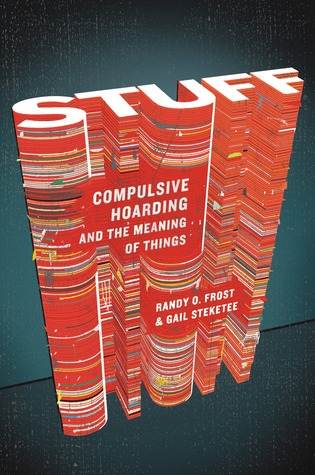
Review: Stuff: Compulsive Hoarding and the Meaning of Things

I just finished reading Stuff, which was recommended at a presentation I recently went to on hoarding, led by one of the staff members of the Institute on Aging (an excellent resource itself). Stuff was well worth a read, as it paints a portrait of the issue of hoarding that creates at least some understanding but more importantly a deep compassion for those who hoard.

I was surprised by many of the things the authors discovered in their research on hoarders and hoarding, the primary one being that hoarders are, almost without fail, perfectionists. They hoard not because they are slobs, but because they can't bear to think about what would happen if they got it wrong and threw the wrong thing away. It illustrates the psychic (and sometimes almost physical) pain hoarders feel when trying to get in control of their hoarding, and the comfort they feel in what most people see as truly unlivable conditions.

Stuff primarily presents its information through illustrative narratives of the lives of individuals, looking at hoarding through a variety of lenses. At the very end it offers further resources for people looking for help. The authors, Randy Frost and Gail Steketee, have a workbook for treating hoarding behavior that sounds very useful for those seeking personal help to change.

I do wonder if the extreme conditions used throughout the book might do a slight disservice, however, as some who may suffer more mildly from hoarding tendencies may read this and think, "Well, at least I'm not as bad as that." As the authors point out, the problem with hoarding is not the stuff per se, but the pain and distress it causes the hoarder.

As I said earlier, however, the overall sense I got from this book was one of compassion for hoarders and their families. It shows that hoarding is not a moral failing, a weakness,  a sin, or consumerism run amok, but a painful and difficult problem that requires treatment and care.

Saturday, March 22, 2014

Review: Twenty Feet from Stardom

I remember thinking when it came out that I'd wanted to see this, but it wasn't until it won the Oscar for Best Documentary Feature that I finally got around to watching Twenty Feet from Stardom.

This film literally shines the spotlight on the back-up singers of the hits for the past 50 years, and it's revelatory. You will not believe how many of these voices you know intimately from songs fronted by performers ranging from Gene Autry to the Rolling Stones to Sting to Nine Inch Nails.

I don't think it escapes anyone's notice that the primary front-line vocalists are white men and the back-up singers are black women. One of the wonderful choices the director made at the beginning of the film is to blot out the faces of the stars on the album covers so we finally take the time to notice the various "ettes" behind them. What makes it clear is these women aren't diminutive. They are divas and forces to be reckoned with.

The story of the vocals on Gimme Shelter is particularly eye-opening. Merry Clayton, pregnant and home asleep, is awakened and told she needs to come to the studio to do some vocals for "The Rolling Somethings." She shows up in curlers, as both she and Mick Jagger remember, and in three takes, screams out "Rape! Murder! It's just a shot away." Then goes home to bed. In this great video interview in the NY Times, Clayton explains that she was just looking to go back to sleep. She also prods the director to reveal the real reason the producer wanted to make the film.

Another of the featured singers, Lisa Fischer, has been touring with the Rolling Stones since 1989, doing this very vocal. Although she has won a Grammy for a solo R&B performance, the solo career never really came to fruition, and she seems at peace with her role in the background.

It's much harder for others, and neither peace nor success is easy to come by. Darlene Love, inducted into the Rock and Roll Hall of Fame in 2011 ("And about time, too," Bette Midler says, introducing her), was royally screwed over by Phil Spector as she sought to be recognized as a performer in her own right. Watching the film gave new insight into her performance accepting the Oscar, as she sang "I sing because I'm happy. I sing because I'm free. His eye is on the sparrow, and I know He's watching me." He's not the only one at this point. And about time, too.

I can't recommend this film highly enough.


Wednesday, January 1, 2014

Review: The World's End

It made sense to me to watch The World's End on New Year's Eve, focusing as it does on heavy drinking and, potentially, an apocalypse. Of course, I've been a big fan of the Simon Pegg/Nick Frost/Edgar Wright movies since watching Shaun of the Dead (which, come to think of it, I may have forced my family to watch on New Year's Eve many years ago).

This may be my favorite of the Cornetto Trilogy. At any rate, this and Shaun are neck and neck. And the reason, I think, I'm so impressed is that The World's End is willing to have a strong current of sadness. Not a heart-tugging moment, but a sadness that starts from the very first scene and continues throughout.

The sadness resides particularly in the manic and deeply addicted Gary King who "gets the band back together," cajoling his high school mates into completing the 12-pub pub crawl they abandoned back in the '90's. There's a desperation in his need to drink these pints dry, a kind of magical thinking as he makes his way from pub to pub despite the obstacles in his path.

If you don't know what the obstacles are, I'm not going to spoil it for you here. I will say, however, that Pierce Brosnan uses all his suavity to creepy effect in a brief scene. He makes his proposition sound so reasonable.

I may be influenced by the fact that I listened to interviews both with Simon Pegg and with Edgar Wright before seeing the film, which added extra insight in to some of what I saw. Great interviews -- though maybe only for fans.

I will also add that I vote for "blue bloods" over "blanks." Funniest scene in the movie. You'll see what I mean.

Wednesday, September 11, 2013

Book review: The Darlings

OK, I got this entirely based on the title, seeing as I have married into the Darling family.

I bought it during a visit to Manhattan about a year ago, and it was featured prominently in the window of a small bookstore on the Upper East Side. Given the title, the cover, and the general quality of the hardback, I figured it would be a Serious Novel of a New York Family with lots of angst and soul searching. It was more like what you would get if John Grisham wrote for the New Yorker.

I found it tremendously satisfying to be able to sit in public with this novel and have everyone think I was engaged in Serious Reading when I was really savoring a financial thriller/keen skewering of the New York elite.

"Skewering" may be a bit harsh. The author, Cristina Alger, does a really good job of bringing you into the lives of these characters with both their struggles and their flaws. And she describes the sense of the financial bottom dropping out from under them in a way that made me feel it viscerally, as they suddenly realize there is no there there.

Then again, she doesn't pull any punches about what their lives are like or how her characters perceive them. One of her protagonists, Merrill Darling, thinks, "Manhattan children were like armadillos: sharp clawed and thick-skinned, deceptively quick moving."

Or maybe Alger thinks this. After all, she grew up in the Upper East Side, went to Harvard, worked as an analyst at Goldman Sachs, then as a lawyer, first in Mergers & Aquisitions, and quickly moving into Bankruptcy.

In short, she knows whereof she writes. I actually wondered if she could continue to live in New York after this book came out. I think it took guts to put much of this out on the page, even in fictional form.

It seems appropriate to write this review on 9/11. For all that it's not elaborated upon, the memories of 9/11 lurk throughout the book and jump out at unexpected moments. That seems about right, too.

I really enjoyed this book.

Saturday, July 27, 2013

Various & Sundry: I'm fairly sure this is not the dumbest thing on the internet

*Yawn!* Where did the week go? I had so many things I thought about posting this week. But did it happen? Well, you tell me.

So you're stuck with the usual mish-mash of things. I hope you enjoy them.

I take comfort in knowing that I am not the dumbest thing on the internet. So says Erin Faulk, who you may remember from her adventures in finding Matt Damon in Morocco. People (apparently) commented harshly, which she says is like that guy at the cocktail party who has no social sense and has to respond to your story by saying, "That's the dumbest thing I've ever heard."
I mean, think about that. There is literally no point in time in which you are the dumbest thing on the internet. Have you seen the internet? YOU ARE NOT THE DUMBEST THING ON THE INTERNET. That will always be true. Statistically, in your lifetime, that will always be true. There will always be someone dumber than you on the internet. Geraldo Rivera tweeted a half-naked selfie last night. I mean, ffs, YOU ARE NOT THE DUMBEST THING ON THE INTERNET. 
Remember that the next time you think about saying something. You are not the dumbest thing on the internet. No matter what anyone else says - and trust me, people will say things - you just aren’t. You may not have the best story to tell, or the smartest take on whatever breaking news is currently breaking, but you’re not the biggest idiot out there either.
Pauline Baird Jones says something similar as she remembers when she was 5 and puked on her tutu right before the big dance recital.
The risk we face in the journey to becoming isn’t dying, it’s puking on our tutu. That fear feels like dying. Fear dresses itself up like the safer choice, it’s the un-puked on tutu, the path of common sense, and it smiles and soothes while it kills our hopes, our dreams, our becoming.
And so I post without regret the exceedingly nerdy post The Most Interesting Theologians In the World which tracks the Twitter exchange between two theology PhDs who had nothing better to do, and I am better for it. In a nerdy sort of way. For example:

Well, I warned you!

On Goodreads, I posted a couple of book reviews that I thought I would be posting on the blog, but never got around to. I highly recommend both Story of a Girl and Committed, if you're interested.

I also loved this performance from this week's episode of So You Think You Can Dance (which is a terrific show). What I loved about it was that ultimately, the woman released herself. The dance starts at ~1:20, if you want to get right to it.


What do you think?

Tuesday, June 25, 2013

Review: Audiobook -- The End of the Affair

Remember how I told you I was going to be listening to Colin Firth reading The End of the Affair by Graham Greene on my drive up and back from Fort Bragg? Well, I did that very thing and am here to tell the tale. Or at least give my opinion. Which is mixed.

First of all, Firth's performance is phenomenal. Truly, it impressed me throughout: the emotional depth he gave to the retelling, and the voice characterization -- especially of Parkis, the private detective, who I kept thinking was a completely different person speaking.

Part of the reason the reading is so powerful is that the writing is potent stuff. And it sounds good being read. The description of London, of gloomy pubs, of the atheist's parlor, of boarding houses, of the narrator Bendrix's own state of mind, are all beautifully rendered.

So it's just a shame that I found I didn't like the book at all. I didn't like Bendrix, or Sarah, the woman with whom he had the titular affair. I actually liked Sarah's husband Henry much better than either of them. Sarah's journal entries simply annoyed me, which is unfair as they were journal entries and sounded realistically journal-like. And the melodrama -- I kept thinking, "Oh please. Get a grip, people."

And I can't help but think that God, for whom all the angst of the affair was spilled, was rolling his eyes and saying "Get a grip" too. Greene made the affair about as tangled and tormented as possible. But really, poor God. I just picture God saying, "Hey, leave Me out of this. I didn't ask to be dragged into this little triangle."

But dragged God was. I guess this was supposed to make the book deeper and profound. It just bothered me, getting God involved when God really has no say in the matter. So God and Henry are the two people I like best in the book. Too bad the book isn't actually about them.

Still. I'm glad I heard it. And what a lovely voice to hear it in.


Monday, June 24, 2013

Review: Much Ado About Nothing (2013)

I do not often go to first run movies, but I did hie me to the theater to see the latest film version of Much Ado About Nothing, and I'm mighty glad I did.

I've always loved the play. Well, I love the Beatrice and Benedick part of the play. That whole Claudio-Hero part? Just once I want to see the friar, or Hero's father, or Beatrice say "Dump him at the altar, babe. Find someone better."

But I have to say, in Joss Whedon's version, the shaming of Hero is less awful than it most often is. And it is to Whedon's credit that he made the villain Borachio's decision to recant his slander make much more sense.

Forgive me for leaping ahead with the assumption that you know what I'm talking about. In case you don't, Much Ado is a double love story: in the first, young Claudio returns from the war to find himself irresistibly drawn to the innocent Hero, the daughter and heir to Leonato. In the second, Beatrice and Benedick, who have known each other "of old", continue to protest how much they detest one another.   No one believes them and the group conspires to have them overcome their self-imposed obstacles.

It is the delight in watching Beatrice and Benedick overcome their defenses that makes the play the charmer it is. And in this version, and especially Amy Acker's performance, the painful and poignant mix of vulnerability and longing and wariness that plays on their faces is wonderful to behold.

Also wonderful to behold: Nathan Fillion's Dogberry, the Detective Malaprop of the play. He has the gestures of the TV detective down as he insists, "do not forget to specify, when time and place shall assert, that I am an ass." And then whips out his sunglasses and coolly places them on his face. Followed instantly by his assistant Verges. Dogberry is a difficult role to get right -- at least I have often found the role funny, but not memorable. This Dogberry is the best I've seen and one I will remember.

The film is all in a contemporary setting, which did jar with the first words of Shakespearean dialogue, and shot in black and white, which made it seem slightly harsh and edgy. But again the word that comes to me is delightful. It was delightful. And I would be delighted to see it again.


Tuesday, May 28, 2013

Review: Aunt Dimity's Death

I had a lovely Memorial Day weekend, and in part I have Aunt Dimity to thank for it. Actually, I have Nancy Atherton to thank for it because the first book in this series, Aunt Dimity's Death, was completely delightful.

There's a gentle mystery, and charming and eccentric characters, and a cottage with a beautiful garden, and a protagonist I root for, and a romance I could not wait to see happen, and it's all extremely well-written, but that's not what made this book delightful for me. 

There were two things: the first was the psychological authenticity of these people. Even though there was a great deal of sweetness, it was sweetness with a realistic amount of sorrow behind it. There is no brutal violence to give this book an edge, but there is an edge that keeps this from getting woolly: the edge that comes simply of being worn down with grief. Everybody in this book understood grief. And the grief had a ring of truth to it.

And the second thing that made this delightful was this: the resolution of the grief and sorrow did not come from vengeance or heroism, but from the patient and steady application of kindness over long periods of time. And that too struck me as authentic and true. Such a simple remedy. And so very hard to do.

Aunt Dimity's Death will not be what everyone is looking for in a mystery. But for me, for a quiet Memorial Day weekend, it was about as perfect as a book could get.

Tuesday, April 9, 2013

Review: The Girl with the Phony Name

"Read this," a friend of mine said to me, handing me a book. "It's very odd."

Well, I'm all for odd, and so I happily plunged into The Girl with the Phony Name which was not nearly so odd as I thought it might be. I'd say the applicable word is wonderful.

And the people in it are wonderful. They include Lucy McAlpin Trelaine (maybe), an orphan and Harvard dropout who has spent her life looking for her parents, and Tak Wing (pronounced Take Wing), a warm-hearted entrepreneur whose Neat 'n' Tidy Funeral Parlors are overextended but who nonetheless joins Lucy on her quest.

There are so many wonderful details in this book, down to the smallest unexpected word choice. Wing has a metabolism "like popcorn." Lucy's receding hangover remains only as a "dissonance." Extended scenes from the past are related with verve, while only the smallest piece of it furthers the plot.

Which itself is compelling, twisty, and fun. This is one of those books where you just sit back and let it take you where it takes you. And if you end up in Nova Scotia, well...why not? It's obvious you were meant to go there.

I'm glad to note that Charles Mathes has a number of other books. I like his style. I hope the rest live up to this one.

Read this. It's very odd. Also wonderful.

Tuesday, March 5, 2013

Review: The Beggar King and the Secret of Happiness

I love a good storyteller, and Joel ben Izzy is an excellent storyteller. I actually heard him for the first time at, of all things, a convention for professional fundraisers as he told a story about King Solomon that illustrated how non-profit organizations need to be able to tell their own story.

The Beggar King and the Secret of Happiness also starts with a story about King Solomon -- and stops just as Solomon reaches the crisis point. And then ben Izzy begins his own tale, which is just as harrowing.

A storyteller by profession, ben Izzy is happily married with two lovely children, making a living doing what he loves, when the worst thing that could befall a storyteller happens to him: he loses his voice. And it doesn't come back.

We have both the print book version and the audiobook version, and I ended up listening to the audiobook over the course of a couple of weeks as I drove here and there.

Now, one of the great things about listening to this book as an audiobook is that you know that somehow his voice does come back, since he's telling you the story. But I was still anxious to see how this would play out for him.

Another great thing about listening to this as an audiobook is that you get to hear him tell stories. Each chapter begins with another story from all over the world -- some I knew, but many I didn't. They're chewy stories, ones that have stuck with me since I heard ben Izzy tell them as I try to digest them fully.

And then ben Izzy does something really amazing: in telling his own true story, he helps you realize that you are (most likely) in the middle of your own story -- and that you don't get to skip out of it. You just get to go through it.

He concludes with one of the best explanations  that I've yet heard -- a hard-won answer drawn from personal experience -- of whether everything happens for a reason.

And then you get to hear what happens to Solomon.

But that's another story.


Tuesday, January 15, 2013

Review: Looper

I watched Looper last weekend and couldn't sleep after I saw it. Not because it was violent, though it was (more on that shortly), but because I had to keep mulling it over and over. I was still mulling it over the next day, and I'm still turning it over in my mind, asking myself, "Is that really about what I think it was about?" Because if it is, it's a completely different movie from the one I was expecting going in.

I had seen and loved Rian Johnson's first film Brick, which set film noir conventions against a high school angst film to great success. Not a movie for kids, to be sure. But a really interesting film. So I had been looking forward to seeing Looper since it first came out last fall.

I sure am glad I watched it at home, however, as it was so tense I would stop it from time to time, walk around the house a little bit, and tweet about how tense it was (while seeing some calming news about who was tap dancing and/or baton twirling at the Miss America Pageant) before I could continue.

It's very hard to write about this movie without spoilers, but I will try.

The premise is this: Our protagonist, Joe, lives in 2044 Kansas City. He announces as the movie begins that "time travel hasn't been invented yet." But by the 2070's it will be. It's illegal, but crime bosses use it to get rid of people without a trace.

Joe is a Looper, someone who's job is to shoot these people when they are sent back in time and dispose of the body. He's paid in silver bars that are strapped to the back of the person being killed. Since the victim wears a bag over his head (always a he, as far as I saw), he's depersonalized, not someone Joe knows, or even sees for more than a second before shooting him in the chest. Soul-deadening, but lucrative.

There's a catch to this set-up. One time, you will shoot someone, turn him over to get your payment and discover gold bars. This means you have shot your future self and "closed the loop." You cash out with your golden pay day and retire from the business, knowing you have 30 more good years ahead of you to do whatever you want. As our narrator says, "This job does not attract the most forward-thinking people."

Then one day, a man shows up to be shot without the bag on his head, and Joe realizes he's looking at the 30-years-older version of himself. Who escapes. Which means young Joe is in terrible trouble with the local-time representative of the crime syndicate that pays the Loopers. And that's not good.

And that's where I'm stopping with the recap because the rest of the movie confounded my expectations and I want it to confound yours too.

A couple of things: first of all, Jeff Daniels plays the local time crime boss and freaked me out so completely that when I saw him the next day all spiffed up for the Golden Globes for his role as straight-arrow Will McAvoy, I honest to goodness felt scared. That's how good he was. And the reason he was so scary is that he seemed almost kind--so persuasive and reasonable. Such a subtle portrayal of evil, one that looks so nice.

The whole time travel thing is dealt with very adroitly. It raises all the usual questions: can you change the past? If you go back and change the past, how does it change the future? Which of course raises the existential question, how does what we do here and now change what the future will be?

Finally: let's talk violence. Rian Johnson does a very clever thing, here. You see the depersonalized violence of Joe's job and since you don't know these people either, it doesn't matter much. But there is one character you get to know, if only slightly, and terrible things happen to him. But you don't see them directly. And it is horrifying. With an amazing absence of gore, you still get the chills at the horror of what is happening to this character.

But here's the even more important thing: the core thesis of this movie, I would argue, is that violence will not solve your problems. In fact, this movie is a parable for Martin Luther King's argument: "Hate cannot drive out hate; only love can do that." I didn't expect that. At all. This is not a movie that supports the myth of redemptive violence. This is a movie that ultimately stands on the side of self-sacrificing love. I never would have guessed.

Wednesday, January 2, 2013

Review: The Hunger Games trilogy

Book 1: The Hunger Games
I've been meaning to read The Hunger Games books by Suzanne Collins for forever, but only just got to them last month. They were a very satisfying and interesting read.

Satisfying because they were well-written and plot driven and I love a good, dense, and well-constructed plot.

Interesting because the books allowed things to be complicated. "Good" and "bad" were not as clear-cut as they first appear. Finding the right person for you and falling in love is not a straightforward proposition. And heroic deeds are not all done by heroes, or even by nice people.

Book 2: Catching Fire
Nor is the result of heroic behavior restful sleep and pleasant dreams. Those called upon to kill one another, whether for justice or for entertainment, are severely damaged by the experience. And you don't often see that in hero's quest books of this nature.

For that reason, I liked the third book, Mockingjay, best of the three (though I though all were terrific). I appreciated how Collins both resolved the action in a truly satisfying way while writing the experience in a way that seemed emotionally believable.

Book 3: Mockingjay
One of the thought-provoking things about it was how it explored the notion that, one way or another, violence would be done and people would be hurt. So given that you have no perfect option, what is the best option you have? What if you know that no matter what you choose, other people will get hurt? What will you do? It reminded me, of all things, of the movie Lincoln, in which the awful choice is to allow the bloody Civil War to continue so that the violent system of slavery can be abolished. Either way, people suffer and die. So what do you choose? Whose lives do you spare? No matter which way you go, your hands are going to have blood on them. So how do you play the game?

Be warned: these books are very violent. Brutal, even. There's no way you'll get me to see the movie versions. But I doubt I'd want to anyway. The books are told in first person, and part of the pleasure and complexity of these books is thinking along with our protagonist Katniss Everdeen about what is happening and how to deal with it. I'm not sure I'd simply want to see what happens without also knowing the mental struggle that's going on inside.


Friday, December 14, 2012

Review: The Leftovers

I'm not really sure if I'm writing a review per se. I'm still trying to figure this one out.

The Leftovers starts with this premise: what would people do if a rapture-like event happened? And what would happen if it didn't look like what anyone expected? Would you rename it, as the people in this novel do, the Sudden Departure?

When I talked to a friend of mine about this, she said she would set up a huge database to run the information on all of the people who had disappeared to find out what they had in common. Which makes sense. And perhaps somewhere in some government office in this alternate world, someone is doing this. But that is not this novel.

This is not a plot-driven book; it's character-driven -- something that rarely works for me any more unless I am really intrigued by the people, as I am here. And I'm not sure why they are so interesting to me, except that the author allows their confusion to shine through in different ways. The book focuses on one family: mother, father, two kids (one starting college, one starting high school) and how they respond. There's another woman who gets a spotlight, whose husband and two children both disappeared. I liked them all. I sympathized with them all.

I can see how this book might frustrate you if you're looking for answers. What's in that database? What really happened? But I think one of the points of this book is, there is no common denominator why one person is taken and another stays; sometimes you will never know why things happen. And isn't that life as well? Why does one person get cancer and another doesn't? Why is one person in a car accident and not another? You can find some commonalities, but you just can't get it all nailed down, settled, and answered. Live your life as best you can, but it's not about whether or not you will be rewarded. And be kind to one another; you do not know what they have seen or experienced.


Tuesday, November 20, 2012

Review: Two books that made me laugh

I read these books a while ago and have been meaning to recommend them to you, if you're looking for something funny but with some real thought behind them.

First, an oldie but a goodie: Heartburn by Nora Ephron. I knew this was a novelized version of her divorce from Carl Bernstein. I had no idea it would make me laugh so much. I loved the protagonist's brutal honesty, which is most likely Nora Ephron's own. For example:
Every so often I contemplate suicide merely to remind myself of my complete lack of interest in it as a solution to anything at all. There was a time when I worried about this, when I thought galloping neurosis was wildly romantic, when I longed to be the sort of girl who knew the names of wildflowers and fed baby birds with eyedroppers and rescued bugs from swimming pools and wanted from time to time to end it all. Now, in my golden years, I have come to accept the fact that there is not a neurasthenic drop of blood i my body, and I have become very impatient with it in others. Show me a woman who cried when the trees lose their leaves in autumn and I'll show you a real asshole.
Love. Her. And whether "her" is Rachel Samstat or Nora Ephron, I really don't care. I'll be very curious to see the movie now.

I'd been meaning to read a book by John Scalzi for a while, and was reminded to do so when I saw a review for his latest novel, Redshirts. The name will mean something to Star Trek fans: Redshirts is the term for the ensigns who get assigned to away teams and are promptly killed. Scalzi writes from their perspective, as people scuttle around the great spaceship The Intrepid, trying to avoid the captain, and ultimately trying to figure out what is going on and how to stop it.

I don't know if this is one that will only appeal to Trekkies, but I'm not hard-core and I thought it was hilarious as well as thought-provoking. I'd say give it a shot. I'll be curious what you think.

Wednesday, November 14, 2012

Review: Skyfall ***THERE WILL BE SPOILERS!***

For my dad's birthday, my parents and I went to see the new James Bond film, Skyfall, and I have things I want to say about it that involve HUGE spoilers! I'm warning you now! If you don't want to know, then don't keep reading.

Have you averted your eyes, you who do not wish to know?

All right then.


Tuesday, October 2, 2012

Kleenex (r) Cool Touch (TM) tissues

The Kleenex (r) brand Cool Touch (tm) facial tissue,   "enriched with moisturizers and aloe" that "immediately feel cool to the skin." They provide "a rush of comfort when noses are sore or gentle refreshment anytime." (Yeah, I want to know when noses are gentle refreshment, too.)

Let me tell you: I am amazed at the variety of Kleeneces available for your purchase. I bought a medley of Kleenex, including anti-viral, ultra-soft, with aloe, with moisturizers, and now this one. And I've got to tell you, this one...I don't know if it's the best, but it sure is odd.

It really does feel cool to the touch when you first use it. I suspect that is a property of the stearyl alcohol that somehow is in the tissue (along with polyethylene). Other than that, I'm not sure what they bring to the party. In my extensive comparison testing, I can't say they're any better than any other Kleenex.

It's not that they're bad. It's just that there's something peculiar about them. You've got to wonder about a Kleenex that warns, "Best if used in conditions below 75 degrees." Additionally, I have to keep dumping my wastebasket into the kitchen trash because I can't imagine these ingredients are good for Harper, who likes to pilfer the used Kleenex and shred them. I find myself concerned about the environmental impact of my Kleenex. They're not the greenest item to begin with, but when you start adding all this stuff to the paper, what does that do? Anybody know?

Good Housekeeping had a brief review of this product earlier this year. For a better sense, though, check out what people have to say on Amazon. They describe the sensation well. In the meantime, I'm going to go hack some more.

Monday, October 1, 2012

Review: Daring Greatly

I'm stuck at home with a cold which is no fun, but at least gives me added time to read, and blog.

Readers of the blog know that I'm a huge Brene Brown fan and will not be surprised that I think her new book is terrific. Daring Greatly: How the Courage to Be Vulnerable Transforms the Way We Live, Love, Parent, and Lead draws on her many years of research studying shame and vulnerability to offer insights into how we can use that information to live a more Wholehearted life.

One thing I deeply appreciate about Brown's work is how research-based it is. Even more compelling, the answers she found were not the ones she was initially looking for. This is not a light-hearted feel-good kind of a project. I was glad she included a section at the end of the book in which she explains the research process and how she collected her data. There are moments in the book where she says, "We don't have the data to back this up yet," as she offers a hypothesis and makes it clear that she is waiting for the data to bear that out. But overall, the theses in this book are backed up by data and research, not a wishy-washy "you should feel good about yourself" sentimentality.

I also appreciate that Brown offers very practical suggestions of how to apply what she has discovered about shame and vulnerability to become, as she terms it, "shame-resilient" (since there is no way to completely avoid shame). She looks at some common areas where we can apply these techniques, such as in leading or parenting, with a lot of case studies and examples.

Many of which are her own life. And this I appreciate as well. She is learning to do these things as well. Brown is well aware of her own imperfections and is not speaking from the point of view of "I've got it all together and you can too!" Instead, as she shared in her initial TED talk, she's coming to all of this information from the perspective of a person who hated the thought of being vulnerable, but has come to see that this is the way to live a whole-hearted, courageous, and joyful life.

There's a lot of information to take in, and I think this is a book that I'll need to revisit. But I think this is an excellent resource, worth adding to your arsenal of life skills.

Monday, September 3, 2012

Review: The Descendents, movie and book

I watched the movie version of The Descendents on the flight out to Hawaii, and I finished reading the book version while I was there, and they were both lovely.

As a general rule, I think it's easier if you watch the movie version of any movie-book combination first. That way you're not disappointed at the changes that are made and you can simply watch the movie as a movie. I set this general rule after being crushed by the movie version of The English Patient--completely unacceptable.

Anyway: The Descendents is a family drama about the King family in the midst of some major decisions. It's a Hawaii movie about people who actually live in Hawaii with all that a normal life involves: family, conflict, tough decisions, small triumphs, the possibility of error. I don't want to give away too much because if you choose either the book or the movie, I think you'll enjoy it a great deal if you let it unfold around you and don't know what to expect. I know the chances that you don't know what the plot is are slim, but still. I thought I'd give you the option.

I liked the movie a lot. I didn't love it, but I liked it. I thought the two girls playing the daughters were particularly terrific, not that I have any problems with George Clooney. Nope. No problem at all. I also loved seeing Robert Forster as Clooney's character's father-in-law, though I wish I could see him cast as Clooney's father in some movie or another; they look like they could be father and son. There were a few moments when I felt like they were trying too hard for the Big Moment, but overall I thought the performances were tender and touching.

I loved the novel. Written by Kaui Hart Hemmings, the novel is told entirely from the point-of-view of the father, Matt King. The movie stayed quite true to the novel, though there were some understandable changes in details and nuance; the younger daughter, for example, wears a T-shirt that says "Mrs. Clooney" which never made it to the screen.

One thing I appreciated about the novel is its simplicity in the telling. It doesn't work hard to be a Literary Novel with a Capital L. The language is straightforward, clean, and lovely. And the language makes sense for the narrator himself: decent, confused, intelligent but not academic, not terribly good at emotion, and a devoted father.

Here's an example of what I mean, as the narrator describes carrying his drunk teenage daughter to bed:
She is so heavy, her limbs seemingly drenched. I strain to get her to her room. I could stop and let her sleep on the sofa in the den, but I want her to sleep in her old bed, which used to be my bed, and part of me enjoys carrying her, the way she's curled into my chest like a baby. 
The most complicated and non-literal word in that paragraph is "drenched," but it's still so beautiful.

If you're going to do one or the other, I suggest reading the book, but truly, both are worth your time. Enjoy.

Tuesday, August 14, 2012

Review: Feed - and vague thoughts on YA dystopias

The other night I finished Feed by MT Anderson, which was a tremendous novel, if highly disturbing. I can't remember how I first heard about it, but it was already on my pile from the library when NPR published its list of top 100 YA novels (where it ranks as number 88).

It was a quick read, but I wouldn't say it was an easy one. It's an Aldous Huxley dystopia, a la Brave New World, in which control is acquired through pleasure rather than repression.

In the highly believable world Feed creates, at every moment the feed implanted in your brain from childhood is selling you things, gathering data on what you purchase to further discern your demographic, and selling you more based on that information. Each chapter ends with some of the ads coming through on the feed, disrupting your own thought processes as you watch clips of pitches of products pass by. It isn't our world, but it is way too easy to imagine a world like that. It was like looking at current society in a distorted and magnifying mirror and realizing the essential parts of you were still being reflected in it.

I looked up MT Anderson as I was reading the book and can't say I was super surprised to learn that his mother is an Episcopal priest. You know he was steeped in something when you get a sentence like this:
The sun was rising over foreign countries, and underwear was cheap, and there were new techniques to reconfigure pecs, abs, and nipples, and the President of the United States was certain of the future, and at Weatherbee & Crotch there was a sale banner and nice rugby shirts and there were pictures of freckled prep-school boys and girls in chinos playing on the beach and dry humping in the eel grass, and as I fell asleep, the feed murmured to me again and again: All shall be well...and all shall be well...and all manner of things shall be well.
In Feed, people young and old are lulled, mollified, and plied with treats. Contrast this with (or compare it to) The Hunger Games, another YA dystopian novel, only in The Hunger Games it is want and scarcity that drives the plot, and rather than being entertained, the young protagonists are to be the entertainment.

All of which has got me thinking about how many dystopian novels seem to be geared toward teens. I don't remember this being the case when I was young. Aside from The Lord of the Flies, the dystopias all involved adults--and Lord of the Flies (though we read it in school) wasn't considered a YA novel.

So why is it that there is so much dystopian literature for youth nowadays? Is it because the youth are the ones listening? Or the ones the authors think need to hear it? Or is it because that's the way to sneak this message out there to old and young alike? Because one thing's for darn sure in both Feed and The Hunger Games: the dystopia ain't the young folks' fault.