Showing posts with label things that irk me. Show all posts

Saturday, March 29, 2014

The World Vision Thing

h/t to the Millennial Pastor for
the great image (& responses)
You heard about this, right?

On Monday, World Vision announced in Christianity Today that it was changing its hiring policy so that gay Christians in legal marriages could be hired. Rich Stearns, president of World Vision, explained the policy change this way:
"It's easy to read a lot more into this decision than is really there," he said. "This is not an endorsement of same-sex marriage. We have decided we are not going to get into that debate. Nor is this a rejection of traditional marriage, which we affirm and support." "We're not caving to some kind of pressure. We're not on some slippery slope. There is no lawsuit threatening us. There is no employee group lobbying us," said Stearns. "This is not us compromising. It is us deferring to the authority of churches and denominations on theological issues. We're an operational arm of the global church, we're not a theological arm of the church."
The shit immediately hit the fan with close to 5,000 people canceling their sponsorships of children. In less than 48 hours, Stearns announced that the board reversed the decision, saying it was a mistake.
"We made certainly in retrospect was a bad decision, but we did it with the right motivations. We weren’t trying to harm, or trying to find revenue, we weren’t doing it for wrong motives. We were trying to find some kind of solution to a divisive issue that would create some space of togetherness around differences within the church. Our regret is that we caused more division instead of finding a place of more unity."
So by Wednesday, I had a fair number of thoughts going through my head. Let me see if I can set them out in any sort of coherent order.

First of all, I'm hugely disappointed by how this whole thing played out. And although I'm upset at those who decided to withdraw their sponsorship of children, I have to admit I understand it. I have not been a financial supporter of World Vision in part because of its conservative Christian background (not the only reason, but one of them). So I'm certainly in the same boat as people who don't want to support an organization that they think represents values counter to their own.

I'm much more disappointed with World Vision, for a few reasons:
  • They (apparently) didn't anticipate this. Really? Knowing the political climate we live in, knowing the reactive nature of our current Christian culture, knowing that homosexuality is THE hot button topic...they hadn't thought through the plan? 
  • They didn't give this any time. Rachel Held Evans had begun rallying the troops to solicit new donors. I suspect many other church leaders would have done the same. I'd come home on Tuesday, after learning about the reaction, planning to donate to World Vision as a show of support for this change, knowing they were getting a beating. But they reversed the decision so quickly, I hadn't gotten to it yet. 
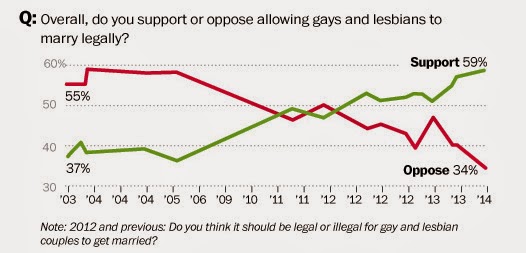
  • It seems tremendously short-sighted. They said they weren't trying to find revenue, and that may be true, but I think they lost a great deal of revenue in the long run by the reversal. Look at these charts, people! Do you see which way these lines are trending? 


  • It's inconsistent. Of course, if opposition to the marriage of same-sex couples truly were one of the fundamental principles under which World Vision operates, then looking at the approval rates would be irrelevant. However, one post I read this week noted that World Vision Canada has had a non-discriminatory hiring policy for over 15 years. Which leads me to believe
  • This is a failure of leadership, not a principled decision. Was it based on the financials? It certainly could be. Their latest 990 (financial reporting) shows that expenses were higher than income in 2011 and 2012, at an increasing rate, so there may be serious financial pressures at work. But I am reminded of Friedman's book A Failure of Nerve, which explains that leadership means holding fast in the face of conflict, rather than immediately reacting to loud and negative voices. 
I was appalled at this particular statement in Stearns' retraction: "We’re learning that a number of people are calling back since the reversal to reinstate their sponsorship. They’re forgiving; they’re saying, ‘Hey we stand with you.’” That, sir, is not forgiveness, any more a child stopping a tantrum after you buy him a toy means the child has forgiven you.

I wish them the best, but I continue to believe this was a huge mistake.

***
FWIW, here are some of the international aid organizations to which I contribute, in case you're looking for other organizations to support:

Against Malaria Foundation: www.againstmalaria.com
CA Bikes: cabikes.org
Evidence Action: www.evidenceaction.org
Kiva: www.kiva.org
Partners in Health: www.pih.org

Saturday, August 17, 2013

A Postcard Postmortem Post

Note: This is total Episcopal Church inside baseball. If that's not your thing, I'd advise you to skip this post entirely.

So there was a kerfuffle in the Episcopal Church over the past couple of days -- not the usual kerfuffle, about human sexuality and/or property disputes. This was a much gentler and intimate kerfuffle about how we want to represent our denomination to those outside our immediate circle through outbound marketing materials.

The materials in question took the form of slogans that could be printed off as postcards. As noted by Adam Trambley and others, these materials were problematic. And by "problematic" I mean very bad. I'll talk more about them below.

To our denomination's great credit, the church center responded to the criticism by taking down the postcards and putting up this message:


That said, there isn't actually a way for someone to direct feedback about this campaign to the people or department in charge that I could find. As an initial suggestion, I would love it if the church center would include a link on this page to allow people to give feedback or answer a survey -- or something.

But I am going to take them up on their encouragement to share ideas and criticisms, which I think are still appropriate. This is not in order to beat a horse that's already been put out of its misery, but because I think it will be helpful to analyze what went wrong in order to consider what needs to happen next.

But first a few more general comments:

1) We need to move beyond print media. This campaign was designed for "postcards, ads, and billboards." Why limit ourselves to these forms of media when there are so many easy ways for people to share online? There's no mention of using these on Facebook, even though people did indeed share the visuals that way. There's no mention of embedding the graphics in the church's website, or encouraging people to use it as a badge on their blogs with, say, a link to their local congregation. There are lots of creative ways to make content shareable. Which leads to the next point:

2) We need to move beyond ads coming from the institution itself. The hard truth is people don't trust ads coming from brands or companies saying "buy me!"; they trust their friends. This is not news. And this holds true for The Episcopal Church as a "brand" as well. Sending out a postcard -- even a good one -- that comes from the institutional church saying "Hey, we're great! You should totally check us out!" is not going to be nearly as effective as helping the members of church talk positively about its place in our lives. I mean, look at this chart.


Speaking of the church...

3) We've got to stop talking about the church as "a place people go to on Sundays."  Or at least as if that were its only manifestation. What I hope we mean by "The Episcopal Church welcomes you" is that we who worship God as part of the church in the Episcopal tradition will love you and care for you whether or not you ever darken the doors of one of our buildings. We welcome you by our prayers for the world, by our advocacy efforts, by our service projects, by the Christian formation that we bring to the work that we do day by day. And of course we invite you to share in this way of being the church because we think it has a lot to offer.

Speaking of which...

4) What do we have to offer? One of the real problems and turn-offs of the recent ad campaign is that it sent the message that the only thing desired was to get butts in pews. And it makes me wonder: is there, in fact, any other outcome we actually want? What do we have to offer? Because "you should join us" is not actually telling me anything.

So. Let's take a look at those ads:

Ad #1: Aside from the tinge of the guilt trip about this ("you never call, you never write..."), my other big complaint about the text is that it tells a person absolutely nothing about the Episcopal Church. Is the Episcopal Church 2,000 years old? No? So what are you talking about? What is it? Where is it? What does it stand for? Why on earth should I show up? If you're surprised to see me, are you really welcoming me?

This one also exemplifies complaints 3 and 4, above. Is there any welcome outside of Sunday? What if I work on Sunday? What if my kid has soccer? What do you have for me then? What do you have to offer me?

Ad #2: Oy vey. "Priests play golf too"? First of all, I don't play golf. I'm trying to think of any priest I know who plays golf. Most priests I know have neither the time nor the money to play golf. Most priests I know finish services on Sundays and go take a nap. So there's that. It's just plain weird and has no relationship to the church I know.

And then consider: You send this to a household with a single mom, what does this say to her? You send this to a household where someone lost his job, what does this say to him? It says (for one thing) that I, as a priest, feel most connected to (to use an unfair shorthand) the country club set. Yes, here in the Episcopal Church, we priests like to cut that boring ol' "worship" short to get to the really important stuff: hob-nobbing with the quality. Like us.

Here's my issue with Ad #3: if people in our communities can't see what we have been doing between Easter and Christmas, maybe the problem is with us. Can we instead say "Here's what we've been doing since Easter" with a photo montage of Episcopalians Doing Things.

That's another issue with this ad campaign as a whole: there's not a single image. It makes for a very passive, sterile kind of campaign, and it implies that The Episcopal Church is devoid of people or activity. And that's just plain not true.

We have good stuff to share. The reason this ad campaign bugged me so much is that it sold our denomination woefully short. We can do so much better. I think everyone has realized that.

Again, huge kudos to The Episcopal Church for listening to the criticism and pulling the campaign. Moving forward, I would love to see a campaign that's more generally shareable rather than institutionally driven. And I'd love a campaign that focuses on the fact that the Church reaches far beyond Sunday morning services and shows Episcopalians in all orders of ministry actively engaged in the work of the kingdom of God.


Thursday, July 18, 2013

Sweet Jesus on a breadstick! No more &*#$%@# handprint stoles!

You can buy this on Etsy for $75.
The description says (and I am not making
this up), "adorned with the colorful hand-
prints of actual joyful children!"
I participate in an online discussion group for people involved in Christian formation. Yesterday, someone asked what would be a good gift for the children to give to a new rector. Promptly, someone wrote back to suggest making a stole on which the children could put their handprints.

As you might have guessed from the title of this post, I reacted poorly.

But perhaps this is just me, I thought, and so I put the question to Twitter:

The reply was swift and clean:
But I continued:
And when Laurie Brock, aka @drtysxyministry, appeared, things started to get real.

At which point I shared this image, which is something you will see if you Google "handprint stoles" as I did.


As Laurie noted,
And you won't either.

Have we learned our lesson, people? It's a sweet thought, but keep your hands off the vestments.

Thursday, May 30, 2013

You can't tell who's hungry by looking

On a discussion group I'm part of, one person raised the question of how to teach children at a Vacation Bible School about hunger. One day at VBS, they are having a visiting missionary from an African country who suggested that for snack that day, they offer the children half a glass of water and half a cracker, telling them that in the African country where this person worked, this was considered a good meal. Was this, the person asked, a good idea?

The more I consider this, the more disturbing it feels to me, and the more certain I am that the answer is, no. This is a terrible idea.

What I wrote to the group is that we do not know if the children coming to our VBS programs are, in fact, well-fed. It may be that parents are sending children to VBS to provide them with snacks and child care. I think it's dangerous to presume that "they" are hungry and "we" are well-fed. All I can truly say is that I am well-fed. That's all I can know for sure. To deprive children of food in the name of teaching them a lesson seems morally dubious to me.

Just a few days ago, the Pew Research Center came out with a report that stated
Despite being the richest country in the survey, nearly a quarter of Americans (24%) say they had trouble putting food on the table in the past 12 months. This is up from just 16% who reported such deprivation in 2007, the year before the Great Recession began.
Share our Strength reports that 16 million children in the US experience hunger.
Nearly one in five children in America lives in households that struggle to put food on the table. They may look no different than other children; child hunger in America is often invisible. They are hurting, just the same.
I think we're too used to picture of hunger that are actually pictures of starvation. But the truth is, you cannot tell who is hungry just by looking. Does the child in this photo look hungry? What does "hunger" look like?

All those very useful exercises that show the relative availability of food from one part of the world to another can only make the point if you yourself are not aware of what it is like not to have food. To tell people who struggle to put food on the table, "Feel sorry about those people very far away"...well, I don't think it's a good idea. And since we do not know who is hungry and who is not, I think it is best to feed everyone.

There's a second part of this that disturbs me: what message are we sending about African nations if the only thing people ever hear about them is "for people in this country, a half a cracker is a good meal"? First of all, I am quite certain that there is more than one person in this country that actually has more than half a cracker for lunch. It is just as incomplete a picture to say "Everyone there is starving" as it is to say "Everyone here has plenty."

Finally, is there anything else we can learn about Africa other than "it's full of needy people and we need to help them"? Are there no values there that people can teach us? Is there not a good children's story from this country that could teach something to us about sharing or hospitality or friendship or anything? Is the only thing to know about Africa is that we should help them? Is there no mutuality? Or is it all Radi-Aid for Norway?


Thursday, May 9, 2013

You don't have to smile

Back when I was living in the second floor apartment of the Parish House in Gambier, OH, every day I would pass a piece of graffiti on the landing by the phone. It said "Smile. Jesus loves you." It made me want to strangle the writer.

I remembered this today, reading Allie Brosh's epic post on Hyperbole and a Half: Depression Part Two. Here's the image that made me want to employ a semi-automatic weapon that most of the time I want to see banned:


Is it just me? Or does it make you want to kill someone too?

When are we going to understand that "Rejoice with those who rejoice; weep with those who weep" means just what it says? We're told to bear one another's burdens, not cheer one another up. "Jesus loves you" comes with no strings attached, not even a smile.

I saw this rewrite of the Serenity Prayer the other day, and I think it's worth sharing:
God grant me the serenity to accept the people I cannot change, the courage to change the one I can, and the wisdom to know it’s me.
The terrible truth is you can't make people feel better. But if you can sit with them where they are, maybe that will feel ok.

Friday, March 8, 2013

Various & Sundry: Oatmeal, Kittens, Rowers, Robbers

I'll have to restrain myself since I have two weeks worth of stuff that's been piling up in the List of Interesting Things. I'll try to keep it to the cream of the crop.

And you know what's good with cream? Oatmeal. Ta-Nehisi Coates doesn't only write brilliantly about racism, he also knows his way around a bowl of steel-cuts.
For those who know this great country, like I know this is great country--which is to say those who have heard the gospel of awesome oatmeal and found themselves born anew--I have glorious news. I have discovered the greatest bowl of oatmeal ever made, in the most unlikeliest place in the world. The place is Flour Bakery in the town of Cambridge.
Oh, TNC, take me there! The close-up photos of croissants and other pastries look mighty good too.

You know how there's that made-up Lorem Ipsum text that's a placeholder when you're building a website? Well, now there's PlaceKitten!

How smart is that! And how cute!

In the Inspirational Story file, I only learned this week about Team Bad Company, paralympic rowers who took bronze in London last summer. They are
DSC_0098Oksana Masters a young women who was adopted from the Ukraine by a single mom at the age of 7. She became an amputee as a result of radiation that caused severe birth defects; she has strived to live life to the fullest, not letting her disability define her.

Rob Jones a former US Marine. The everyday hometown hero that went to Afghanistan to serve his country; he came home an amputee as the result of an IED explosion. He decided that the losses of his legs were not the loss of his life and he has become an amazing adaptive athlete.
And they're impressive as hell. (Image from U.S. Rowing's Flickr feed)

Also inspirational and beautiful: this story about how We Found Our Son in the Subway. Just lovely.

On the depressing end of things, this report on where the money meant to rebuilt Haiti actually went just makes you want to go and kick things. Or at least I do.

So keeping with the theme of highway robbery, I loved the recent obituary for Bruce Reynolds, "the mastermind behind the Great Train Robbery" in Britain in 1963. Of course, there's always something appealing about a good mastermind.
The late Fifties and early Sixties were halcyon days. He was earning £1,000 a week from his activities and gaining the respect of the criminal fraternity. As if born to the role, he behaved with the suavity of a gentleman thief. He holidayed in the South of France, escorted women to expensive restaurants and nightclubs, patronised Jermyn Street tailors, drove Aston Martins, and mixed with the new aristocracy of actors, models, pop stars and hoods.
Besides, isn't he the spitting image of John Hodgman? Who, I must point out, has neither confirmed nor denied that he was, in fact, Bruce Reynolds.


Which one is John Hodgman? And which is a train robber? Or is John Hodgman a train robber? Only one man can decide.

\

Wednesday, February 27, 2013

Use the full names of Harriet Ross Tubman and the women honored with her

Originally posted in a slightly different form in July 2010. I'm reposting today in honor of Harriet Tubman who is paired with Nicholas Ferrar in today's Lent Madness matchup. You can vote here.

There are worse things in the world, I know, but it gets my dander up every year.

Here's the collect for the feast of Elizabeth Cady Stanton, Amelia Bloomer, Sojourner Truth, and Harriet Tubman whose feast is July 20:
O God, whose Spirit guides us into all truth and makes us free: Strengthen and sustain us as you did your servants Elizabeth, Amelia, Sojourner, and Harriet. Give us vision and courage to stand against oppression and injustice and all that works against the glorious liberty to which you call all your children; through Jesus Christ our Savior, who lives and reigns with you and the Holy Spirit, one God, for ever and ever. Amen.
So what's the problem? Let's compare it with the collect for William Reed Huntington whose feast day is one week later.
O Lord our God, we thank you for instilling in the heart of your servant William Reed Huntington a fervent love for your Church and its mission in the world; and we pray that, with unflagging faith in your promises, we may make known to all people your blessed gift of eternal life; through Jesus Christ our Lord, who lives and reigns with you and the Holy Spirit, one God, for ever and ever. Amen
So maybe it's because there are several of them on one day, you say. Let's take a look, shall we? Ah, here we go:
Keep us, O Lord, constant in faith and zealous in witness, after the examples of thy servants Hugh Latimer, Nicholas Ridley, and Thomas Cranmer; that we may live in thy fear, die in thy favor, and rest in thy peace; for the sake of Jesus Christ thy Son our Lord, who liveth and reigneth with thee and the Holy Spirit, one God, now and for ever.
OK, so first of all, the Episcopal Church is breaking the style for the collects by leaving off the last names of these women. And secondly, they are doing it to four women who fought to see that women would be treated and respected as the equals of men.

Man, it ticks me off. I wrote to the Standing Commission on Liturgy and Music to point this out a couple of years ago, hoping it would be duly noted and corrected at General Convention last year. No dice.

Please pass the word along to any liturgically-minded friends. And if you are marking this feast day, please amend the collect to include their full names. This July 20th, I would like to know that at least a few churches are showing these women the respect they deserve.

Monday, February 25, 2013

Why, yes, Hollywood, we DID see your boobs

It was hard to see in the midst of the almost-equal-opportunity offensiveness fest that was the Oscars last night, but Seth McFarlane actually did do a good job of hosting -- if by "good job" you mean clear, engaged, moved things along. But if by hosting you mean something more akin to hospitality, greeting one and all and making them feel welcomed and comfortable, well, he failed miserably on that point.

Here's the thing, though, that I'm actually grateful for: McFarlane revealed the racism and sexism that exists throughout the system that pats itself on the back and calls itself liberal and enlightened.

McFarlane is just the front man for a much larger system. A system that convinces women to undress in the name of art and then sings a puerile little song saying, "We saw your boobs!" A system that claims Quentin Tarantino is starting an important conversation about slavery and then jokes about how Daniel Day-Lewis would try to free Don Cheadle from slavery.

I agree with this writer who says
The best moment of Seth MacFarlane's Oscars hosting gig may have come late in the night when, in announcing Meryl Streep, he said "our next presenter needs no introduction" ... and then just walked away. If only he'd kept his mouth shut more frequently.
Buzzfeed did an in the moment run-down of sexist moments at the Oscars that are quite stark when you see them strung one after another. Again, I'm not happy about it, but I think it is good for these things to be revealed.

And let's remember this is not about McFarlane, but about a system that rewards this kind of speech. Sure, you can make sure McFarlane doesn't present next year, but what do we need to do to change things?

Unfortunately, it's going to be a long slog of speaking the truth to power over and over again. It means looking for the real causes and not just the presenting issues. It means putting our money where our mouth is. It means listening to those who are offended and understanding why and changing our behaviors. It means making mistakes. It means a hell of a lot of work.

In the meantime, there are moments of grace. Such as this one.

Go, Quvennzhane! Make sure they know your name.

Wednesday, November 14, 2012

Review: Skyfall ***THERE WILL BE SPOILERS!***

For my dad's birthday, my parents and I went to see the new James Bond film, Skyfall, and I have things I want to say about it that involve HUGE spoilers! I'm warning you now! If you don't want to know, then don't keep reading.

Have you averted your eyes, you who do not wish to know?

All right then.


Friday, September 21, 2012

Unless you want my tomatoes, quit asking for my tithe!

Seeing Father Tim's great post asking for music to put on a Stewardship Soundtrack made me realize I'd better get in quick if I wanted to get this off my chest:

It is just as inaccurate to talk about the Biblical tithe as proof you should give 10 percent of your income to the church as it is to talk about selected passages in Leviticus as proof that homosexuality is a sin.

I ask you: how many times has your church talked about tithing as the Biblical standard of stewardship? And that tithing means you should give 10 percent of your income away? In all that time, has anyone actually ever even shown you the passages where it says that? It was only a couple of years ago that I realized I'd never actually looked at the texts, and since then each year I've only grown more peeved at how we have abused the Bible to, frankly, no good end.

Let's visit our old friend Leviticus, shall we? Here's Leviticus 27:30-32:
All tithes from the land, whether the seed from the ground or the fruit from the tree, are the Lord's; they are holy to the Lord. If person wish to redeem any of their tithes, they must add one-fifth to them. All tithes of herd and flock, every tenth one that passes under the shepherd's staff, shall be holy to the Lord.
Now from Numbers 18:11-13, 21
[The Lord spoke to Aaron:] This also is yours: I have given to you, togther with your sons and daughters, as a perpetual due, whatever is set aside from the gifts of all the elevation offerings of the Israelites; everyone who is clean in your house may eat them. All the best of the oil and all the best of the wine and of the grain, the choice produce that they give to the Lord, I have given to you. The first fruits of all that is in their land, which they bring to the Lord, shall be yours; everyone who is clean in your house may eat of it...To the Levites I have given every tithe in Israel for a possession in return for the service that they perform, the service in the tent of meeting.
And Deuteronomy 14:22-27
Set apart a tithe of all the yield of your seed that is brought in yearly from the field. In the presence of the Lord your God, in the place that he will choose as a dwelling for his name, you shall eat the tithe of your grain, your wine, and your oil, as well as the firstlings of your herd and flock, so that you may learn to fear the Lord your God always. But if, when the Lord your God has blessed you, the distance is so great that you are unable to transport it, because the place where the Lord your God will choose to set his name is too far away from you, then you may turn it into money. With the money secure in hand, go to the place that the Lord your God will choose; spend the money for whatever you wish—oxen, sheep, wine, strong drink, or whatever you desire. And you shall eat there in the presence of the Lord your God, you and your household rejoicing together. As for the Levites resident in your towns, do not neglect them, because they have no allotment or inheritance with you.
Got that? Tithing applies to agricultural products. This is why Jesus talks to the Pharisees about tithing "mint and rue and herbs of all kinds." And if you preferred to do cash instead, well, it cost 20 percent more, according to the Leviticus reading above.

Seriously, can you take those passages above and make a case for saying "This means today that you should give 10 percent of your income to your local parish"? If we are serious about Biblical context for other Old Testament texts, it's rather sloppy of us to say there's an easy equivalence between these texts and the annual pledge drive.

Here's the context: Unless you owned land and had crops and flocks, tithing did not apply to you. What applied to you non-landowner types was offerings.

Take a look at Exodus as an example. In Exodus 25,
The Lord said to Moses: Tell the Israelites to take for me an offering; from all whose hearts prompt them to give you shall receive the offering for me. This is the offering that you shall receive from them: gold, silver, and bronze, blue, purple, and crimson yarns and fine linen, goats' hair, tanned rams' skins, fine leather, acacia wood, oil for the lamps, spices for the anointing oil and for the fragrant incense, onyx stones and gems to be set in the ephod and for the breastpiece. And have them make me a sanctuary, so that I may dwell among them.
So here you see that gifts are asked of people--in no particular amount, but for the specific purpose of worship, "from all whose hearts prompt them."

But here's what's particularly interesting to me: in Exodus 36:2-6, we read
Moses then called Bezalel and Oholiab and every skillful one to whom the Lord had given skill, everyone whose heart was stirred to come do the work; and they received from Moses all the free-will offerings that the Israelites had brought for doing the work on the sanctuary. They still kept bringing him freewill offerings every morning, so that all the artisans who were doing every sort of task on the sanctuary came, each from the task being performed, and said to Moses, "The people are bringing much more than enough for doing the work that the Lord has commanded us to do." So Moses gave the command, and word was proclaimed throughout the camp: "No man or woman is to make anything else as an offering for the sanctuary." So the people were restrained from bringing; for what they had already brought was more than enough to do all the work.
So you've got two kinds of freewill offerings: the offerings of goods, and the offerings of services. And at a certain point, they had enough to do the work God wanted of them. It wasn't a set percentage based on income; it only had to do with the actual ministry and tasks to be performed!

Tithing is a quick and easy short-cut; 10 percent, done. You know you're set with God and the church for the year. But a) should we be bound by Old Testament law in the first place? and b) does setting the tithe as a standard do anything to help us examine either our hearts or understand our ministries? I would argue no, and no.

I feel that using the tithing short-cut actually damages our churches. Tithing sets up a disconnect between stewardship and mission, making giving all about "how much" and not what the gifts are supposed to do. In asking for a tithe, we ask church members to conform to an external standard rather than the more challenging work of coming to terms with God and one's own conscience.  It encourages guilty giving rather than joyful and generous giving. How can we be generous people if all we know is the demand of a certain dollar amount?

I really wish churches would think about stewardship in terms of getting the resources to do mission that stirs people's hearts to give rather than targeting people to commit a particular percentage amount of income to the church. The case for the Biblical tithe is flimsy at best, to begin with. Given that as Christians, we are no longer bound by the Law, it's irresponsible to use the tithe as our standard of giving, even if it weren't applicable to agricultural products.

On the other hand, I do have some zucchini to share.


Friday, July 27, 2012

Various & Sundry: Annoyances and Olympians

I have about an hour or so before the Olympic Opening Ceremony to fling a whole bunch of mostly non-Olympic-related links and stuff at you. Let's get cracking!

Top of the list: The charming Tim Schenck has started yet another new blog project with 10 Things That Annoy Me, a satisfying little offering to which you can add your own list of 10. Mine is here. It was frighteningly easy to develop.

You know what annoys some people? The notion that "they didn't build that." I liked this article by David Frum about why this rankles people so much. His conclusion:
the president is still delivering the shocking news, as unwelcome today as it was when first propounded, that:
the race is not to the swift, nor the battle to the strong, neither yet bread to the wise, nor yet riches to men of understanding, nor yet favour to men of skill; but time and chance happeneth to them all.
To be sure, other politicians have declared that "life is unfair." But that instruction is usually directed to society's losers. Obama is—almost uniquely—directing the message to society's winners, including the very grand winner who will soon be nominated to run for president against him. They're not used to it, and they don't like it, not one bit.
Meanwhile, to protest the Boy Scouts of America's continued policy of excluding gays from its ranks, a number of Eagle Scouts have started returning their medals along with letters of protest. You can read many of them here. And here's one example:


Meanwhile, PeaceBang delivered a barn-burner of a rant on her blog about the completely erroneous assumptions we make when newcomers appear in our churches of a Sunday morning. Here is a sampling:
People do not attend a church service because they are interested in joining a church. They attend a church service because they are looking for something deep. They are seeking. They are searching. They are in need.  [jump]
I believe that if today’s seekers do not immediately experience a church community as a group of people who take spiritual questions seriously, they will not return. And why should they? Because we’re cool? Because we march in the right parades and support social justice causes? Because we agree with them that the Catholic Church/Bible Belt is hopelessly corrupt, and we’re willing to stand around and mock the religious right in the most spiteful language at our gatherings?
Oh, preach on, sister! And she does. I hope you churchy types will take the time to read, mark, learn, and inwardly digest that one as well as the follow-up.

Finally, to bring us back to the real reason we are here today: The Olympics obituaries, I loved this one about Olympic swimmer, Ann Curtis, "who was widely regarded as one of the greatest female swimmers, winning 2 Olympic gold medals in 1948 [in London!] and 34 United States championships, died on June 26 at her home in San Rafael, Calif. She was 86."

Hers is a great story of hard work, overcoming adversity, and going against common wisdom. She also displayed a touching, almost ridiculous, modesty about her achievements. Her children only learned that she had been in the Olympics from other people. She and her husband managed a swimming pool in San Rafael until she was in her '70's. She kept swimming, as you might guess, but perhaps not as much as you think. The obit ends,
At 50, Curtis won five gold medals in the United States masters championships. She seemed unimpressed.

“My times were terrible,” she said. “I did a complete turnaround and took up tennis.”
I suspect she was good at tennis too.

And now: Let the games begin!

Monday, June 4, 2012

Who's talking about women's issues?

No comment.

via Upworthy. h/t Dave Dickerson.

Update: OK, some comment.

After seeing this, I sent the link on to the New York Times and NPR ombudspeople, since those are the two  news sources cited that I use. I asked:
Would you care to comment on this chart? What is [your organization] going to do to increase the parity (at least) in quoting men and women -- particularly on issues with a strong women's interest? Thank you for your attention and answer.

Answer from NPR:
Dear Laura ,

Thank you for contacting the NPR Ombudsman.

As for your email, we appreciate your comments regarding the perceived lack of female voices in stories concerning women's issues. The Ombudsman has written on gender, racial and ethnic diversity, both at NPR specifically and with respect to specific issues. Below are some links that may be of interest:

Where are the Women?
Black, Latino, Asian and White: Diversity at NPR
The Contraception Mandate: Where are the Women?
And then some boilerplate about NPR.

Kudos, NPR, for at least acknowledging the issue!

Here's what I got from the NY Times:
I can't really comment on this because I have no idea how these findings were calculated. The reason I say that is that I find it incredibly difficult to be able calculate what is suggested in this article. If you can get me more information on how this calculated, or the raw data that was used, I would be much more willing to take a look.
 Best,
Joseph Burgess Joseph Burgess | Office of the Public Editor |
NYT Note: The public editor's opinions are his own and do not represent those of The New York Times.
Well, OK then. You do realize, Joseph Burgess, that this chart is circulating around out there. I didn't make it up.  Apparently you're not interested in learning whether this is accurate or not. Oh, heck, let's go further: apparently, the NY Times thinks the burden of proof is on me personally to fact check data about the Times.

This is as much about how you are perceived as it is about the data. I'm not sure it's my job to do your public relations for you. And for all that little note, there, I'm assuming this is the attitude of the NY Times.

I think I'll just believe this data is accurate until it's proven otherwise. By, say, a reporter. Who is willing to investigate. Because it's their job.

Wednesday, May 16, 2012

The laborer deserves to be paid

Got an email from a clergy colleague who knew me from my former life as a sign language interpreter.  She forwarded on to me a message from another clergyperson with a Deaf congregant, wondering about resources for finding a cheap interpreter. The priest thought they couldn't afford to pay the professional expense the interpreter was asking.  I wrote back with a suggestion of where to look, but also pointed out that the amount being asked was less than I got paid as a professional interpreter 20 years ago.

Here's what stuck in my craw: the question was not, "Do you know of any resources to find ways to pay a professional interpreter a professional rate?"  It was not, "Do you know of any grants we could apply for?"  It was, "Do you know anyone who will do it for less or for free?"

This "Where can we get it cheap?" attitude devalues work and devalues people.  In this case especially it made me mad; why should the Deaf person get a cheap interpreter?  What kind of quality do you think you're going to get?  Don't you think someone should be paid for providing this service?  This church has the opportunity to provide high-quality interpreting services and employ someone in a down economy.  Instead, they want to half-ass it at minimal cost.

I know churches are strapped.  But it also gets my goat that churches' first reaction often seems to be, "Where can we get a cut-rate version?" rather than "What do we need to do to pay someone a fair amount to do a good job as we provide a ministry to others?"

Here's a thought for you: if you can't pay people for their work, then maybe you are not ready to provide this ministry.  Here's another: quit being so cheap.

Friday, March 23, 2012

Various & Sundry: the "What is WRONG with people?" edition

As I look over what I've compiled during the week, things seem mostly to have taken a fairly serious turn. Nothing wrong with that, but if you want  something lighthearted, skip to the video at the end.

Trayvon Martin. Can there be a more appalling tale out there? Ta-Nehisi Coates has been posting something daily about what's being said and done, but I think the most...I don't know if "helpful" is the right word, but illuminating, perhaps, was this larger picture piece of the Stand Your Ground law that allows people to use lethal force when feeling--feeling--threatened. Trayvon Martin is not the only person to be killed because of this law. Unbelievable.

Again going to a larger picture, the Kony2012 video inspired Teju Cole's reflections on the White Savior Industrial Complex, which is very much worth your read.  Here's the key take-away:
What innocent heroes don't always understand is that they play a useful role for people who have much more cynical motives. The White Savior Industrial Complex is a valve for releasing the unbearable pressures that build in a system built on pillage. We can participate in the economic destruction of Haiti over long years, but when the earthquake strikes it feels good to send $10 each to the rescue fund. I have no opposition, in principle, to such donations (I frequently make them myself), but we must do such things only with awareness of what else is involved. If we are going to interfere in the lives of others, a little due diligence is a minimum requirement.
Preach it.

I haven't had much to say about rhetoric recently, though I've been thinking about it.  I was struck by this article that talks about how changing the rhetoric on the "War on Islam" changed the narrative.  Am I happy about our current military engagements? By no means.  But I still think Saletan has a point when he says,
Bin Laden wanted a religious war. Bush and Obama refused to let him have it. At the end of his life, isolated by left-wing drone strikes and marked for death by PC commandos, this was Bin Laden’s chief lament. And that, Sen. Santorum, is why you don’t call it a war on radical Islam: because choosing your words carefully is part of winning the war.
Another time, I may (or may not) have something to say about how we use the word "war" to score rhetorical points--the War on Women vs. the War on Religion being a prime example. But while I'm pondering that, I am also still incredulous about Rachel Held Evans' report that her publisher wouldn't let her use the word...vagina in her book "because we have to sell it to Christian bookstores, which apparently have a thing against vaginas." This and more astonishing info in her post on Scattered Thoughts on my Life in the Christian "Industry".  Infuriating! The vagina is a body part! Not a dirty word, for God's sake!

OK, I'm calmer now.

All that being said, I am glad to report that baseball season is coming, and that right soon. So with all that is wrong with the world, please just take a moment to enjoy this nifty bat trick.


And remember it's spring. So that's good.

Monday, March 12, 2012

What's wrong with raising awareness?

I'm sorry, but you're just going to have to put up with this Kony 2012 obsession of mine for a bit longer.

As I've been reading various posts responding to the Kony 2012 campaign, one response comes up over and over again in the comments: "At least they're raising awareness, and that's a good thing. No one else has ever gotten anyone to pay any attention to the situation in Northern Uganda, so quit your armchair quibbling!"

So what's wrong with raising awareness?

And the answer is of course there is nothing inherently wrong with raising awareness, just as there is nothing inherently wrong with chocolate pie.  (mmm...chocolate pie...)  But not all awareness-raising is created equal.  Raising awareness, like eating a chocolate pie, requires both discipline and discernment.   And if you don't have any discipline or discernment, well, people are going to feed you all kinds of stuff.  (You've read/seen The Help, haven't you?)

There are three ways I can think of that "raising awareness" can be misused: when information is presented out of context, out of proportion, or as an end in itself--or a combination of the three.  A quick look at each.

1. Out of context  No one can give the full context for a complex situation, and certainly not when they're trying to catch our eye when we're thinking about other things.  It would be wonderful to believe that each and every awareness-raising organization is doing its utmost to present a persuasive yet accurate picture of the whole situation.  But when an organization is appealing for our time, money, or action, it is often in their interests to leave out complicating details.  

2. Out of proportion  Of course an organization that's focused on a cause that is the most important thing to them is going to want you to make that your most important cause too.  But watch out when there is an insistent urgency.  Watch out for the word "now."  Organizations want you to care about their cause; that is their job.  But just because they say something is the most important thing to be done this very instant doesn't mean it is.

3. An end in itself  I worry about organizations or movements (I'm looking at you, Occupy Wall Street) that only want to raise awareness.  OK, so I'm aware; now what? Are they done now? Or will they not be satisfied until they are absolutely sure that everyone, everywhere knows--and wears the right color ribbon to prove it (I'm looking at you, Susan G. Komen).  If the cause is important, then something in the world needs to change.  What an organization chooses to do is important.  Awareness is not enough.

But I don't blame any organization for doing the best to promote its cause however it can.  It is incumbent upon us as potential supporters to do due diligence: to find out more, to learn about the cause, to discover what the organization actually hopes to accomplish, and to discern whether that meshes with our own hopes and goals for a better world. 

An important cause deserves to be taken seriously.  If you really don't know anything about it--and refuse to listen to anyone other than the organization who does--then I need to ask, how aware are you?

Thursday, March 8, 2012

Why I don't support Invisible Children or Kony 2012

You know that scene in a movie when someone is about do release the tiger (for example) and another character is shown in slo-mo saying "Noooooooo!" but can't get there in time? That's kind of how I feel watching the video for Kony 2012 go viral.

Invisible Children, a San Diego-based organization, has launched a huge campaign to support the arrest of Joseph Kony, the head of the Lords Resistance Army (LRA) in Northern Uganda.  They have a video called Kony 2012 that they posted 2 days ago that now has almost 37 million views.  I watched it and was appalled. Just appalled.

I posted something yesterday on my Facebook page in hopes of slowing down the virus, but by the afternoon at least three of my friends had rapturously shared the video and I'd gotten an excited text from someone saying, "Wouldn't this be great for youth group?" Nooooooo!

And I'll tell you why, in four parts: my personal experience, what others are saying, my observations, and some questions to ask yourself.

My personal experience
In 2008, I went to Uganda as a Kiva Fellow.  The first organization I worked with had offices in Kampala (where I was) and Gulu, in Northern Uganda, the main city near where the LRA was operating.  One day, I went with one of the loan officers to the Kampala offices of Invisible Children to talk to someone there who had received a loan.

I found out from the loan officer that when the head of Invisible Children first arrived in Gulu, they had begun a partnership with the loan officer's organization.  But as time went on, IC (according to him) reneged on their original agreements and partnership, poached workers and donors and allies, and generally made it harder for this organization to do its work in Gulu, which it had been doing for years.

Now, I have to say, this organization also had its problems.  However, it also sounded like Invisible Children took help when they needed it and then discarded locals when they had the resources to carry on on their own.  *Please note this lack of respect for local organizations and abilities! This theme will return.*

The Invisible Children compound was in the most beautiful and wealthiest suburb of Kampala.  That still doesn't mean what it means in the US, but it was strikingly different from any other NGO (Non-governmental Organization) office I saw.

There, about a half a dozen people were being paid to create bracelets to send to donors.  These bracelets were not like anything I saw anyone in Uganda wear.  They were a kind of hip accessory to go with an urban American outfit.  It seemed to be a gimmick, at best, to get my money and make me feel I had done something.  It's hard to convey exactly what it was like, but I was overwhelmed with the sense that this was a cash cow for the founders with a dollop of Good Deeds on top.

I left there feeling jaded, used, and angry.  Although I hope they were doing good things on the ground, what I saw made me feel that they were at least as interested in perpetuating their organization through continually whipping up donors than in solving the problems that needed solving.

I am very grateful to Invisible Children, actually.  It was seeing their organization in Kampala that opened my eyes to the fact that not all aid organizations are the same.  At first, I was so disgusted by the disjunction between the messages of aid organizations and how they operate that I stayed away for a while.  But I also began to learn more and (I hope) become more savvy, with the help of a lot of other people, to whom I'd like to introduce you.

What others are saying
First off, this article gives some more information on what is actually going on in Uganda today--much of which recasts (to put it kindly) the information in the Kony 2012 video including the fact that (as the headline says) Joseph Kony is not in Uganda.

The posts I think are most important for us to listen to are the ones by Ugandans themselves.  Rosebell Kagumire, a Ugandan journalist, posted her own video response to Kony 2012, outlining how the video simplifies the situation and denies Ugandans their own voice about their own circumstances. In comparison to IC's 36 million views, Kagumire has 301.  If life were fair, at least as many people would listen to the local perspective as that of someone recent to the situation.

TMS Ruge, also a Ugandan who works with those directly affected by the conflict in Northern Uganda, wrote a powerful post at Project Diaspora called Respect My Agency that deserves to be read in full.  But here is one thing he says about IC and similar projects:
They are not selling justice, democracy, or restoration of anyone’s dignity. This is a self-aware machine that must continually find a reason to be relevant. They are, in actuality, selling themselves as the issue, as the subject, as the panacea for everything that ails me as the agency-devoid African. All I have to do is show up in my broken English, look pathetic and wanting. You, my dear social media savvy click-activist, will shed a tear, exhaust Facebook’s like button, mobilize your cadre of equally ill-uninformed netizens to throw money at the problem. 

Cause, you know, that works so well in the first world.
Yeah, he's ticked. Please read the whole thing.

I won't go into detail about others, but on Twitter you can check out the hashtag #stopIC.  Other articles of note:

How matters
Invisible Children and Joseph Kony
On Invisible Children's Kony 2012 campaign (particularly even-handed and good, I think)
Why You Should Not Donate to Invisible Children/Kony 2012
Visible Children tumblr

My Observations
I watched the Kony 2012 video.  Here are my problems with it:

1. It's all about what we can do, not how we can support those already doing the work
Early on, the filmmaker says to a boy whose brother had been killed by the LRA,"We’re going to stop them."   But "we" never seems to include Ugandans themselves. Throughout this video, I never hear him asking Ugandans, "What is being done about this? What would you like us to do to help?"  Instead, Invisible Children is going to come in and fix this. The West comes to the rescue of the poor benighted Africans. I'm sure they appreciate that.

2. It oversimplifies and distorts the situation
"Who is the bad guy?" the filmmaker asks his young son.  Really? That's the information we as viewers need to respond to a situation that's been going on in Uganda for 20+ years? Who is the bad guy?  It skips over any changes in the situation over the past 10 years, including how things have improved in Northern Uganda, how much less influence Joseph Kony now has, and what is currently being done.  And it makes it seem as if it would all be better if only Kony were brought before the ICC.

3. It removes the Ugandan leaders from the equation
Invisible Children petitions the government...but just the U.S. government.  Why did they not interview the Ugandan president or members of Parliament?  Why not the African Union or United Nations? Invisible Children wants to involve culture and policy leaders...but not African culture and policy leaders.  There are no Africans on their list of influencers.  Justin Bieber? Really?  Rather than have young Justin, there, tell the world that Joseph Kony is the bad guy, why not have Americans hear about that from Ugandan artists?

4. It is promoting ad hoc, a la carte military actions as justice activism!
Really? This is what we want to be promoting in our churches and youth groups?  Really?  We want to support putting pressure on the U.S. government to keep sending military advisors to Northern Uganda?  That's what we think will help?  That's what will solve the problem?

I could go on.  I will just leave you with

Some questions to ask
If you watch the Kony 2012 video, ask yourself:

1. How are Africans portrayed?
Are they victims, villains, or heroes?  Do they have power or are they powerless?  What do they get to say for themselves?  What actions do they ask others to take?

2. How is the West portrayed?
Again, victims, villains, or heroes?  Do Westerners have power or are they powerless?  What do they get to say about Africa?

3. Who gets to speak?
Pretty self-explanatory. But also note in what role people are cast when they speak and who gets to interrupt whom.

4. How does this video appeal to your emotions?
What techniques does it use to heighten emotions? When does it speak to you directly? What does this video tell you about you?

5. What does Invisible Children get out of this?
Not assigning any motives here, but what does this organization get if people participate?   How does this campaign benefit them?

OK, I'm done now.  Here's the video if you want to see it.  If you do, please watch the video by Ms. Kagumire, which is immediately below.


Wednesday, February 22, 2012

On the contra-contraception conniptions

I have been trying for...it seems like forever, but it's probably only been days to wrap my brain around the Catholic bishop's argument against allowing people in their employ to get the contraception that would be provided by the insurer as part of the insurance policy.  I really am trying to understand, to try to find an equivalent situation where my beliefs would be so strong that I would say, "No, I cannot bear to have any possible part in other people making their own moral and ethical decisions that are against no law but are against my own morals." I just can't come up with an equivalent that allows me to comprehend their argument.

I find myself going to extremes, thinking, "Well, you probably shouldn't pay them either, since they may do something you find immoral with the money--like buying birth control."  I find myself asking, "Does the Christian Science Monitor offer health insurance benefits to its employees?" (Yes, they do.)

I have been floored by the comments I've been hearing: that women should "keep their legs together," that birth control is "a license to do things in the sexual realm that is counter to how things are supposed to be," and similar notions. In a way, I'm glad to get them out in the open where we can look at them, go "wha?! You mean people in this day and age actually think that?", and then do our best to counter-argue.

One of the things that ticks me off most about this argument is that I haven't heard much mention of the fact that birth control pills can be used for other medical reasons not related to birth control.  A very good friend of mine used them for endometriosis; another friend who had both ovaries removed  also used them.  Neither was able to conceive and in fact both of them had to go to great lengths to have children.  And yet, as I visited my friend in the hospital after emergency surgery to remove her ovary, I heard that she was unable to get the pill because the only pharmacy available to her that day was that of the Catholic hospital.

It is irrational that hospitals cannot provide treatments because a particular religious group doesn't like something else that the treatment does. It is unconscionable that one group should block any means for others to live according to the law and in keeping with their ethics.  Keeping your legs together will not control the pain of endometriosis.  And requiring women to buy birth control from the salaries you give them just means reducing their pay, not keeping you pure.

Tuesday, February 7, 2012

The masculine world of the Church

The General Synod of the Church of England is debating this week about whether or not women should be allowed to become bishops. Sigh.  And much of the debate is about how to keep the people who don't want women bishops happy.  Deep sigh.  Don't they know by now that they're not going to be happy as long as there are any women bishops?

Meanwhile, here is the U.S. of A., someone named John Piper (I didn't know who that was) said something at some conference recently about how "God's intention for Christianity is for it to have a 'masculine feel.'" This would be more convincing if the goalposts for "masculinity" didn't seem to move whenever women stand on the field.

A couple of examples leap to mind.

Let's start with the color pink (also a newsmaker these days, is it not?). According to an article in the Smithsonian,
a June 1918 article from the trade publication Earnshaw's Infants' Department said, “The generally accepted rule is pink for the boys, and blue for the girls. The reason is that pink, being a more decided and stronger color, is more suitable for the boy, while blue, which is more delicate and dainty, is prettier for the girl.”

Take, also, the flute, which until the last century was a man's instrument. The late Frances Blaisdell, who played with the New York Philharmonic, told the Flutist Quarterly, “I had lots of opportunities because I was sort of a freak, and people couldn’t imagine a girl flutist."

Yeah, so let's have Christianity with a more masculine feel: lots of flute music and pink banners everywhere.

Seems to me that the problem is not that Christianity is becoming feminine, but that men still think standing side by side with a woman makes them less than a man.  Maybe someday they'll get a grip. Or are they afeard someone's going to steal their purse.


Friday, December 9, 2011

Strong reaction

I'm not ashamed to admit that I'm a Christian, but you don't need to be in the pew every Sunday to know there's something wrong in this country when presidential candidates can disparage those serving in the military and tell outright lies about our nation and its president.

As a voter, I will do my part to work against slander and falsehood. And I'll fight against attacks on our religious heritage that twists religion into a platform for fear and hatred.

I'm an American citizen, and I approved this message.

Here's the ad I'm reacting to: