Showing posts with label social issues. Show all posts

Sunday, September 6, 2015

Sermon: Confession, Repentance and Commitment to End Racism Sunday September 6, 2015

In today’s gospel, Jesus does something that troubles me, but it’s probably not what you think.

Here’s the offending passage:
They brought to him a deaf man who had an impediment in his speech; and they begged him to lay his hand on him. He took him aside in private, away from the crowd, and put his fingers into his ears, and he spat and touched his tongue. Then looking up to heaven, he sighed and said to him, "Ephphatha," that is, "Be opened." And immediately his ears were opened, his tongue was released, and he spoke plainly. 
Not what you thought, was it? Let me explain to you why this is a problematic passage for me.

My first career was in Deaf Education and I received my degree in Educational Interpreting from the National Technical Institute for the Deaf, NTID.  While there, I got to meet many people who identified as culturally Deaf, and who objected to the identification of deafness as a disability. They looked at developments such as cochlear implants as a way of pathologizing deafness, when many are in fact proud of their history, language, culture, and traditions.

So when I hit this reading, I instantly see it through that lens. And then, when you see it that way, there are other parts that make it problematic:
  1. The deaf person doesn’t seem to have a say in what happens to him. He is brought by others.
  2. Who is this “they”? Are they close friends who know what the person wants? Are they the disciples, in which case, why are they bringing him?
  3. What is the motivation? Is it to bring healing and restoration? Is it to make the community more comfortable? And does this motivation matter, in light of what the deaf man actually wants?
  4. “They” were astounded – but how did the formerly deaf man feel about it? Though the story says “he spoke plainly,” we never actually hear his words.

Then there’s the problem of suddenly being able to hear. When you grow up being able to hear, the sense of hearing has a powerful ability to filter out background noises. When I grew up in Alameda, I was under the flight path of the Oakland airport, but I never noticed the airplanes until someone was visiting and pointed out how loud they were. Similarly, one of the things that’s difficult for people who get fitted with hearing aids is suddenly they hear everything; they can’t filter out the background noises.

So when someone who has been deaf can suddenly hear, it’s not like sounds automatically make sense. 

For me,  the story ends on a false positive note, where we never actually hear the man say anything, and instead, this mysterious “they” announce that  Jesus “even makes the deaf to hear and the mute to speak,” rather than say, “he has helped us to be reconciled with our friend and brother.”

**

On Tuesday, the Presiding Bishop and the President of the House of Deputies issued a letter calling on Episcopal congregations to participate in "Confession, Repentance, and Commitment to End Racism Sunday" this Sunday.

On the plus side, this was requested by African American leadership of the AME church.  As AME Bishop Reginald T. Jackson writes, "Racism will not end with the passage of legislation alone; it will also require a change of heart and thinking. This is an effort which the faith community must lead, and be the conscience of the nation. We will call upon every church, temple, mosque and faith communion to make their worship service on this Sunday a time to confess and repent for the sin and evil of racism, this includes ignoring, tolerating and accepting racism, and to make a commitment to end racism by the example of our lives and actions." I am more than happy to honor this call.

On the other hand, if we are truly committed to ending racism, this cannot happen on 5 days notice, with a guest preacher, on a holiday weekend. 

It seems to me that for many of us, racism has become a background noise we’ve learned to filter out. One of the powerful changes in this past year is that many of us have finally heard the constant background noise of racism as we see videos of police brutality and learn the names of those who have died in police custudy.

As I looked at the liturgical material offered for this Sunday, I was struck by the first line of a “Litany for those who aren’t ready for healing,” from the ELCA: 
“Let us not rush to the language of healing, before understanding the fullness of the injury and the depth of the wound.” 
Understanding the fullness of the injury and the depth of the wound requires listening: re-training our hearing to hear the things we’ve learned to screen out.

It requires not presuming we know what the injury is: what we may presume to be pathology may instead be celebrated as culture, and what we presume to be health may instead be a coping mechanism.

It requires time and commitment: not just this sermon, this confession, this Sunday, but an ongoing commitment to understanding.


May those who have ears to hear, truly listen.

Saturday, March 29, 2014

The World Vision Thing

h/t to the Millennial Pastor for
the great image (& responses)
You heard about this, right?

On Monday, World Vision announced in Christianity Today that it was changing its hiring policy so that gay Christians in legal marriages could be hired. Rich Stearns, president of World Vision, explained the policy change this way:
"It's easy to read a lot more into this decision than is really there," he said. "This is not an endorsement of same-sex marriage. We have decided we are not going to get into that debate. Nor is this a rejection of traditional marriage, which we affirm and support." "We're not caving to some kind of pressure. We're not on some slippery slope. There is no lawsuit threatening us. There is no employee group lobbying us," said Stearns. "This is not us compromising. It is us deferring to the authority of churches and denominations on theological issues. We're an operational arm of the global church, we're not a theological arm of the church."
The shit immediately hit the fan with close to 5,000 people canceling their sponsorships of children. In less than 48 hours, Stearns announced that the board reversed the decision, saying it was a mistake.
"We made certainly in retrospect was a bad decision, but we did it with the right motivations. We weren’t trying to harm, or trying to find revenue, we weren’t doing it for wrong motives. We were trying to find some kind of solution to a divisive issue that would create some space of togetherness around differences within the church. Our regret is that we caused more division instead of finding a place of more unity."
So by Wednesday, I had a fair number of thoughts going through my head. Let me see if I can set them out in any sort of coherent order.

First of all, I'm hugely disappointed by how this whole thing played out. And although I'm upset at those who decided to withdraw their sponsorship of children, I have to admit I understand it. I have not been a financial supporter of World Vision in part because of its conservative Christian background (not the only reason, but one of them). So I'm certainly in the same boat as people who don't want to support an organization that they think represents values counter to their own.

I'm much more disappointed with World Vision, for a few reasons:
  • They (apparently) didn't anticipate this. Really? Knowing the political climate we live in, knowing the reactive nature of our current Christian culture, knowing that homosexuality is THE hot button topic...they hadn't thought through the plan? 
  • They didn't give this any time. Rachel Held Evans had begun rallying the troops to solicit new donors. I suspect many other church leaders would have done the same. I'd come home on Tuesday, after learning about the reaction, planning to donate to World Vision as a show of support for this change, knowing they were getting a beating. But they reversed the decision so quickly, I hadn't gotten to it yet. 
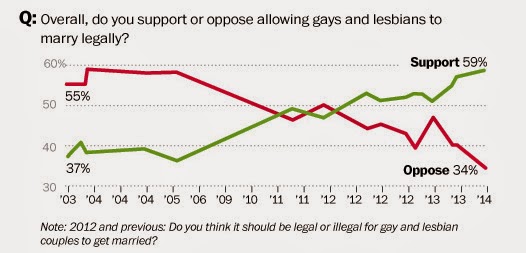
  • It seems tremendously short-sighted. They said they weren't trying to find revenue, and that may be true, but I think they lost a great deal of revenue in the long run by the reversal. Look at these charts, people! Do you see which way these lines are trending? 


  • It's inconsistent. Of course, if opposition to the marriage of same-sex couples truly were one of the fundamental principles under which World Vision operates, then looking at the approval rates would be irrelevant. However, one post I read this week noted that World Vision Canada has had a non-discriminatory hiring policy for over 15 years. Which leads me to believe
  • This is a failure of leadership, not a principled decision. Was it based on the financials? It certainly could be. Their latest 990 (financial reporting) shows that expenses were higher than income in 2011 and 2012, at an increasing rate, so there may be serious financial pressures at work. But I am reminded of Friedman's book A Failure of Nerve, which explains that leadership means holding fast in the face of conflict, rather than immediately reacting to loud and negative voices. 
I was appalled at this particular statement in Stearns' retraction: "We’re learning that a number of people are calling back since the reversal to reinstate their sponsorship. They’re forgiving; they’re saying, ‘Hey we stand with you.’” That, sir, is not forgiveness, any more a child stopping a tantrum after you buy him a toy means the child has forgiven you.

I wish them the best, but I continue to believe this was a huge mistake.

***
FWIW, here are some of the international aid organizations to which I contribute, in case you're looking for other organizations to support:

Against Malaria Foundation: www.againstmalaria.com
CA Bikes: cabikes.org
Evidence Action: www.evidenceaction.org
Kiva: www.kiva.org
Partners in Health: www.pih.org

Friday, July 12, 2013

Various & Sundry: Some really weird stuff, plus some justice and injustice

I think tomorrow I'll have to do a special obit round-up. It's been a good week in death. But let's focus on other things for now, shall we?

So get yourself a nice mug of tea, maybe in one of these upside-down mugs, and settle in.

Hard to take in isn't it? But as the blogger who posted this noted (or at least claims), these mugs are "more stable and more balanced in the hand because of the handles position (being upside down and lower down than normal). This gives a more comfortable pour when drinking due to where the centre of gravity is. They are also more stable in general and less likely to be knocked over. The inverted shape also keeps tea and coffee hotter for longer." If true, then where have they been all my life?

More photos of the creator at work here.

Hungry now? So here's a question I'm sure you've been asking yourself: What's in Prince's Fridge? You will be glad to know someone has answered that question. And it's...an unusual mix of items. There's no photographic evidence (Prince would not allow photographs), but here is an artist's rendering:


Did they make this up? Who knows? But if so, my hat is off to the person who came up with this quote from Prince about his real maple syrup:
“People say U can’t tell the difference, but U know, it’s the real deal. It’s a cut above. It’s about 100 cuts above. This is the only thing that touches my waffles.”
I smell hit lyrics!

Continuing our theme of weird fetishes, let's examine this 12-foot-tall statue of Colin Firth as Mr. Darcy in the coming-out-of-the-lake scene of Pride and Prejudice. No, I am not making this up.


In a more serious mode, now, I thought this satirical list of 15 things black people must do to end racism was truly heartbreaking. And eye-opening. For example,
4. It is the responsibility of the Negro to always dress in a respectable manner. The Negro must, at all times, dress professionally with impeccably pressed trousers and non-threatening white button down shirts. Ties are preferred. The Negro should try to avoid sneakers, sweats, baggy jeans, hoodies, or any other apparel that may constitute a thuggish, frightening appearance or suggest that he may be concealing a weapon or drugs. These types of clothing, however, are perfectly suitable for whites.
Something I'm sure is on people's minds as the jury in the George Zimmerman trial enters deliberations and as the film Fruitvale Station opens in theaters.

I think this story has a much happier ending, though. What do you do if your car is broken into and the thief leaves behind his cell phone? If you're smart, like this woman, you press the speed dial on the miscreant's phone helpfully labelled "Mom."


Justice is served. Home-style.

Monday, February 25, 2013

Why, yes, Hollywood, we DID see your boobs

It was hard to see in the midst of the almost-equal-opportunity offensiveness fest that was the Oscars last night, but Seth McFarlane actually did do a good job of hosting -- if by "good job" you mean clear, engaged, moved things along. But if by hosting you mean something more akin to hospitality, greeting one and all and making them feel welcomed and comfortable, well, he failed miserably on that point.

Here's the thing, though, that I'm actually grateful for: McFarlane revealed the racism and sexism that exists throughout the system that pats itself on the back and calls itself liberal and enlightened.

McFarlane is just the front man for a much larger system. A system that convinces women to undress in the name of art and then sings a puerile little song saying, "We saw your boobs!" A system that claims Quentin Tarantino is starting an important conversation about slavery and then jokes about how Daniel Day-Lewis would try to free Don Cheadle from slavery.

I agree with this writer who says
The best moment of Seth MacFarlane's Oscars hosting gig may have come late in the night when, in announcing Meryl Streep, he said "our next presenter needs no introduction" ... and then just walked away. If only he'd kept his mouth shut more frequently.
Buzzfeed did an in the moment run-down of sexist moments at the Oscars that are quite stark when you see them strung one after another. Again, I'm not happy about it, but I think it is good for these things to be revealed.

And let's remember this is not about McFarlane, but about a system that rewards this kind of speech. Sure, you can make sure McFarlane doesn't present next year, but what do we need to do to change things?

Unfortunately, it's going to be a long slog of speaking the truth to power over and over again. It means looking for the real causes and not just the presenting issues. It means putting our money where our mouth is. It means listening to those who are offended and understanding why and changing our behaviors. It means making mistakes. It means a hell of a lot of work.

In the meantime, there are moments of grace. Such as this one.

Go, Quvennzhane! Make sure they know your name.

Friday, January 18, 2013

Various & Sundry: People to avoid, theologians to watch, magicians to mislead

Oh, I give up. I'm not getting anything else done today, so I might as well move on to the snips and snails of the blogging week that I wanted to share with you.

The White House has gotten some push back on its recent proposal...not to build a death star. The Mischiefs of Faction debate the estimated cost of building the Death Star, the intergalactic politics of blowing up planets, and the technical work-arounds for the thermal exhaust port problem. And Galactic Empire Public Relations also posted a response: Planet Earth Abandons Death Star Project In Face Of Superior Galactic Imperial Power. Our planet is such a wuss.

In school shooting news, I'm surprised we haven't heard more about the fact that it wasn't an armed guard that stopped a shooting in Bakersfield, but an unarmed teacher who talked a student into putting down his weapon. Of course it may have helped that this was a shotgun and not a semi-automatic.

I doubt I would be able to stand up to someone holding a shotgun. On the other hand, I would do well to remember these 5 types of people to run like heck from: Distract-o-matics, Grillers, Status Claimers, Narcissists, and Non-Learners.
I just finished a huge and hard project in 2012, and I realize the people that made that project successful were exactly the opposite of this list of five-to-avoid: They were collaborators who were open and willing to explore ideas together, inherently curious people, and ones who didn’t grade our relationship on some hierarchical scale but based on our shared interests.
Good to remember.

Impressive news from the world of theology: 10 theologians under the age of 10, inspired by works as varied as Brown bear, brown bear, what do you see? to Toy Story. Here's Derrick, age 10:
Author of Why I want to be an Archeologist
What was the first piece that had an impact on your theology?
The Missing Piece. I’m not sure you can say anything definitive about salvation and self-understanding if you’ve not read that book. This idea we have that we are somehow deficient, and need to spend our lives searching for that one piece that will make us whole is so destructive. Shel Silverstein did the world a great service.
Tell us a bit about the piece included for this list.
“Searching” is a theme in my life. Clarifying what our gifts and skills are is the first step to understanding who God has called and created us to be.
What makes good theology “good theology”?
I need it to do something new. Listen, we’ve all read Barth and Moltmann. Those guys are old hat. I want you to push a few boundaries. Make me see something I hadn’t before.
What is your current project?
I’m working on a lost treasure story. I’m thinking of calling it Seek and Ye Shall Find. Do you think that’s too on the nose?
Name one of your favorite theologians over 10.
I gotta go with Tony Jones. A Better Atonement is the best thing I read last year.
Suzannah Paul wrote a really great post on Privilege and the Emerging Church. Whitney Johnson and Tara Mohr remind women that work isn't school. And illusionist Derren Brown explains why you are deceived.


Friday, January 11, 2013

Various & Sundry: Starting with National Hot Tea Month and ending with sloths

Let's see what's been piling up during the week that I'm bursting to share with one and all.

First things first: January is National Hot Tea Month. Well, to be honest, every month is National Hot Tea Month, as far as I'm concerned, so I don't have any special celebrations planned. I did think that these tea pods were pretty cute, though.

See how the tag is a little origami boat so it floats on the tea water?
What? Too precious for you? Fine.

How about a website that helps you plan your living wills and stuff? That real enough for you? It's called Get Your Shit Together.

I don't have all my shit together, but I did get my flu shot today, thanks in part to this old post of mine about passing the peace without spreading the flu. I kept noticing it coming up in the stats as people look for what to do in the midst of the flu outbreak. I've added a brief update, based on the comments that were made. I wish there were a perfect solution - or no flu.

After going to the meeting on Wednesday about how Washington plans to reduce gun violence, I was drawn to two articles focused on the NRA: this article traces the fairly recent history of the NRA's connection to fighting for the interests of the firearm industry as opposed to gun owners; while this article suggests the White House may just ignore the NRA. I'd be fine with that.

Lance Mannion has been writing Miserable Thoughts about Les Mis and tying them to our contemporary culture, politics, and religion. I thought his post about the character of the Bishop of Digne was particularly spectacular. Truly, I hope you'll read it. Here's how it ends:
Conservative Christian leaders are quick to tell us that every hurricane, terrorist attack, and school shooting is an angry God’s will. He’s punishing us for abortion, feminism, secularism, “the homosexual agenda,” etc. But he never punishes us for our greed and our lack of charity. We’re punished for allowing gay couples to get married but not for letting children go hungry and old people freeze or swelter to death or sick people to go without medicine or a doctor’s care.

God is always punishing us for not being mean enough to each other and ourselves and never for not doing a good enough job of loving one another.
I'd never heard it put that way. His Fifth Miserable Thought on Jalvert the Republican (French, not American) is also fantastic.

This long reflection on how we need to ask ourselves questions when we consume media was eye-opening to me. I had never thought of the Disney movie Beauty and the Beast as an abuse-apologist narrative. Now, I will not be able to see it as anything but.
I get that it’s hard to see something you love get lambasted, or tarred with a brush you’d rather not think about, or called bad names. I get that it feels like things are being ruined, like people are looking for things to hate, like people are taking things too seriously.

But consuming media critically is a skill, and in an age where media is more prevalent than ever before, it’s a skill worth having. It’s a skill worth having because you are going to continue to be exposed to media, and it is going to continue to attempt to manipulate you. It’s a skill worth having because it makes it less difficult to see people talking shit about things you like, not more. It’s a skill worth having because some of the shit being taught en masse by media is horrible scary damaging shit, and maybe you don’t think you’ve learned that horrible scary damaging shit, and maybe you don’t think you’re susceptible to that horrible scary damaging shit, and honestly? Maybe you haven’t. Maybe you’re not. I don’t know you. But I know that a classroom full of average southern Ohio state school students went silent in horror at the full realization of what Beauty and the Beast teaches kids too young to know better.
On a lighter note, I admire the chutzpah of the man who claimed he was driving legally in the carpool lane with two people because he had Articles of Incorporation in the passenger seat. Corporations are people, my friends.

And finally, because it's been a long week, slow down with some true facts about sloths.

Saturday, December 22, 2012

Various & Sundry: Maximum Guns

As you can tell, since Sandy Hook, the issue of guns has been on my mind. Here are a few more things I've seen that I thought were illuminating, thought-provoking, helpful, or hopeful in the swirl of information.

Let me start here so it doesn't get buried: In the "but what can we do?" category, the most helpful thing I've found this week is the Children's Defense Fund's document Protect Children, Not Guns. It was written earlier this year, and is an issue they have been working on a long time, so it wasn't a rush-to-find-an-answer kind of a thing. I also like that they had calls to action for all of us, not just "them."

Knowing that you can examine any non-profit's 990 tax form, I thought I'd take a look at the NRA's, and found this post examining their finances for 2010, the year in which Wayne LaPierre, president of the NRA, made $835,469 (plus another $125K and change in "other compensation"). It's a fascinating document to dig into. You know who's on the board of directors? Grover Norquist.

If you are wondering, "How did we get to this place?", Terry Gross's interview with Tom Diaz of the Violence Policy Center, tracing the history of the rise of the assault-style weapon for the civilian market, may be something you want to listen to, or read the transcript. The information is disturbingly fascinating, and presented in a very matter-of-fact way.

Also looking at history, Tony Horwitz notes the similarities between the gun lobby and the slavery lobby of the 18th century. And blogger Nancy Kho found similar parallels after seeing the movie Lincoln on the day of the Sandy Hook shootings.

Lance Mannion had two posts that resonated with me. The first is the satirical Dear Gun Nuts, Uncle Sam needs you! The second, Against any grand unifying  theories explaining Sandy Hook, is one he says he's not happy with and will add to later. His summary in the comments is this: "I think rather than trying to explain anything and everything in reference to broad social issues, we'll learn more if we focus on the individual stories of the killers themselves and we're better off asking not what causes violence in general but what would have stopped this particular killer well before he got to killing people." But everything we're posting and thinking right now is a work in progress, it seems to me.

In the thought-provoking category, Mike the Mad Biologist writes that Nothing in Movement Conservatism Makes Sense Except in the Light of Creationism: The Second-Amendment Edition, which shows similar ways of thinking about gun rights and creationism, the same resentment about anyone who wants to "take them away," or not take their logic seriously. It's worth reading for the "oh" of understanding.

I'm assuming you've read Adam Gopnik's article in the New Yorker about the Simple Truth about Gun Control. I'm just not sure it will convince anyone who isn't already convinced. But it just seems to damn obvious. As tweeter Mary Matthews said, "The 'right' says to limit IN ANY WAY an American's right to drive a racecar down a suburban road at 150 mph infringes on their freedom."

After all of this, I don't know about you, but I needed to see a picture of baby hedgehogs. Here you go.

Peace be with you.

Friday, August 3, 2012

What an ass.

And he seems so pleased with himself.


Listen. I don't have a dog in this Chick-Fil-A fight. But there's a mighty fine display of self-righteousness on everybody's part all across the spectrum. Is this really where we need to put our energy? Really?

And this guy: Haranguing the girl who's working in the drive-thru window? That's a good thing to do? That's going to help? Really?

Sigh.

Friday, July 20, 2012

Various & Sundry, July 20

Interesting day today with lots of good conversations. The one that surprised me most, though, was the conversation I had on Twitter with someone I don't know personally who tweeted,"The only people who murder others with guns are those that already break the law. This is why gun control is not a solution. Very simple." It was one of those, "Are you seeing the world I'm seeing?" moments and I'm afraid I let my knee-jerk reactions get the best of me. Went a couple rounds based on my initial position and then, you know, actually decided to do a little research.

What I found, looking into it a titch more, is, boy, the numbers will let you argue whatever way you want. There's nothing I can even link to because the issue is so clouded that I have no idea what's a trustworthy source. One thing I found that challenges my starting point without seeming nut-jobby was this editorial, written after the Virginia Tech shooting. I can't say I like his conclusions (much preferring something that reinforces my original opinion), but it raises the question, What can we do to make our society and our particular culture as a whole less violent?

At any rate, my prayers are with the victims of the shootings in Aurora, their families and loved ones, and the shooter himself.

So let's talk about tea, shall we? Yes, let's. Because we have three tea-related items to share this week.

First, there's this gizmo that's a teapot with a timer built in. "No unnecessary bells or whistles (let alone a power cord) are needed for this elegantly simple tea timer-and-steeper to do its job. Just pour, screw, tip and wait." Nifty.

This next product makes the same mistake made by the folks who brought you the Tea Monkey Infuser. Namely, you don't want to put something that looks like a human or animal in your tea because said human or animal turns your lovely bath/tea water brown. And that's just gross.

But these folks gave it the good college try with Mr. Tea. You may not be able to see it in the small photo there, but the tag line is "throw some tea in your trousers." Really? "Throw some tea in your trousers"? That's simply unfortunate. Nice try, but no.

I keep trying to think what kind of thing you could make into an infuser where you say to yourself, "How lovely to soak this in my water! I was just hoping that it would turn clear water brown." I'm not coming up with anything. How about you?

I do, however, love the idea behind the Universal Tea Machine, “a gargantuan cross between a tea-making device, a primitive computer and a pinball machine.” Built to mark both the London Olympics and Alan Turing's centenary,
The Universal Tea Machine will dispense up to 2,000 free, freshly made cups of tea each week from its temporary home next to a giant screen streaming Olympic coverage in Victoria Park, Hackney — but you will only receive a nice builder’s brew with milk and sugar, as opposed to a dry tea bag with three sugar lumps or a cup of hot milk and water, if you can perform binary addition...Would-be tea drinkers will have to perform five sequential additions correctly in order to produce a perfect cuppa.

I'm sure Douglas Adams would approve.

In other literary references, Mark Twain has some wise words on how he came up with his characters.

My favorite obit of the week is one that the subject, one Val Patterson, wrote himself. Here's the part that's gotten the most attention:
Now that I have gone to my reward, I have confessions and things I should now say. As it turns out, I AM the guy who stole the safe from the Motor View Drive Inn back in June, 1971. I could have left that unsaid, but I wanted to get it off my chest. Also, I really am NOT a PhD. What happened was that the day I went to pay off my college student loan at the U of U, the girl working there put my receipt into the wrong stack, and two weeks later, a PhD diploma came in the mail. I didn't even graduate, I only had about 3 years of college credit. In fact, I never did even learn what the letters "PhD" even stood for. For all of the Electronic Engineers I have worked with, I'm sorry, but you have to admit my designs always worked very well, and were well engineered, and I always made you laugh at work. Now to that really mean Park Ranger; after all, it was me that rolled those rocks into your geyser and ruined it. I did notice a few years later that you did get Old Faithful working again. To Disneyland - you can now throw away that "Banned for Life" file you have on me, I'm not a problem anymore - and SeaWorld San Diego, too, if you read this.
But the whole thing is completely delightful and truly touching. I'm sure his friends and family miss him very much.

And with that I must add: Life can be short. Tell your friends and family that you love them.

Have a great weekend.

Friday, June 29, 2012

Various & Sundry, June 29

Happy Friday, everyone! Are you ready for a miscellany? Let's get to it!

The only good thing to come out of the death of Nora Ephron is a bunch of Nora Ephron stories, such as this great tale she tells of seeing Steve Wynn accidentally destroy a Picasso. Not just any Picasso. This Picasso. I also appreciate a woman who likes to eat.

A couple of posts explore how to be a good do-gooder--or perhaps more accurately, what are some of its challenges. This article, titled Post-Humanitarian Advertising: Because You're Worth It! is a fascinating analysis of #Kony2012 in the larger context of how aid and development is now being marketed. Key quote:
Kony2012 did not spread like wildfire because it stood in opposition to individualism and consumerism, but because it managed to turn the pursuit of global justice into an individualistic, consumerist activity. It did not aim to inspire feelings of universal moral responsibility, but commodified ‘universal moral responsibility’ into a consumable product that can operate within the capitalist culture most people readily understand.
The second is called Why the word "missional" bugs me and raises some worthwhile concerns, such as what is the difference between being somebody's mission and somebody's friend?

I loved this brief article on why you should hire introverts, and why you should leave them alone.

I also loved this much longer article on why the House of Hufflepuff kicks ass. It made me want to be a Hufflepuff, I tell you what.

Pulling from the vault, I found (after last week's church service) that I had this brief examination of the David and Goliath story that I think is worth sharing again. It's not the story we've been told it is. As I said,"I noticed David took 5 stones for his sling. Five. He's a confident little twerp, but he's not stupid." I love the David saga.

And while we're doing Toepfer promotional stuff, my sister has a cool YouTube channel. You should check it out.


Monday, June 4, 2012

Who's talking about women's issues?

No comment.

via Upworthy. h/t Dave Dickerson.

Update: OK, some comment.

After seeing this, I sent the link on to the New York Times and NPR ombudspeople, since those are the two  news sources cited that I use. I asked:
Would you care to comment on this chart? What is [your organization] going to do to increase the parity (at least) in quoting men and women -- particularly on issues with a strong women's interest? Thank you for your attention and answer.

Answer from NPR:
Dear Laura ,

Thank you for contacting the NPR Ombudsman.

As for your email, we appreciate your comments regarding the perceived lack of female voices in stories concerning women's issues. The Ombudsman has written on gender, racial and ethnic diversity, both at NPR specifically and with respect to specific issues. Below are some links that may be of interest:

Where are the Women?
Black, Latino, Asian and White: Diversity at NPR
The Contraception Mandate: Where are the Women?
And then some boilerplate about NPR.

Kudos, NPR, for at least acknowledging the issue!

Here's what I got from the NY Times:
I can't really comment on this because I have no idea how these findings were calculated. The reason I say that is that I find it incredibly difficult to be able calculate what is suggested in this article. If you can get me more information on how this calculated, or the raw data that was used, I would be much more willing to take a look.
 Best,
Joseph Burgess Joseph Burgess | Office of the Public Editor |
NYT Note: The public editor's opinions are his own and do not represent those of The New York Times.
Well, OK then. You do realize, Joseph Burgess, that this chart is circulating around out there. I didn't make it up.  Apparently you're not interested in learning whether this is accurate or not. Oh, heck, let's go further: apparently, the NY Times thinks the burden of proof is on me personally to fact check data about the Times.

This is as much about how you are perceived as it is about the data. I'm not sure it's my job to do your public relations for you. And for all that little note, there, I'm assuming this is the attitude of the NY Times.

I think I'll just believe this data is accurate until it's proven otherwise. By, say, a reporter. Who is willing to investigate. Because it's their job.

Friday, March 23, 2012

Various & Sundry: the "What is WRONG with people?" edition

As I look over what I've compiled during the week, things seem mostly to have taken a fairly serious turn. Nothing wrong with that, but if you want  something lighthearted, skip to the video at the end.

Trayvon Martin. Can there be a more appalling tale out there? Ta-Nehisi Coates has been posting something daily about what's being said and done, but I think the most...I don't know if "helpful" is the right word, but illuminating, perhaps, was this larger picture piece of the Stand Your Ground law that allows people to use lethal force when feeling--feeling--threatened. Trayvon Martin is not the only person to be killed because of this law. Unbelievable.

Again going to a larger picture, the Kony2012 video inspired Teju Cole's reflections on the White Savior Industrial Complex, which is very much worth your read.  Here's the key take-away:
What innocent heroes don't always understand is that they play a useful role for people who have much more cynical motives. The White Savior Industrial Complex is a valve for releasing the unbearable pressures that build in a system built on pillage. We can participate in the economic destruction of Haiti over long years, but when the earthquake strikes it feels good to send $10 each to the rescue fund. I have no opposition, in principle, to such donations (I frequently make them myself), but we must do such things only with awareness of what else is involved. If we are going to interfere in the lives of others, a little due diligence is a minimum requirement.
Preach it.

I haven't had much to say about rhetoric recently, though I've been thinking about it.  I was struck by this article that talks about how changing the rhetoric on the "War on Islam" changed the narrative.  Am I happy about our current military engagements? By no means.  But I still think Saletan has a point when he says,
Bin Laden wanted a religious war. Bush and Obama refused to let him have it. At the end of his life, isolated by left-wing drone strikes and marked for death by PC commandos, this was Bin Laden’s chief lament. And that, Sen. Santorum, is why you don’t call it a war on radical Islam: because choosing your words carefully is part of winning the war.
Another time, I may (or may not) have something to say about how we use the word "war" to score rhetorical points--the War on Women vs. the War on Religion being a prime example. But while I'm pondering that, I am also still incredulous about Rachel Held Evans' report that her publisher wouldn't let her use the word...vagina in her book "because we have to sell it to Christian bookstores, which apparently have a thing against vaginas." This and more astonishing info in her post on Scattered Thoughts on my Life in the Christian "Industry".  Infuriating! The vagina is a body part! Not a dirty word, for God's sake!

OK, I'm calmer now.

All that being said, I am glad to report that baseball season is coming, and that right soon. So with all that is wrong with the world, please just take a moment to enjoy this nifty bat trick.


And remember it's spring. So that's good.

Thursday, March 8, 2012

Why I don't support Invisible Children or Kony 2012

You know that scene in a movie when someone is about do release the tiger (for example) and another character is shown in slo-mo saying "Noooooooo!" but can't get there in time? That's kind of how I feel watching the video for Kony 2012 go viral.

Invisible Children, a San Diego-based organization, has launched a huge campaign to support the arrest of Joseph Kony, the head of the Lords Resistance Army (LRA) in Northern Uganda.  They have a video called Kony 2012 that they posted 2 days ago that now has almost 37 million views.  I watched it and was appalled. Just appalled.

I posted something yesterday on my Facebook page in hopes of slowing down the virus, but by the afternoon at least three of my friends had rapturously shared the video and I'd gotten an excited text from someone saying, "Wouldn't this be great for youth group?" Nooooooo!

And I'll tell you why, in four parts: my personal experience, what others are saying, my observations, and some questions to ask yourself.

My personal experience
In 2008, I went to Uganda as a Kiva Fellow.  The first organization I worked with had offices in Kampala (where I was) and Gulu, in Northern Uganda, the main city near where the LRA was operating.  One day, I went with one of the loan officers to the Kampala offices of Invisible Children to talk to someone there who had received a loan.

I found out from the loan officer that when the head of Invisible Children first arrived in Gulu, they had begun a partnership with the loan officer's organization.  But as time went on, IC (according to him) reneged on their original agreements and partnership, poached workers and donors and allies, and generally made it harder for this organization to do its work in Gulu, which it had been doing for years.

Now, I have to say, this organization also had its problems.  However, it also sounded like Invisible Children took help when they needed it and then discarded locals when they had the resources to carry on on their own.  *Please note this lack of respect for local organizations and abilities! This theme will return.*

The Invisible Children compound was in the most beautiful and wealthiest suburb of Kampala.  That still doesn't mean what it means in the US, but it was strikingly different from any other NGO (Non-governmental Organization) office I saw.

There, about a half a dozen people were being paid to create bracelets to send to donors.  These bracelets were not like anything I saw anyone in Uganda wear.  They were a kind of hip accessory to go with an urban American outfit.  It seemed to be a gimmick, at best, to get my money and make me feel I had done something.  It's hard to convey exactly what it was like, but I was overwhelmed with the sense that this was a cash cow for the founders with a dollop of Good Deeds on top.

I left there feeling jaded, used, and angry.  Although I hope they were doing good things on the ground, what I saw made me feel that they were at least as interested in perpetuating their organization through continually whipping up donors than in solving the problems that needed solving.

I am very grateful to Invisible Children, actually.  It was seeing their organization in Kampala that opened my eyes to the fact that not all aid organizations are the same.  At first, I was so disgusted by the disjunction between the messages of aid organizations and how they operate that I stayed away for a while.  But I also began to learn more and (I hope) become more savvy, with the help of a lot of other people, to whom I'd like to introduce you.

What others are saying
First off, this article gives some more information on what is actually going on in Uganda today--much of which recasts (to put it kindly) the information in the Kony 2012 video including the fact that (as the headline says) Joseph Kony is not in Uganda.

The posts I think are most important for us to listen to are the ones by Ugandans themselves.  Rosebell Kagumire, a Ugandan journalist, posted her own video response to Kony 2012, outlining how the video simplifies the situation and denies Ugandans their own voice about their own circumstances. In comparison to IC's 36 million views, Kagumire has 301.  If life were fair, at least as many people would listen to the local perspective as that of someone recent to the situation.

TMS Ruge, also a Ugandan who works with those directly affected by the conflict in Northern Uganda, wrote a powerful post at Project Diaspora called Respect My Agency that deserves to be read in full.  But here is one thing he says about IC and similar projects:
They are not selling justice, democracy, or restoration of anyone’s dignity. This is a self-aware machine that must continually find a reason to be relevant. They are, in actuality, selling themselves as the issue, as the subject, as the panacea for everything that ails me as the agency-devoid African. All I have to do is show up in my broken English, look pathetic and wanting. You, my dear social media savvy click-activist, will shed a tear, exhaust Facebook’s like button, mobilize your cadre of equally ill-uninformed netizens to throw money at the problem. 

Cause, you know, that works so well in the first world.
Yeah, he's ticked. Please read the whole thing.

I won't go into detail about others, but on Twitter you can check out the hashtag #stopIC.  Other articles of note:

How matters
Invisible Children and Joseph Kony
On Invisible Children's Kony 2012 campaign (particularly even-handed and good, I think)
Why You Should Not Donate to Invisible Children/Kony 2012
Visible Children tumblr

My Observations
I watched the Kony 2012 video.  Here are my problems with it:

1. It's all about what we can do, not how we can support those already doing the work
Early on, the filmmaker says to a boy whose brother had been killed by the LRA,"We’re going to stop them."   But "we" never seems to include Ugandans themselves. Throughout this video, I never hear him asking Ugandans, "What is being done about this? What would you like us to do to help?"  Instead, Invisible Children is going to come in and fix this. The West comes to the rescue of the poor benighted Africans. I'm sure they appreciate that.

2. It oversimplifies and distorts the situation
"Who is the bad guy?" the filmmaker asks his young son.  Really? That's the information we as viewers need to respond to a situation that's been going on in Uganda for 20+ years? Who is the bad guy?  It skips over any changes in the situation over the past 10 years, including how things have improved in Northern Uganda, how much less influence Joseph Kony now has, and what is currently being done.  And it makes it seem as if it would all be better if only Kony were brought before the ICC.

3. It removes the Ugandan leaders from the equation
Invisible Children petitions the government...but just the U.S. government.  Why did they not interview the Ugandan president or members of Parliament?  Why not the African Union or United Nations? Invisible Children wants to involve culture and policy leaders...but not African culture and policy leaders.  There are no Africans on their list of influencers.  Justin Bieber? Really?  Rather than have young Justin, there, tell the world that Joseph Kony is the bad guy, why not have Americans hear about that from Ugandan artists?

4. It is promoting ad hoc, a la carte military actions as justice activism!
Really? This is what we want to be promoting in our churches and youth groups?  Really?  We want to support putting pressure on the U.S. government to keep sending military advisors to Northern Uganda?  That's what we think will help?  That's what will solve the problem?

I could go on.  I will just leave you with

Some questions to ask
If you watch the Kony 2012 video, ask yourself:

1. How are Africans portrayed?
Are they victims, villains, or heroes?  Do they have power or are they powerless?  What do they get to say for themselves?  What actions do they ask others to take?

2. How is the West portrayed?
Again, victims, villains, or heroes?  Do Westerners have power or are they powerless?  What do they get to say about Africa?

3. Who gets to speak?
Pretty self-explanatory. But also note in what role people are cast when they speak and who gets to interrupt whom.

4. How does this video appeal to your emotions?
What techniques does it use to heighten emotions? When does it speak to you directly? What does this video tell you about you?

5. What does Invisible Children get out of this?
Not assigning any motives here, but what does this organization get if people participate?   How does this campaign benefit them?

OK, I'm done now.  Here's the video if you want to see it.  If you do, please watch the video by Ms. Kagumire, which is immediately below.


Wednesday, February 22, 2012

On the contra-contraception conniptions

I have been trying for...it seems like forever, but it's probably only been days to wrap my brain around the Catholic bishop's argument against allowing people in their employ to get the contraception that would be provided by the insurer as part of the insurance policy.  I really am trying to understand, to try to find an equivalent situation where my beliefs would be so strong that I would say, "No, I cannot bear to have any possible part in other people making their own moral and ethical decisions that are against no law but are against my own morals." I just can't come up with an equivalent that allows me to comprehend their argument.

I find myself going to extremes, thinking, "Well, you probably shouldn't pay them either, since they may do something you find immoral with the money--like buying birth control."  I find myself asking, "Does the Christian Science Monitor offer health insurance benefits to its employees?" (Yes, they do.)

I have been floored by the comments I've been hearing: that women should "keep their legs together," that birth control is "a license to do things in the sexual realm that is counter to how things are supposed to be," and similar notions. In a way, I'm glad to get them out in the open where we can look at them, go "wha?! You mean people in this day and age actually think that?", and then do our best to counter-argue.

One of the things that ticks me off most about this argument is that I haven't heard much mention of the fact that birth control pills can be used for other medical reasons not related to birth control.  A very good friend of mine used them for endometriosis; another friend who had both ovaries removed  also used them.  Neither was able to conceive and in fact both of them had to go to great lengths to have children.  And yet, as I visited my friend in the hospital after emergency surgery to remove her ovary, I heard that she was unable to get the pill because the only pharmacy available to her that day was that of the Catholic hospital.

It is irrational that hospitals cannot provide treatments because a particular religious group doesn't like something else that the treatment does. It is unconscionable that one group should block any means for others to live according to the law and in keeping with their ethics.  Keeping your legs together will not control the pain of endometriosis.  And requiring women to buy birth control from the salaries you give them just means reducing their pay, not keeping you pure.

Thursday, December 1, 2011

Reflections on World AIDS Day

Cross-posted at the Confirm not Conform blog

 It occurred to me today, on this World AIDS Day, that for many of the youth in our churches, AIDS is something that happens to Other People Far Away. But for many of us who work with youth, we went through the time when AIDS was a death sentence that affected people close to us. I wonder if sharing those stories and memories will help to make our current response to AIDS more compassionate and more urgent.

At St. John's Oakland, where Confirm not Conform was developed, we are lucky enough to have a story of AIDS from halfway across the world who came to live among us. Chris Ategeka, whose parents both died from AIDS in their home in Western Uganda, was sponsored by a family at St. John's and eventually came to live here. Last May, he graduated from UC Berkeley with a degree in Mechanical Engineering. You can see his commencement address here. He is now the executive director of Pedal or Power, a nonprofit that helps people in Western Uganda build their own bicycles and scooters. Among its goals, this program will allow AIDS/HIV positive patients easier access to anti-retroviral drugs.

The youth of St. John's have had the opportunity to see up close that AIDS is not just something that happens to Other People. What stories do you have in your congregation that can help your youth--and other people--see AIDS as something real, present, and worth fighting?

Remember this? 

Wednesday, November 2, 2011

What's wrong with this picture?

A friend of mine posted this to her Facebook page:

Sounds good, right? Reminding us to care for the poor and needy rather than our own selfish wealthy Western selves? But I would argue that this is a dangerous distortion that hurts the poor.

It's clear to me that the photo on the top is the 1%--the poorest of the poor. This kind of thing is often referred to in aid circles as poverty porn, used by charities to drum up donations.  This skewed view of poverty leads to discrimination throughout society.  Fox News did a segment during the summer on the "so-called poor" complaining--complaining--that 99 percent of them have a refrigerator. The Heritage Foundation uses the Census Report to proclaim that
For most Americans, the word “poverty” suggests near destitution: an inability to provide nutritious food, clothing, and reasonable shelter for one’s family. However, only a small number of the 46 million persons classified as 'poor' by the Census Bureau fit that description. While real material hardship certainly does occur, it is limited in scope and severity.
THAT is why this picture is so dangerous. It establishes a picture of poverty that requires the poor to be absolutely destitute before they deserve any pity. Clearly if "the poor" look well-fed and happy then they're not really poor, are they? Just lazy whiners.

Let's take a look at another picture of poverty, one I took while I was working with Kiva in Uganda.


These women are all entrepreneurs getting microfinance loans. They fit any definition of "poor" you care to name. Do they look miserable enough? Should they even be getting a loan? In fact, there was another photo (that I didn't keep) of this same group hamming it up and smiling which I didn't post to the Kiva website because I was afraid that lenders would think they didn't need the money because they looked too happy.


Luckily in the picture I took, at least the poor in question are African women. At least they are the right color and gender to appear properly poor. How dare a white male suggest he could be part of the 99 percent! Except if he earns less than $47,500 a year, then he is. Not just in the U.S., but in the world. Leaving aside  any other consideration: what do we know about this guy? Absolutely nothing. He could be doing  an unpaid internship. He could be unemployed. He could have a good job somewhere. He could come from a wealthy family--we don't know.

But it is presumptuous to claim that he is part of the top 1 percent without information. We are basing that on a stereotype of rich and poor that is not helpful to anyone. It certainly does not get to the issues behind the Occupy Wall Street protests. This image is a cheap shot and it isn't good for anyone.