This story came to me through a neighborhood email list. I asked the teacher in the email if he'd let me share the story on my blog and he said "Of course. That's the idea: to keep it growing. Please delete my name, though."
So here, name deleted, is a report from DAP's classroom in Vallejo.
Dear Neighbors,
Our Winter Auction was a great success THANKS TO ALL OF YOU! The Vallejo Heights Neighborhood Association joined our Bay Terrace group in supporting the classroom's Winter Auction this year, allowing the students to get gifts for their family and friends that they otherwise would not be able to afford. And your response was truly moving.
It was such a big event that word spread through the school, kids hanging outside the classroom just to get a glimpse of the mountain of donations that had been accumulating for the last few weeks. In fact, it caused a bit of a commotion. At the end of the day, as we all prepared for a long vacation, some of my colleagues told me that I was a great teacher; and to those with whom I am close, I confided that I was just an average teacher of curricula, but a pretty good teacher of love (thanks to my mom). And as you read on, you'll see how the love you showed by donating so generously will continue to grow for a long time to come.
Prior to the very morning of the Auction, I assumed that claiming one of the five $20 Target gift cards, or one of four $15 Best Buy cards, or maybe the digital camera would be the single most popular item in this year's Auction. Along with some extra large stuffed animals - some of which even sang and danced - and a lot of new electronic items, I think they were leading the pack. But on the morning of the Auction, I received a lovingly-used bicycle. And when it rolled into class, I knew that practically every child in that moment really wanted that bright green, slick-looking bike.
And they did. Without a doubt. Each of them wanted it. For themselves. "Give it to me" was an omnipresent sentiment... Then, out of the back of the class, I heard a student call out, "Let's give it to Javier, so he can get to school." Javier - not his real name - is one of my students, whose single mother has a work schedule that interferes with transportation to and from school. In fact, just the day before, I had asked the kids to find out if they could help Javier with rides. He was being bullied when he walked back and forth from school to his home near Kaiser Hospital (a distance of about 3 miles!). Javier is a boy of above average intellect and has great potential, if he can just overcome the obstacles which he confronts and in which he played no part in creating.
Despite the palpable lust for that bright green bike that charged the room, another voice chimed in, "Yeah! Let's give it to Javier!" Of course, I could have, but I told them that I couldn't just give it away, since it was donated to an auction in which they were supposed to buy items with money earned for good behavior. The kids knew that Javier didn't have a lot off class money, because so frequently he was absent or late. But I also told them that if Javier made a bid and no one bid any higher, he'd automatically get the bike. Since Javier was late as usual, he had heard none of this.
The auction continued after Javier's arrival with a few more items - a bath robe, scented candles, a baby blanket and bib - and I made sure to wait until he understood how it worked before I brought out the bike. Typically, the kids just yell out, "Five dollars!" "Ten dollars!" (and even "$100" for the largest gifts), with the loudest voice driving the bids. You know, an open auction. Competitive. But with thirty-three 11-year-olds. When I rolled the bike across the floor, I asked, "And what is my bid for this almost-new bright green bike," and I paused before adding, "Javier?" Surprised at being singled-out when no one else had been before, he fumbled with his meager stash of cash before making his bid, which he knew was too low to win. "Fifty dollars."
Now I was on the line, personally. Not to make this about me, it's not. It's about my precious kids... what I'm trying to teach them between integers and earthquakes and Ancient India... and it's about all of you who made such kind donations. But to continue, I wondered whether they would show me that they had learned the lesson I teach and reteach and teach again: "From Egocentrism to Altruism." I know it sounds too advanced for sixth graders; but with a little help, they come to understand it. And in this moment, I would understand whether or not I had been successful. If everyone was quiet, they were putting Javier's needs before their own desires. But if someone spoke, I would know that I had not yet reached them all.
And someone did speak. As those first vibrations of sound moved through the air, I thought that I had failed. But when they reached my ears in their fullness, I knew the students had learned how to be altruistic. "Don't say anything!" came the hushed admonition from the crowd, along with an ample chorus of "Shhh!"s, until there wasn't a sound in the room. Complete silence. "Well, Javier, it looks like you've got yourself a new bike, young man," I told him, more pleased than I've felt in a very long time. The other students cheered and surrounded him, before escorting him to his new bike and intentionally making a big deal of how awesome it was. I shed a couple of tears in class that day and Javier arrived bright and early and on time for school the very next day.
Call me crazy, but that's a holiday miracle in my book (and if you know much about 11-year-olds, probably in yours, too). And as you all can imagine, the love didn't stop growing there. One item after another was scooped up, wrapped, and taken away, until well over 100 gifts had been purchased with money earned for actively demonstrating responsibility, good citizenship and altruism. Some gifts were delivered right away, causing a few tears and a lot of hugs - I've been told - while others were stashed away to be a proud surprise.
But rather than me recounting their gratitude in my words, here are some of their own - a little cleaned-up - from thank you notes addressed,
Dear Neighbors,
You guys are like the world's BEST neighbors! It's heart-warming that you are so sweet and caring and awesome.
The gifts I got made me feel like this is the best Christmas ever!
This is the first Christmas that I [was able to] give my mom a present... Thank you!
If you guys [hadn't] donated, I wouldn't have anything to give out this Christmas. I hope you have a great Winter Holiday!
I love that you give to people you don't know. I'm very thankful for that.
I feel great because I know there are still generous people in Vallejo.
I appreciate the fact that people I have never met before would offer so much to our class.
And the love just keeps growing, moving among us, being paid forward even as you read this, perhaps:
[In addition to gifts for my family,] I got a gold-wrapped chocolate box. I gave it to a very poor family that I see a lot in the park. It made them tear up.
I didn't get myself anything because I want my family to be happy. That will make me happy this Christmas.
I think this is the sweetest and kindest thing anyone can do. Thank you very much for everything you have done. I hope we can return the favor!
Well, they did for me. How about you?
THANK YOU ALL SO MUCH AND HAPPY HOLIDAYS!
Showing posts with label charitable giving. Show all posts
Showing posts with label charitable giving. Show all posts
Tuesday, December 23, 2014


Saturday, March 29, 2014
The World Vision Thing
 |
| h/t to the Millennial Pastor for the great image (& responses) |
On Monday, World Vision announced in Christianity Today that it was changing its hiring policy so that gay Christians in legal marriages could be hired. Rich Stearns, president of World Vision, explained the policy change this way:
"It's easy to read a lot more into this decision than is really there," he said. "This is not an endorsement of same-sex marriage. We have decided we are not going to get into that debate. Nor is this a rejection of traditional marriage, which we affirm and support." "We're not caving to some kind of pressure. We're not on some slippery slope. There is no lawsuit threatening us. There is no employee group lobbying us," said Stearns. "This is not us compromising. It is us deferring to the authority of churches and denominations on theological issues. We're an operational arm of the global church, we're not a theological arm of the church."The shit immediately hit the fan with close to 5,000 people canceling their sponsorships of children. In less than 48 hours, Stearns announced that the board reversed the decision, saying it was a mistake.
"We made certainly in retrospect was a bad decision, but we did it with the right motivations. We weren’t trying to harm, or trying to find revenue, we weren’t doing it for wrong motives. We were trying to find some kind of solution to a divisive issue that would create some space of togetherness around differences within the church. Our regret is that we caused more division instead of finding a place of more unity."So by Wednesday, I had a fair number of thoughts going through my head. Let me see if I can set them out in any sort of coherent order.
First of all, I'm hugely disappointed by how this whole thing played out. And although I'm upset at those who decided to withdraw their sponsorship of children, I have to admit I understand it. I have not been a financial supporter of World Vision in part because of its conservative Christian background (not the only reason, but one of them). So I'm certainly in the same boat as people who don't want to support an organization that they think represents values counter to their own.
I'm much more disappointed with World Vision, for a few reasons:
- They (apparently) didn't anticipate this. Really? Knowing the political climate we live in, knowing the reactive nature of our current Christian culture, knowing that homosexuality is THE hot button topic...they hadn't thought through the plan?
- They didn't give this any time. Rachel Held Evans had begun rallying the troops to solicit new donors. I suspect many other church leaders would have done the same. I'd come home on Tuesday, after learning about the reaction, planning to donate to World Vision as a show of support for this change, knowing they were getting a beating. But they reversed the decision so quickly, I hadn't gotten to it yet.
- It seems tremendously short-sighted. They said they weren't trying to find revenue, and that may be true, but I think they lost a great deal of revenue in the long run by the reversal. Look at these charts, people! Do you see which way these lines are trending?
- It's inconsistent. Of course, if opposition to the marriage of same-sex couples truly were one of the fundamental principles under which World Vision operates, then looking at the approval rates would be irrelevant. However, one post I read this week noted that World Vision Canada has had a non-discriminatory hiring policy for over 15 years. Which leads me to believe
- This is a failure of leadership, not a principled decision. Was it based on the financials? It certainly could be. Their latest 990 (financial reporting) shows that expenses were higher than income in 2011 and 2012, at an increasing rate, so there may be serious financial pressures at work. But I am reminded of Friedman's book A Failure of Nerve, which explains that leadership means holding fast in the face of conflict, rather than immediately reacting to loud and negative voices.
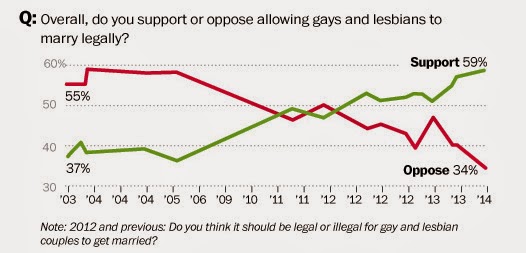

I wish them the best, but I continue to believe this was a huge mistake.
***
FWIW, here are some of the international aid organizations to which I contribute, in case you're looking for other organizations to support:
Against Malaria Foundation: www.againstmalaria.com
CA Bikes: cabikes.org
Evidence Action: www.evidenceaction.org
Kiva: www.kiva.org
Partners in Health: www.pih.org
Saturday, October 12, 2013
Why I hate tithing, and what I recommend instead
You may recall that I posted a sermon a few weeks ago in which I get pretty shirty about tithing. Well, the brave folks at the Church of the Incarnation, Santa Rosa, invited me to contribute to their stewardship materials, thus putting their money where my mouth is. I hope I helped them!
Here's what I wrote.
***
 I hate tithing. I don’t mean that I hate to do it; I mean that I think it’s a terrible way to determine giving. It’s so mechanical! So guilt-laden, too. But all my life, I’d heard people talk about the tithe as the Biblical basis of stewardship. It wasn’t until a few years ago that I thought, “Hey, wait a minute! People keep talking about tithing as Biblical, but I’ve never actually seen any of these texts!”
I was surprised by what I discovered. Did you know that tithing only refers to agricultural products? That’s why you hear Jesus talks about the Pharisees “tithing mint and rue and herbs of all kinds” (Luke 11:42) – they were keeping to the letter of the law down to the herbs in the kitchen garden.
But looking at the New Testament, what I see as the Biblical standard of giving is not tithing, or any sort of definitive rule. Instead, I see two traits that characterize faithful giving: generosity and mission.
Generosity: Unlike tithing, which is simply a math problem, generosity is a spiritual practice. I know many generous people who are tithers, but tithing on its own is simply about a transfer of goods or money from one entity to another. Generosity, on the other hand, is the attitude in which the tithing – or any giving – is undertaken. Tithing answers the question, “Have I done enough?” Generosity answers the question, “How can I contribute as much as possible?”
Mission: One of the things that most annoys me about tithing is that it is so disconnected to what happens to the money. But what I see over and over again in the New Testament is that giving is directed to some purpose: supporting Jesus’ ministry, helping one another in the church, caring for widows and orphans, or reaching out to the church in Jerusalem.
Mission is actually the question of generosity as it is answered by a community or organization: “How can we as a group contribute as much as possible?” When we are clear about our mission, it makes it clear why we are giving and what we are giving towards. Tithing eliminates any dialogue, expecting people to shut up and give because the Bible says so. But a call for giving based on mission opens the question of what it is we hope to do together and how can we get it done.
And so I would encourage the community of the Church of the Incarnation, Santa Rosa, to reflect on the mission of your congregation: how can we contribute? Talk about it with one another, and really come to grips with what it is you want to do together and how to accomplish that.
Then as individuals, take time to answer that same question: How can I contribute? If Incarnation has a mission that excites you that you want to support, what can you do to make that happen?
Paul, writing to the wealthy church in Corinth, challenged them to give to support the church in Jerusalem as the much poorer church in Macedonia had done. He summarized giving in a way that resonates with me, saying, “If the eagerness is there, the gift is acceptable according to what one has” (2 Corinthians 8:12).
I hope you are eager to see the great things you can do as the Church of the Incarnation, and I pray that you might be able to give generously to see that happen.
Here's what I wrote.
***

I was surprised by what I discovered. Did you know that tithing only refers to agricultural products? That’s why you hear Jesus talks about the Pharisees “tithing mint and rue and herbs of all kinds” (Luke 11:42) – they were keeping to the letter of the law down to the herbs in the kitchen garden.
But looking at the New Testament, what I see as the Biblical standard of giving is not tithing, or any sort of definitive rule. Instead, I see two traits that characterize faithful giving: generosity and mission.
Generosity: Unlike tithing, which is simply a math problem, generosity is a spiritual practice. I know many generous people who are tithers, but tithing on its own is simply about a transfer of goods or money from one entity to another. Generosity, on the other hand, is the attitude in which the tithing – or any giving – is undertaken. Tithing answers the question, “Have I done enough?” Generosity answers the question, “How can I contribute as much as possible?”
Mission: One of the things that most annoys me about tithing is that it is so disconnected to what happens to the money. But what I see over and over again in the New Testament is that giving is directed to some purpose: supporting Jesus’ ministry, helping one another in the church, caring for widows and orphans, or reaching out to the church in Jerusalem.
Mission is actually the question of generosity as it is answered by a community or organization: “How can we as a group contribute as much as possible?” When we are clear about our mission, it makes it clear why we are giving and what we are giving towards. Tithing eliminates any dialogue, expecting people to shut up and give because the Bible says so. But a call for giving based on mission opens the question of what it is we hope to do together and how can we get it done.
And so I would encourage the community of the Church of the Incarnation, Santa Rosa, to reflect on the mission of your congregation: how can we contribute? Talk about it with one another, and really come to grips with what it is you want to do together and how to accomplish that.
Then as individuals, take time to answer that same question: How can I contribute? If Incarnation has a mission that excites you that you want to support, what can you do to make that happen?
Paul, writing to the wealthy church in Corinth, challenged them to give to support the church in Jerusalem as the much poorer church in Macedonia had done. He summarized giving in a way that resonates with me, saying, “If the eagerness is there, the gift is acceptable according to what one has” (2 Corinthians 8:12).
I hope you are eager to see the great things you can do as the Church of the Incarnation, and I pray that you might be able to give generously to see that happen.
Thursday, May 30, 2013
You can't tell who's hungry by looking
On a discussion group I'm part of, one person raised the question of how to teach children at a Vacation Bible School about hunger. One day at VBS, they are having a visiting missionary from an African country who suggested that for snack that day, they offer the children half a glass of water and half a cracker, telling them that in the African country where this person worked, this was considered a good meal. Was this, the person asked, a good idea?
The more I consider this, the more disturbing it feels to me, and the more certain I am that the answer is, no. This is a terrible idea.
What I wrote to the group is that we do not know if the children coming to our VBS programs are, in fact, well-fed. It may be that parents are sending children to VBS to provide them with snacks and child care. I think it's dangerous to presume that "they" are hungry and "we" are well-fed. All I can truly say is that I am well-fed. That's all I can know for sure. To deprive children of food in the name of teaching them a lesson seems morally dubious to me.
Just a few days ago, the Pew Research Center came out with a report that stated
All those very useful exercises that show the relative availability of food from one part of the world to another can only make the point if you yourself are not aware of what it is like not to have food. To tell people who struggle to put food on the table, "Feel sorry about those people very far away"...well, I don't think it's a good idea. And since we do not know who is hungry and who is not, I think it is best to feed everyone.
There's a second part of this that disturbs me: what message are we sending about African nations if the only thing people ever hear about them is "for people in this country, a half a cracker is a good meal"? First of all, I am quite certain that there is more than one person in this country that actually has more than half a cracker for lunch. It is just as incomplete a picture to say "Everyone there is starving" as it is to say "Everyone here has plenty."
Finally, is there anything else we can learn about Africa other than "it's full of needy people and we need to help them"? Are there no values there that people can teach us? Is there not a good children's story from this country that could teach something to us about sharing or hospitality or friendship or anything? Is the only thing to know about Africa is that we should help them? Is there no mutuality? Or is it all Radi-Aid for Norway?
The more I consider this, the more disturbing it feels to me, and the more certain I am that the answer is, no. This is a terrible idea.
What I wrote to the group is that we do not know if the children coming to our VBS programs are, in fact, well-fed. It may be that parents are sending children to VBS to provide them with snacks and child care. I think it's dangerous to presume that "they" are hungry and "we" are well-fed. All I can truly say is that I am well-fed. That's all I can know for sure. To deprive children of food in the name of teaching them a lesson seems morally dubious to me.
Just a few days ago, the Pew Research Center came out with a report that stated
Despite being the richest country in the survey, nearly a quarter of Americans (24%) say they had trouble putting food on the table in the past 12 months. This is up from just 16% who reported such deprivation in 2007, the year before the Great Recession began.Share our Strength reports that 16 million children in the US experience hunger.
Nearly one in five children in America lives in households that struggle to put food on the table. They may look no different than other children; child hunger in America is often invisible. They are hurting, just the same.I think we're too used to picture of hunger that are actually pictures of starvation. But the truth is, you cannot tell who is hungry just by looking. Does the child in this photo look hungry? What does "hunger" look like?

All those very useful exercises that show the relative availability of food from one part of the world to another can only make the point if you yourself are not aware of what it is like not to have food. To tell people who struggle to put food on the table, "Feel sorry about those people very far away"...well, I don't think it's a good idea. And since we do not know who is hungry and who is not, I think it is best to feed everyone.
There's a second part of this that disturbs me: what message are we sending about African nations if the only thing people ever hear about them is "for people in this country, a half a cracker is a good meal"? First of all, I am quite certain that there is more than one person in this country that actually has more than half a cracker for lunch. It is just as incomplete a picture to say "Everyone there is starving" as it is to say "Everyone here has plenty."
Finally, is there anything else we can learn about Africa other than "it's full of needy people and we need to help them"? Are there no values there that people can teach us? Is there not a good children's story from this country that could teach something to us about sharing or hospitality or friendship or anything? Is the only thing to know about Africa is that we should help them? Is there no mutuality? Or is it all Radi-Aid for Norway?
Saturday, May 18, 2013
Various & Sundry: The cats are unimpressed
I'm kind of tempted to start this week's collection of online tidbits with the Sad Cat Diary.
I hope you are not too depressed to read on.
But if you have made it this far, I hope you will read this terrific article about what we can learn from one of the worst charities in the world. I think it captures some of the key things we need to consider in aid and development work in a way that's really eye-opening. The gist is we need to look at the outcome (what does the charity actually accomplish) rather than focus on the process (how does it go about it -- assuming it is legal and ethical). Take a look and see what you think of the author's arguments.
Meanwhile, over at How Matters (because, yes, this is a both/and kind of a situation), Jennifer Lentfer writes about her recent visit to Haiti and the comments made to her by the recipients of various aid programs. Here's the one that particularly got me: "Is it a political strategy for Americans to come waste their money and weaken us?" Youch.
@pj_blue had a tweet that summed all of this up very neatly:
So...will it do any good to sign this petition to make it easier for musicians to bring their instruments on airplanes? One can always try, and hope. Apparently,
 Congratulations to 18-year-old Jennie Lamere who won a Boston Hackathon (a programming competition) with a code to stop television spoilers in your Twitter feed. Which, if you're a Twitter type, is actually really useful. What's more, she was the only female to present a project, and the only solo competitor. Go, Jennie. Another story on how she got into coding here.
On the other end of the life spectrum, this week I read the fascinating obituary of Marcella Pattyn, 92, who was the last of the Beguines. Yes, I did start humming a little Cole Porter, there, but little did I know that the Beguines were a lay order for women established in the late 12th century.

Another who has served his term is Lt. Col. Will Adams, who had been deployed in Afghanistan for 2 years. I dare you to watch this without crying.
I hope you are not too depressed to read on.
But if you have made it this far, I hope you will read this terrific article about what we can learn from one of the worst charities in the world. I think it captures some of the key things we need to consider in aid and development work in a way that's really eye-opening. The gist is we need to look at the outcome (what does the charity actually accomplish) rather than focus on the process (how does it go about it -- assuming it is legal and ethical). Take a look and see what you think of the author's arguments.
Meanwhile, over at How Matters (because, yes, this is a both/and kind of a situation), Jennifer Lentfer writes about her recent visit to Haiti and the comments made to her by the recipients of various aid programs. Here's the one that particularly got me: "Is it a political strategy for Americans to come waste their money and weaken us?" Youch.
@pj_blue had a tweet that summed all of this up very neatly:
@intldogooder @pandpvolunteer I think the point being made is that it is easy to be a do-gooder. It's the actual doing good that is tricky.Amen to that.
— Philip Blue (@pj_blue) May 16, 2013
So...will it do any good to sign this petition to make it easier for musicians to bring their instruments on airplanes? One can always try, and hope. Apparently,
When musicians are travelling by air in the United States, their instruments have no protections under current law. Each air carrier can decide their own rules on how to treat instrumentalists, and this results in arbitrary decisions made down the line.Here's hoping we can make that a little less crazy.

On the other end of the life spectrum, this week I read the fascinating obituary of Marcella Pattyn, 92, who was the last of the Beguines. Yes, I did start humming a little Cole Porter, there, but little did I know that the Beguines were a lay order for women established in the late 12th century.

Beguines took no religious vows. They could leave and marry, if they chose. They could own property and took no alms. Women of all classes were welcomed, and wealthy Beguines often brought their servants with them. They carried on professions, often in the textile industry; they did good works, such as teaching or caring for the sick. They elected women — Grandes Dames — to lead their communities. Each Beguine was expected to support herself and make a contribution to the beguinage, through work or rent payments. They had no motherhouse, no common rule, no general of the order. Every community was run according to its own rules.Fascinating stuff. Marcella herself, there, was the last surviving member of the order. Do we need something else like it? Or has it simply served its term?
Another who has served his term is Lt. Col. Will Adams, who had been deployed in Afghanistan for 2 years. I dare you to watch this without crying.
Sunday, April 14, 2013
Meanwhile, in Malawi...
I thought I would include this story in the Various & Sundry post (coming soon), but then realized it needed a complete post of its own.
I have been completely engrossed this week in the ongoing flap/snarkfest between Madonna and Malawi. It's like junior high only with, you know, an African nation. First Madonna's all, "Hey, girl," (to the President of Malawi Dr. Joyce Banda) "'Sup? Wanna Hang?" And the President is all, uh, no, and Madonna is all, "The President won't meet with me because I fired her sister," and her friends are all like, "oooh," and then the President of Malawi is all like, "Whatevs, like I even care," and her spokeperson is all
And then, like, Madonna has to go through regular security with, like, regular people to get out of the country. Super snap!
Binyavanga Wainaina posted an open letter to Madonna in the Guardian, sarcastically pointing out that Madonna can bestow her largesse on Kenya, which is much better equipped to deal with tourists.
But aside from all the gossipy and snarky bits, How Matters posted an important reflection:
I have been completely engrossed this week in the ongoing flap/snarkfest between Madonna and Malawi. It's like junior high only with, you know, an African nation. First Madonna's all, "Hey, girl," (to the President of Malawi Dr. Joyce Banda) "'Sup? Wanna Hang?" And the President is all, uh, no, and Madonna is all, "The President won't meet with me because I fired her sister," and her friends are all like, "oooh," and then the President of Malawi is all like, "Whatevs, like I even care," and her spokeperson is all
1. Neither the President nor any official in her government denied Madonna any attention or courtesy during her recent visit to Malawi because as far as the administration is concerned there is no defined attention and courtesy that must be followed in respect of her.and goes on for, like, 10 more points. Ooh, snap!
And then, like, Madonna has to go through regular security with, like, regular people to get out of the country. Super snap!
Binyavanga Wainaina posted an open letter to Madonna in the Guardian, sarcastically pointing out that Madonna can bestow her largesse on Kenya, which is much better equipped to deal with tourists.
It's been well over a century since we met your people, and since then Africa's relationship with the western world has gone from strength to strength. Today, bad people, like those from China, Brazil and India are coming to Africa to bring colonialism back by buying our minerals and crops at good market prices and giving us cheapish loans for infrastructure.
But some of us Africans are deeply committed to the values Europe and the west brings to us: like democracy, human rights and lots and lots of cold hard cash for human rights workers and civil society and anything, really, that does things like Sustainability, Empowerment and most of all, Capacity Building – which, as you know is very, very important for Africa's future especially as it is tax free and comes with per diems and conference allowances. Imagine what your money would do in Kenya! We have cannier auditors than the Malawians.Again, ouch. And a bit of a zing for all of us who want to Help The Africans to note that The Africans despise much of the charitable help we offer.
But aside from all the gossipy and snarky bits, How Matters posted an important reflection:
Beyond the celebrity vs. politician whoo-ha, there is another story to take notice of– the behind-the-scenes persistence, vision, and impact of the local leaders and effective, indigenous organizations who are working to solve their own country’s problems, on their own terms.
I’ve worked for many years with the leaders of Eye of the Child, Malawi’s leading child rights advocacy organization, which led the civil society charge for an injunction against both of Madonna’s adoptions. Though they were not successful in preventing the adoptions, they have been incredibly successful in forging closer ties with government officials to support them to navigate tricky donor relations with such funders and foundations as Madonna’s, as well as to reform Malawi’s contradictory laws governing adoption and child protection.
That’s the story I’d rather hear–one of citizens holding their governments to account. Not as sexy, but way more important at the end of the day.
Monday, March 18, 2013
The way we think about charity is dead wrong
I've been meaning to watch this TED talk for a while and finally got around to it today, thanks to the Episcopal Cafe. I am in total agreement that our thinking about the non-profit sector and our assignment of morality to money is detrimental to work we would like to do.
As we saw in yesterday's gospel, people get very wound up about issues of money and morality. We often miss the forest for the trees.
I hope you'll take 20 minutes to watch it. Or you can read the transcript.
Friday, December 28, 2012
Various & Sundry: The Sound of the Music of the Wolves of the White Christmas of the Dead. And some other stuff.
Hey, how about we have a normal Friday evening V&S post before the end of 2012. Won't that be fun? Let's see here.
 For some lightness, let's start with Tom & Lorenzo's devastating take-down of White Christmas. There were never such devoted sisters. "Honeys, if a gay man over 35 tries to tell you that they don't know EVERY SINGLE WORD to this song, don't believe them. Trust us on this."
Meanwhile, the Baroness Schraeder regrets to inform you that her wedding to Captain Von Trapp has been canceled.
 Speaking of dough, I thought this article on women and organizational leadership made an absolutely fascinating point: when asked why there was a disparity in leadership representation, the men blamed the system; the women blamed themselves. It suggests a radically different approach to creating change in an organization which was, in many ways, a huge relief.
Also on the issue of gender/racial balance, the Columbia Journalism Review did officially what I have done only casually and analyzed who gets a NY Times obituary. Among other things, dead people most often went to an Ivy League school. Did you know that? State school people apparently live forever. The gender imbalance is noted in the chart below:

Finally, I was very sorry to see that this was the Anglian Wolf Society, not the Anglican Wolf Society. But I think someone ought to start an Anglican Wolf Society. Then we can all have a Wolf Experience and Llama Walk, instead of needing to go to North Bedfordshire. Might be worth a trip, though.


Meanwhile, the Baroness Schraeder regrets to inform you that her wedding to Captain Von Trapp has been canceled.
But I don’t want you to be angry at him. We are all adults here. “But Baroness,” so many of my friends have said, “you must be devastated. You yourself are fabulously wealthy, so you cannot have wanted the Captain for his money—you must have truly loved him.” It’s true. But so, I am sure, does his new fiancée, his children’s nanny. Her wardrobe is made of curtains. She’s definitely not a gold digger or anything.Ha. That will bring us back to dough. (oh oh oh)

Also on the issue of gender/racial balance, the Columbia Journalism Review did officially what I have done only casually and analyzed who gets a NY Times obituary. Among other things, dead people most often went to an Ivy League school. Did you know that? State school people apparently live forever. The gender imbalance is noted in the chart below:
I loved this idea of the Virtual Food Drive from the Alameda County Community Food Bank.
Why a Virtual Food Drive?And, they point out, they can stretch every $1 donated into $4 of food by buying in bulk. Sounds sensible.
It's the greenest (and easiest) of all food drives
You save the Food Bank precious resources – schedulers, drivers, food sorters and fuel Your donations allow us to purchase our most-needed items
Finally, I was very sorry to see that this was the Anglian Wolf Society, not the Anglican Wolf Society. But I think someone ought to start an Anglican Wolf Society. Then we can all have a Wolf Experience and Llama Walk, instead of needing to go to North Bedfordshire. Might be worth a trip, though.


Saturday, November 24, 2012
Various & Sundry: Gnawing on Leftover Knee-Jerk Reactions
.JPG) |
| Gromit had a good Thanksgiving. |
If you're in a profession that requires fundraising, here's information that might help you as we enter the race to the end of tax deductible donation season: 5 things charities do that turn off young donors. And, I might add, middle aged donors as well.
While we're on the subject of donations: get that Donate button up on your website!
After posting my very vague thoughts on Black Friday yesterday, I found these articles that challenge my assumptions about the evils of WalMart. (h/t @PeterSuderman on Twitter who wrote Why Black Friday is My Favorite Holiday, also enlightening.)
Meanwhile, to appeal to the lefty-ness part of my nature, I thought this post on the Propaganda of Shared Sacrifice was powerful; and though I haven't finished watching it yet, this conversation between Infusion fave Ta-Nehisi Coates and Chris Hayes about Chris' book The Twilight of the Elites is extremely interesting. I'm going to have to add this book to my reading list.
And to finish up this compilation of Challenges to My Knee-Jerk Reactions, I loved this website for Radi-Aid: Africa for Norway. Set up by various aid organizations in Norway, the website asks, "Imagine if every person in Africa saw the “Africa for Norway”-video, and this was the only information they ever got about Norway. What would they think about Norway?"
What indeed? Watch the video and see what you think:
Wednesday, November 7, 2012
Not By Bread Alone, continued
Earlier this year, I posted about a program proposed by the mother of a friend of mine. Called Not By Bread Alone, this program provided toiletries, beauty products, nylons, and other items for women at the local food pantry.
Today I heard a follow-up story about the program. A woman came to the food pantry and was beside herself - simply ecstatic - to be able to get...a hairbrush. Because she didn't have one, not in any real sense. It had completely fallen apart. And, she told my friend's mother, if she'd had the money to buy a hairbrush, she would have bought something else.
It was also a good thing because, she said to my friend's mother, she was running out of elastics to hold her hair back. And now she didn't need to worry about that.
Just thought you should know.
Today I heard a follow-up story about the program. A woman came to the food pantry and was beside herself - simply ecstatic - to be able to get...a hairbrush. Because she didn't have one, not in any real sense. It had completely fallen apart. And, she told my friend's mother, if she'd had the money to buy a hairbrush, she would have bought something else.
It was also a good thing because, she said to my friend's mother, she was running out of elastics to hold her hair back. And now she didn't need to worry about that.
Just thought you should know.
Monday, November 5, 2012
Giving post-Sandy
My parents asked me yesterday who I suggested giving to in the wake of Sandy's devastation of the eastern seaboard. I'd been thinking about that myself. I haven't yet decided where I'm going to put my money, but here are some of the principles I'm using to decide:
- No stuff If it requires collection on this end, unloading and sorting on the other end, and transport in between, I don't think it's a good use of resources. As numerous people have pointed out, the time and energy required of volunteers to sort through gifts-in-kind donations - not to mention the need to dispose of unnecessary or unwanted stuff - in general makes this a bad call. Especially since I am on the other side of the country. Why use the fuel to ship stuff thousands of miles when a) resources are much closer to hand and b) one of the things they need is fuel? There's nothing wrong with giving money!
- No new charities I am very leery of any charity that crops up specifically to respond to Hurricane Sandy. Especially in such a charity-rich environment as NY-NJ, the rest of the northeast, and Haiti, why establish a new charity when there are so many already there with networks and systems in place?
- Who do I know? Are there any charities in these areas with which I am already affiliated? Who do I know who lives there? What do they need? Which charities or organizations do they recommend?
- Emergency response or long-term needs? First responders can always use an influx of cash, if not for this crisis, then to be ready for the next one. If what gets to you is wanting someone to be there at the outset, then it's not too late to give; your donation will be used for the next disaster, because there will be one. If, on the other hand, it's the devastation of this specific disaster that has touched you, then I would recommend considering how to contribute for the long haul, which means more thought on your part.
- For long-term needs, what do I want to contribute towards? Spend a little time thinking specifically about the issue or issues that mean a lot to you: children's health? Animal welfare? Homelessness? The arts? Then start investigating who does a good job in those areas in the affected area. Charity Navigator can help you with this. Or again, get in touch with people you know in the area.
- One-time gift or ongoing? Is this something where I want to give an added influx of cash to a local organization to help them with a sudden increase in need? Or do I want to have an ongoing relationship with this organization? Do I have a plan for how much I want to give over how long a period of time?
So there you go! I haven't helped you much, have I? Charity Navigator has a helpful post on responding to Hurricane Sandy that gives some specifics on organizations working in response to the hurricane.
Here's the thing: it's so much easier when someone can tell you, "Give to this organization!" And it's easy to be overwhelmed by the need. But remember: it's OK not to fix everything! Because, to be honest with you, you're not going to.
You know what? There are people in need even in places that haven't been hit by a hurricane. Maybe, as you think about the long-term needs that you think should be addressed, you realize that you can make a far greater difference near your home. And that's OK. Be thoughtful. Be intentional. Be prayerful. And be kind to one another.
Friday, September 21, 2012
Unless you want my tomatoes, quit asking for my tithe!
Seeing Father Tim's great post asking for music to put on a Stewardship Soundtrack made me realize I'd better get in quick if I wanted to get this off my chest:
It is just as inaccurate to talk about the Biblical tithe as proof you should give 10 percent of your income to the church as it is to talk about selected passages in Leviticus as proof that homosexuality is a sin.
I ask you: how many times has your church talked about tithing as the Biblical standard of stewardship? And that tithing means you should give 10 percent of your income away? In all that time, has anyone actually ever even shown you the passages where it says that? It was only a couple of years ago that I realized I'd never actually looked at the texts, and since then each year I've only grown more peeved at how we have abused the Bible to, frankly, no good end.
Let's visit our old friend Leviticus, shall we? Here's Leviticus 27:30-32:
Seriously, can you take those passages above and make a case for saying "This means today that you should give 10 percent of your income to your local parish"? If we are serious about Biblical context for other Old Testament texts, it's rather sloppy of us to say there's an easy equivalence between these texts and the annual pledge drive.
Here's the context: Unless you owned land and had crops and flocks, tithing did not apply to you. What applied to you non-landowner types was offerings.
Take a look at Exodus as an example. In Exodus 25,
But here's what's particularly interesting to me: in Exodus 36:2-6, we read
Tithing is a quick and easy short-cut; 10 percent, done. You know you're set with God and the church for the year. But a) should we be bound by Old Testament law in the first place? and b) does setting the tithe as a standard do anything to help us examine either our hearts or understand our ministries? I would argue no, and no.
I feel that using the tithing short-cut actually damages our churches. Tithing sets up a disconnect between stewardship and mission, making giving all about "how much" and not what the gifts are supposed to do. In asking for a tithe, we ask church members to conform to an external standard rather than the more challenging work of coming to terms with God and one's own conscience. It encourages guilty giving rather than joyful and generous giving. How can we be generous people if all we know is the demand of a certain dollar amount?
I really wish churches would think about stewardship in terms of getting the resources to do mission that stirs people's hearts to give rather than targeting people to commit a particular percentage amount of income to the church. The case for the Biblical tithe is flimsy at best, to begin with. Given that as Christians, we are no longer bound by the Law, it's irresponsible to use the tithe as our standard of giving, even if it weren't applicable to agricultural products.
On the other hand, I do have some zucchini to share.

It is just as inaccurate to talk about the Biblical tithe as proof you should give 10 percent of your income to the church as it is to talk about selected passages in Leviticus as proof that homosexuality is a sin.
I ask you: how many times has your church talked about tithing as the Biblical standard of stewardship? And that tithing means you should give 10 percent of your income away? In all that time, has anyone actually ever even shown you the passages where it says that? It was only a couple of years ago that I realized I'd never actually looked at the texts, and since then each year I've only grown more peeved at how we have abused the Bible to, frankly, no good end.
Let's visit our old friend Leviticus, shall we? Here's Leviticus 27:30-32:
All tithes from the land, whether the seed from the ground or the fruit from the tree, are the Lord's; they are holy to the Lord. If person wish to redeem any of their tithes, they must add one-fifth to them. All tithes of herd and flock, every tenth one that passes under the shepherd's staff, shall be holy to the Lord.Now from Numbers 18:11-13, 21
[The Lord spoke to Aaron:] This also is yours: I have given to you, togther with your sons and daughters, as a perpetual due, whatever is set aside from the gifts of all the elevation offerings of the Israelites; everyone who is clean in your house may eat them. All the best of the oil and all the best of the wine and of the grain, the choice produce that they give to the Lord, I have given to you. The first fruits of all that is in their land, which they bring to the Lord, shall be yours; everyone who is clean in your house may eat of it...To the Levites I have given every tithe in Israel for a possession in return for the service that they perform, the service in the tent of meeting.And Deuteronomy 14:22-27
Set apart a tithe of all the yield of your seed that is brought in yearly from the field. In the presence of the Lord your God, in the place that he will choose as a dwelling for his name, you shall eat the tithe of your grain, your wine, and your oil, as well as the firstlings of your herd and flock, so that you may learn to fear the Lord your God always. But if, when the Lord your God has blessed you, the distance is so great that you are unable to transport it, because the place where the Lord your God will choose to set his name is too far away from you, then you may turn it into money. With the money secure in hand, go to the place that the Lord your God will choose; spend the money for whatever you wish—oxen, sheep, wine, strong drink, or whatever you desire. And you shall eat there in the presence of the Lord your God, you and your household rejoicing together. As for the Levites resident in your towns, do not neglect them, because they have no allotment or inheritance with you.Got that? Tithing applies to agricultural products. This is why Jesus talks to the Pharisees about tithing "mint and rue and herbs of all kinds." And if you preferred to do cash instead, well, it cost 20 percent more, according to the Leviticus reading above.
Seriously, can you take those passages above and make a case for saying "This means today that you should give 10 percent of your income to your local parish"? If we are serious about Biblical context for other Old Testament texts, it's rather sloppy of us to say there's an easy equivalence between these texts and the annual pledge drive.
Here's the context: Unless you owned land and had crops and flocks, tithing did not apply to you. What applied to you non-landowner types was offerings.
Take a look at Exodus as an example. In Exodus 25,
The Lord said to Moses: Tell the Israelites to take for me an offering; from all whose hearts prompt them to give you shall receive the offering for me. This is the offering that you shall receive from them: gold, silver, and bronze, blue, purple, and crimson yarns and fine linen, goats' hair, tanned rams' skins, fine leather, acacia wood, oil for the lamps, spices for the anointing oil and for the fragrant incense, onyx stones and gems to be set in the ephod and for the breastpiece. And have them make me a sanctuary, so that I may dwell among them.So here you see that gifts are asked of people--in no particular amount, but for the specific purpose of worship, "from all whose hearts prompt them."
But here's what's particularly interesting to me: in Exodus 36:2-6, we read
Moses then called Bezalel and Oholiab and every skillful one to whom the Lord had given skill, everyone whose heart was stirred to come do the work; and they received from Moses all the free-will offerings that the Israelites had brought for doing the work on the sanctuary. They still kept bringing him freewill offerings every morning, so that all the artisans who were doing every sort of task on the sanctuary came, each from the task being performed, and said to Moses, "The people are bringing much more than enough for doing the work that the Lord has commanded us to do." So Moses gave the command, and word was proclaimed throughout the camp: "No man or woman is to make anything else as an offering for the sanctuary." So the people were restrained from bringing; for what they had already brought was more than enough to do all the work.So you've got two kinds of freewill offerings: the offerings of goods, and the offerings of services. And at a certain point, they had enough to do the work God wanted of them. It wasn't a set percentage based on income; it only had to do with the actual ministry and tasks to be performed!
Tithing is a quick and easy short-cut; 10 percent, done. You know you're set with God and the church for the year. But a) should we be bound by Old Testament law in the first place? and b) does setting the tithe as a standard do anything to help us examine either our hearts or understand our ministries? I would argue no, and no.
I feel that using the tithing short-cut actually damages our churches. Tithing sets up a disconnect between stewardship and mission, making giving all about "how much" and not what the gifts are supposed to do. In asking for a tithe, we ask church members to conform to an external standard rather than the more challenging work of coming to terms with God and one's own conscience. It encourages guilty giving rather than joyful and generous giving. How can we be generous people if all we know is the demand of a certain dollar amount?
I really wish churches would think about stewardship in terms of getting the resources to do mission that stirs people's hearts to give rather than targeting people to commit a particular percentage amount of income to the church. The case for the Biblical tithe is flimsy at best, to begin with. Given that as Christians, we are no longer bound by the Law, it's irresponsible to use the tithe as our standard of giving, even if it weren't applicable to agricultural products.
On the other hand, I do have some zucchini to share.

Friday, July 6, 2012
Various & Sundry: Not About General Convention Edition
I'm sitting in the Denver airport, en route between General Convention in Indianapolis and the World Domination Summit in Portland, and thought I would write a quick post that includes ABSOLUTELY NOTHING about the Episcopal Church. It's going to be quick, though. Ready? Here you go:
 Let's start with the obits, and baseball great Doris Sams. "Doris Sams, who pitched a perfect game and set a single-season home run record in the women’s professional baseball world of the 1940s and 50s that inspired the movie “A League of Their Own,” died Thursday in Knoxville, Tenn." A phenom. I also love this story:
You might be surprised to learn of these 5 forms of charity that are not helping. This article helpfully summarizes what you think you are doing, and why you shouldn't do it.
I thought this article on who gives or accepts compliments was fascinating. (Hint: women are bad at it in a strange variety of ways.) Note to self: say thank you and move on.
Looking for that perfect gift for your 16th wedding anniversary? The Bloggess suggests you say it with sloths.

No slothiness allowed here. Got to run!
She once outdueled Lois Florreich of the Rockford Peaches through 22 innings, winning by 1-0, as she remembered it, in a game that had been tied after the scheduled seven innings as the short game of a doubleheader.In World War II obituary news, you must read this great account of derring-do by the wonderfully titled Count Robert de la Rochefoucauld. He escaped execution twice, once by faking an epileptic fit
“After that, I told my manager: ‘I don’t want to pitch any more seven-inning games. They’re too long,’” Sue Macy quoted Sams saying in her league history “A Whole New Ball Game” (1993).
and, when the guard opened the door to his cell, hit him over the head with a table leg before breaking his neck. (“Thank Goodness for that pitilessly efficient training,” he noted). After putting on the German’s uniform, La Rochefoucauld walked into the guardroom and shot the two other German jailers. He then simply walked out of the fort, through the deserted town, and to the address of an underground contact.The escape further entailed dressing as a nun.
You might be surprised to learn of these 5 forms of charity that are not helping. This article helpfully summarizes what you think you are doing, and why you shouldn't do it.
I thought this article on who gives or accepts compliments was fascinating. (Hint: women are bad at it in a strange variety of ways.) Note to self: say thank you and move on.
Looking for that perfect gift for your 16th wedding anniversary? The Bloggess suggests you say it with sloths.

No slothiness allowed here. Got to run!
Wednesday, April 25, 2012
It's World Malaria Day!
 Not much time to write today, but I wanted to alert you to the fact that it is World Malaria Day!
Here are some key facts about malaria from the World Health Organization:
- Malaria is a life-threatening disease caused by parasites that are transmitted to people through the bites of infected mosquitoes.
- In 2010, malaria caused an estimated 655 000 deaths (with an uncertainty range of 537,000 to 907,000), mostly among African children.
- Malaria is preventable and curable.
- Increased malaria prevention and control measures are dramatically reducing the malaria burden in many places.
- Non-immune travellers from malaria-free areas are very vulnerable to the disease when they get infected.
WHO also notes that half the world's population (3.3 billion people) are at risk for malaria.
If you are wondering what you can do, the Charity Rating website GiveWell ranks the Against Malaria Foundation its #1 top rated charity. A $5 donation will pay for one long-lasting insecticidal net. You could also donate to Nothing But Nets or Nets for Life.
You can learn more about malaria and actions you can take from the links above (including the icon), or from
Roll Back Malaria
The Bill and Melinda Gates Foundation
and many others (linked on those sites)
If you're on Twitter, I encourage you to take a look at the #malaria hashtag to find lots more commentary and action.
OK, got to run!
The Bill and Melinda Gates Foundation
and many others (linked on those sites)
If you're on Twitter, I encourage you to take a look at the #malaria hashtag to find lots more commentary and action.
OK, got to run!
Monday, March 12, 2012
What's wrong with raising awareness?

As I've been reading various posts responding to the Kony 2012 campaign, one response comes up over and over again in the comments: "At least they're raising awareness, and that's a good thing. No one else has ever gotten anyone to pay any attention to the situation in Northern Uganda, so quit your armchair quibbling!"
So what's wrong with raising awareness?
And the answer is of course there is nothing inherently wrong with raising awareness, just as there is nothing inherently wrong with chocolate pie. (mmm...chocolate pie...) But not all awareness-raising is created equal. Raising awareness, like eating a chocolate pie, requires both discipline and discernment. And if you don't have any discipline or discernment, well, people are going to feed you all kinds of stuff. (You've read/seen The Help, haven't you?)
There are three ways I can think of that "raising awareness" can be misused: when information is presented out of context, out of proportion, or as an end in itself--or a combination of the three. A quick look at each.
1. Out of context No one can give the full context for a complex situation, and certainly not when they're trying to catch our eye when we're thinking about other things. It would be wonderful to believe that each and every awareness-raising organization is doing its utmost to present a persuasive yet accurate picture of the whole situation. But when an organization is appealing for our time, money, or action, it is often in their interests to leave out complicating details.
2. Out of proportion Of course an organization that's focused on a cause that is the most important thing to them is going to want you to make that your most important cause too. But watch out when there is an insistent urgency. Watch out for the word "now." Organizations want you to care about their cause; that is their job. But just because they say something is the most important thing to be done this very instant doesn't mean it is.
3. An end in itself I worry about organizations or movements (I'm looking at you, Occupy Wall Street) that only want to raise awareness. OK, so I'm aware; now what? Are they done now? Or will they not be satisfied until they are absolutely sure that everyone, everywhere knows--and wears the right color ribbon to prove it (I'm looking at you, Susan G. Komen). If the cause is important, then something in the world needs to change. What an organization chooses to do is important. Awareness is not enough.
But I don't blame any organization for doing the best to promote its cause however it can. It is incumbent upon us as potential supporters to do due diligence: to find out more, to learn about the cause, to discover what the organization actually hopes to accomplish, and to discern whether that meshes with our own hopes and goals for a better world.
An important cause deserves to be taken seriously. If you really don't know anything about it--and refuse to listen to anyone other than the organization who does--then I need to ask, how aware are you?
Friday, March 9, 2012
Various & Sundry, March 9
First off, don't forget to fill out the 2 question survey on what you want to see in The Infusion in future. So far, reviews, religious reflections, and rants are leading the way. What, you don't like zombies?
Speaking of rants, a couple of updates to yesterday's post on Invisible Children.
I thought this post on How to Determine If a Charity like Kony 2012 Is Worth Your Money was a terrific response that helps donors with due diligence not only in this situation but in many others. It tells you how to find out how a charity spends its money and what kinds of things to look for, using Invisible Children as a case study.
Also, while I was looking for an image to go with yesterday's post, I found this beauty, courtesy of The Onion:

Perfect.
And before this even started, I had tweeted this article from The Lark, The Onion's sacred counterpart: Church sends clown and puppet teams to war-torn Africa. Ha.
In other news, Church Marketing Sucks offers a great suggestion that organizations need to write about benefits, not features.
The NY Times had an article last week asking Does Couples Therapy Work? There was a link within the article to another article called Bad Couples Therapy, written by a couples therapist who pointed out some of the pitfalls of the trade. I recommend it to anyone doing pastoral care; great food for thought.
Finally, two writer-related tidbits: first, this excerpt from a story written by a 14-year-old Jane Austen:
Glad they didn't listen to him.
Have a great weekend!
Speaking of rants, a couple of updates to yesterday's post on Invisible Children.
I thought this post on How to Determine If a Charity like Kony 2012 Is Worth Your Money was a terrific response that helps donors with due diligence not only in this situation but in many others. It tells you how to find out how a charity spends its money and what kinds of things to look for, using Invisible Children as a case study.
Also, while I was looking for an image to go with yesterday's post, I found this beauty, courtesy of The Onion:

Perfect.
And before this even started, I had tweeted this article from The Lark, The Onion's sacred counterpart: Church sends clown and puppet teams to war-torn Africa. Ha.
In other news, Church Marketing Sucks offers a great suggestion that organizations need to write about benefits, not features.
Features are all about you. It’s the checklist of whatever you have to offer. Certainly you care about it, but it doesn’t mean anybody else does. Features are how many services you offer and the incredible music and the coffee hour. But most people don’t come to church (or buy anything) because of a list of features.
They do it for the benefits. Benefits are all about them. How does this church service (or product) benefit them? The spiritual change, the fellowship, the community–those are benefits. While features are external, benefits are internal. Benefits are all about what people get out of it, what they experience, what’s important to them.Good to remember.
The NY Times had an article last week asking Does Couples Therapy Work? There was a link within the article to another article called Bad Couples Therapy, written by a couples therapist who pointed out some of the pitfalls of the trade. I recommend it to anyone doing pastoral care; great food for thought.
Finally, two writer-related tidbits: first, this excerpt from a story written by a 14-year-old Jane Austen:
One evening in December, as my father, my mother, and myself were arranged in social converse round our fireside, we were on a sudden greatly astonished by hearing a violent knocking on the outward door of our rustic cot.
My father started — ‘What noise is that?’ said he. ‘It sounds like a loud rapping at the door,’ replied my mother. ‘It does indeed,’ cried I. ‘I am of your opinion,’ said my father, ‘it certainly does appear to proceed from some uncommon violence exerted against our unoffending door.Love those sarcastic teenagers. And from the same blog, JRR Tolkien had this to say about The Lord of the Rings to his publisher:
My work has escaped my control, and I have produced a monster; an immensely long, complex, rather bitter, and rather terrifying romance, quite unfit for children (if fit for anybody); and it is not really a sequel to The Hobbit, but to The Silmarillion. Ridiculous and tiresome as you may think me, I want to publish them both — The Silmarillion and The Lord of the Rings. That is what I should like. Or I will let it all be. I cannot contemplate any drastic rewriting or compression. But I shall not have any just grievance (nor shall I be dreadfully surprised) if you decline so obviously unprofitable a proposition.
Glad they didn't listen to him.
Have a great weekend!
Thursday, March 8, 2012
Why I don't support Invisible Children or Kony 2012
You know that scene in a movie when someone is about do release the tiger (for example) and another character is shown in slo-mo saying "Noooooooo!" but can't get there in time? That's kind of how I feel watching the video for Kony 2012 go viral.
I posted something yesterday on my Facebook page in hopes of slowing down the virus, but by the afternoon at least three of my friends had rapturously shared the video and I'd gotten an excited text from someone saying, "Wouldn't this be great for youth group?" Nooooooo!
And I'll tell you why, in four parts: my personal experience, what others are saying, my observations, and some questions to ask yourself.
My personal experience
In 2008, I went to Uganda as a Kiva Fellow. The first organization I worked with had offices in Kampala (where I was) and Gulu, in Northern Uganda, the main city near where the LRA was operating. One day, I went with one of the loan officers to the Kampala offices of Invisible Children to talk to someone there who had received a loan.
I found out from the loan officer that when the head of Invisible Children first arrived in Gulu, they had begun a partnership with the loan officer's organization. But as time went on, IC (according to him) reneged on their original agreements and partnership, poached workers and donors and allies, and generally made it harder for this organization to do its work in Gulu, which it had been doing for years.
Now, I have to say, this organization also had its problems. However, it also sounded like Invisible Children took help when they needed it and then discarded locals when they had the resources to carry on on their own. *Please note this lack of respect for local organizations and abilities! This theme will return.*
The Invisible Children compound was in the most beautiful and wealthiest suburb of Kampala. That still doesn't mean what it means in the US, but it was strikingly different from any other NGO (Non-governmental Organization) office I saw.
There, about a half a dozen people were being paid to create bracelets to send to donors. These bracelets were not like anything I saw anyone in Uganda wear. They were a kind of hip accessory to go with an urban American outfit. It seemed to be a gimmick, at best, to get my money and make me feel I had done something. It's hard to convey exactly what it was like, but I was overwhelmed with the sense that this was a cash cow for the founders with a dollop of Good Deeds on top.
I left there feeling jaded, used, and angry. Although I hope they were doing good things on the ground, what I saw made me feel that they were at least as interested in perpetuating their organization through continually whipping up donors than in solving the problems that needed solving.
I am very grateful to Invisible Children, actually. It was seeing their organization in Kampala that opened my eyes to the fact that not all aid organizations are the same. At first, I was so disgusted by the disjunction between the messages of aid organizations and how they operate that I stayed away for a while. But I also began to learn more and (I hope) become more savvy, with the help of a lot of other people, to whom I'd like to introduce you.
What others are saying
First off, this article gives some more information on what is actually going on in Uganda today--much of which recasts (to put it kindly) the information in the Kony 2012 video including the fact that (as the headline says) Joseph Kony is not in Uganda.
The posts I think are most important for us to listen to are the ones by Ugandans themselves. Rosebell Kagumire, a Ugandan journalist, posted her own video response to Kony 2012, outlining how the video simplifies the situation and denies Ugandans their own voice about their own circumstances. In comparison to IC's 36 million views, Kagumire has 301. If life were fair, at least as many people would listen to the local perspective as that of someone recent to the situation.
TMS Ruge, also a Ugandan who works with those directly affected by the conflict in Northern Uganda, wrote a powerful post at Project Diaspora called Respect My Agency that deserves to be read in full. But here is one thing he says about IC and similar projects:
They are not selling justice, democracy, or restoration of anyone’s dignity. This is a self-aware machine that must continually find a reason to be relevant. They are, in actuality, selling themselves as the issue, as the subject, as the panacea for everything that ails me as the agency-devoid African. All I have to do is show up in my broken English, look pathetic and wanting. You, my dear social media savvy click-activist, will shed a tear, exhaust Facebook’s like button, mobilize your cadre of equally ill-uninformed netizens to throw money at the problem.
Yeah, he's ticked. Please read the whole thing.
Cause, you know, that works so well in the first world.
I won't go into detail about others, but on Twitter you can check out the hashtag #stopIC. Other articles of note:
How matters
Invisible Children and Joseph Kony
On Invisible Children's Kony 2012 campaign (particularly even-handed and good, I think)
Why You Should Not Donate to Invisible Children/Kony 2012
Visible Children tumblr
My Observations
I watched the Kony 2012 video. Here are my problems with it:
1. It's all about what we can do, not how we can support those already doing the work
Early on, the filmmaker says to a boy whose brother had been killed by the LRA,"We’re going to stop them." But "we" never seems to include Ugandans themselves. Throughout this video, I never hear him asking Ugandans, "What is being done about this? What would you like us to do to help?" Instead, Invisible Children is going to come in and fix this. The West comes to the rescue of the poor benighted Africans. I'm sure they appreciate that.
2. It oversimplifies and distorts the situation
"Who is the bad guy?" the filmmaker asks his young son. Really? That's the information we as viewers need to respond to a situation that's been going on in Uganda for 20+ years? Who is the bad guy? It skips over any changes in the situation over the past 10 years, including how things have improved in Northern Uganda, how much less influence Joseph Kony now has, and what is currently being done. And it makes it seem as if it would all be better if only Kony were brought before the ICC.
3. It removes the Ugandan leaders from the equation
Invisible Children petitions the government...but just the U.S. government. Why did they not interview the Ugandan president or members of Parliament? Why not the African Union or United Nations? Invisible Children wants to involve culture and policy leaders...but not African culture and policy leaders. There are no Africans on their list of influencers. Justin Bieber? Really? Rather than have young Justin, there, tell the world that Joseph Kony is the bad guy, why not have Americans hear about that from Ugandan artists?
4. It is promoting ad hoc, a la carte military actions as justice activism!
Really? This is what we want to be promoting in our churches and youth groups? Really? We want to support putting pressure on the U.S. government to keep sending military advisors to Northern Uganda? That's what we think will help? That's what will solve the problem?
I could go on. I will just leave you with
Some questions to ask
If you watch the Kony 2012 video, ask yourself:
1. How are Africans portrayed?
Are they victims, villains, or heroes? Do they have power or are they powerless? What do they get to say for themselves? What actions do they ask others to take?
2. How is the West portrayed?
Again, victims, villains, or heroes? Do Westerners have power or are they powerless? What do they get to say about Africa?
3. Who gets to speak?
Pretty self-explanatory. But also note in what role people are cast when they speak and who gets to interrupt whom.
4. How does this video appeal to your emotions?
What techniques does it use to heighten emotions? When does it speak to you directly? What does this video tell you about you?
5. What does Invisible Children get out of this?
Not assigning any motives here, but what does this organization get if people participate? How does this campaign benefit them?
OK, I'm done now. Here's the video if you want to see it. If you do, please watch the video by Ms. Kagumire, which is immediately below.
Friday, March 2, 2012
Various & Sundry, March 2
So much good stuff this week! Let's get right to it with a pressing ethical question: When is it okay to kill a zombie? I'm glad they also note "zombie end-of-life issues":
Philander Chase prevailed in the first round of Lent Madness this week (as I knew he would), thanks in part to the promotional efforts of a Kenyon College blog called The Thrill, which is where I also found the very helpful How to Succeed as an English Major Without Really Trying. Fabulous.
I loved, loved, loved this report about how Olivia de Haviland prepares for her role...as a lector at the American Cathedral in Paris. I would love to hear her read scripture. Has anyone out there had the opportunity to hear her in person? Hmm?
Via Good Intentions are Not Enough, I found this article on the 7 worst international aid ideas. I simply find these fascinating as an object lesson. I hope that if I hear about them enough, I'll understand the principles behind bad and good aid and avoid egregious missteps.
And finally, Anibundel (happy blogoversary!) posted Relentlessly Cheerful Star Wars, including Wookie the Chew, which you really must see. Adorable. Also geeky.

The resolution is that for those who know they are infected, an honest discussion about how they wish to die before infection sets in is had. Mourning, goodbyes and choice of euthanasia are allowed as the situation permits (we are presuming an ideal here, not under constant assault by a shuffling hoard). In this instance, the amount of pain likely caused by transition makes "letting die" an immoral and impermissible decision, thus "active killing" becomes the moral action.Well, you need to think about these things. I plan to add this in my living will.
Philander Chase prevailed in the first round of Lent Madness this week (as I knew he would), thanks in part to the promotional efforts of a Kenyon College blog called The Thrill, which is where I also found the very helpful How to Succeed as an English Major Without Really Trying. Fabulous.
I loved, loved, loved this report about how Olivia de Haviland prepares for her role...as a lector at the American Cathedral in Paris. I would love to hear her read scripture. Has anyone out there had the opportunity to hear her in person? Hmm?
Via Good Intentions are Not Enough, I found this article on the 7 worst international aid ideas. I simply find these fascinating as an object lesson. I hope that if I hear about them enough, I'll understand the principles behind bad and good aid and avoid egregious missteps.
And finally, Anibundel (happy blogoversary!) posted Relentlessly Cheerful Star Wars, including Wookie the Chew, which you really must see. Adorable. Also geeky.

Tuesday, February 28, 2012
Not By Bread Alone
The mother of a friend of mine is on the board of a food pantry in upstate New York. She was approached by a local organization that offers grants to organizations--but with a catch: the grant had to go to a program specifically to support women. Now, how do you do that with a food pantry?
My friend's mother had a brilliant idea: why not provide food pantry participants with nylons, skin care products, and the basic things women need to go to job interviews and present professionally? And why not call it Not By Bread Alone?
I think that's simply fantastic! One of the things I love about it is that it conveys (I hope it conveys) to the patrons of the food pantry that they are not seen as people just looking for a handout. It says (I hope it says), "We don't think you're lazy." When the food pantry provides for some of the things people need for work or for a job interview, it acknowledges some of the issues they might face beyond food.
But there's more to it than the pragmatic job-related issues. There's also something about aesthetics that I find worth noting. I vaguely remember a story Dorothy Day relates that, thanks to the wonder of Google and the Dorothy Day Library on the Web, I can quote accurately.
One thing I like about this project is that it does not insist that the poor must look properly poor in order to be worthy of aid. That it is all right for people to want to look good and feel good, to dress well and impress people by how they present themselves. That you can wear nylons and have beauty products, they are not things only for those who have "gotten their life together". My pleasure in Not By Bread Alone is that it says, "Yes, you do have a right to beauty--your own first of all."
This is not about vanity; this is not about fashion. This is about giving people the message, "You are a person of substance and worth in this world. We believe in you. Go out and show them who you are."
I hope this project goes like gangbusters.
Update: I wrote a follow-up on the program here.
My friend's mother had a brilliant idea: why not provide food pantry participants with nylons, skin care products, and the basic things women need to go to job interviews and present professionally? And why not call it Not By Bread Alone?
I think that's simply fantastic! One of the things I love about it is that it conveys (I hope it conveys) to the patrons of the food pantry that they are not seen as people just looking for a handout. It says (I hope it says), "We don't think you're lazy." When the food pantry provides for some of the things people need for work or for a job interview, it acknowledges some of the issues they might face beyond food.
But there's more to it than the pragmatic job-related issues. There's also something about aesthetics that I find worth noting. I vaguely remember a story Dorothy Day relates that, thanks to the wonder of Google and the Dorothy Day Library on the Web, I can quote accurately.
Another family moving in with us, on one of our Catholic Worker farms, felt that the beautifying which had made the farmhouse and its surroundings a charming spot was not consistent with a profession of poverty. They broke up the rustic benches and fence, built by one of the men from the Bowery who had stayed with us, and used them for firewood. The garden surrounding the statue of the Blessed Virgin, where we used to say the rosary, was trampled down and made into a woodyard filled with chips and scraps left from the axe which chopped the family wood. It was the same with the house: the curtains were taken down, the floor remained bare, there were no pictures--the place became a scene of stark poverty, and a visiting bishop was appalled at the "poverty." It had looked quite comfortable before, and one did not think of the crowded bedrooms or the outhouse down the hill, or the outdoor cistern and well where water had to be pumped and put on the wood stove in the kitchen to heat. Not all these hardships were evident.Dorothy Day goes on to say in that same passage, "But the poor, it seems, have no right to beauty, to order. Poverty must be squalor, filth, ugliness, to be esteemed as poverty."
One thing I like about this project is that it does not insist that the poor must look properly poor in order to be worthy of aid. That it is all right for people to want to look good and feel good, to dress well and impress people by how they present themselves. That you can wear nylons and have beauty products, they are not things only for those who have "gotten their life together". My pleasure in Not By Bread Alone is that it says, "Yes, you do have a right to beauty--your own first of all."
This is not about vanity; this is not about fashion. This is about giving people the message, "You are a person of substance and worth in this world. We believe in you. Go out and show them who you are."
I hope this project goes like gangbusters.
Update: I wrote a follow-up on the program here.
Thursday, January 19, 2012
Review: Toxic Charity

I appreciate his thesis: that in our compassion we may end up doing things that hurt and undermine the very people we intend to help. In our good intentions, we give people things that they might be better off working for themselves. His assessment of mission trips is particularly brutal, as he shows us unemployed people standing outside the gates of a church being poorly painted by volunteers who are paying thousands of dollars for the privilege. When I think of the time and energy I spent rousting groups of people to do labor that might have gone to someone who needed the work and the money, I just cringe. For this information alone, I am glad I read the book.
I also appreciate his experience. Lupton is writing from his own background of 40 years in urban ministry, and is open about his mistakes and what he has learned from them. His anecdotes showing what is said and done behind the scenes of the projects that make us feel so good are sobering.
But for me the weakness is that his argument seems to rest almost entirely on anecdotes. Some things are presented as statements of fact without any corroborating evidence whatsoever. For example, he writes that "Decades of free aid from well-meaning benefactors has produced an entitlement mentality and eroded a spirit of entrepreneurship and self-sufficiency." That may be true, but he presents no evidence to support it. It's a tremendously sweeping statement and one I would have liked to see some data to illustrate.
The other problem with an anecdotal argument is that it is just as easy to argue the other side with other anecdotes. He's not very enamored of food pantries, for example, but I'm sure you could find plenty of anecdotes from people who used a food pantry for a while to get back on their feet--and who do not feel it eroded their spirit of entrepreneurship. Who's to say whose anecdote is right? I found myself aching for more research and more data on each approach and its results and effects.
I wish this were a stronger book because I think it has some important things to say, such as its astute insights into the short-term service industry, its approach to community leadership and intervention, and its examination of how one-way giving poisons relationships. I still recommend it as a starting place for discussion and understanding, but only as a starting place.
Even so, it changed and challenged my thinking. I'll need to continue in my quest, but Toxic Charity at least gave me food for thought.
Subscribe to:
Posts (Atom)