It was my turn this week to write the World In Prayer prayers. With my deadline on January 1, of course I was thinking about the new year. I realized how odd it is that we give this one arbitrary day such significance as a time of new beginnings since every day gives us that same opportunity, so I decided to write prayers that could actually be used at any time. I didn't refer to any specific world events, but certainly for me there was a lot of subtext in what I chose to focus on. But I wanted to leave them open enough for people to include whatever is on their own hearts and minds.
I fussed around quite a bit with which order to put the intercessions. It's not perfect, but then, they never are.
At any rate, here you go.
World News This Week in Prayer
Gracious God, our lives are new every morning. Each day we are given opportunities to love you and to love the people you send to us. As we begin a new year, we use this moment to rededicate ourselves to your service and our gifts and talents towards creating your kingdom in this world.
Your kingdom come, O Lord.
We rededicate ourselves to compassion: give us courage when we find ourselves encountering pain and suffering in others and in ourselves. Free us from judgment and self-righteousness and give us the gift of humility in all we do.
Your kingdom come, O Lord.
We rededicate ourselves to reconciliation: let us ask for forgiveness of those we have hurt; help us, in your mercy, to do the hard work of forgiving those who have hurt us. Where there is division between individuals, races, or tribes, may we be bearers of light and understanding.
Your kingdom come, O Lord.
We rededicate ourselves to hope: when we hear of wars that seem unending and see scars of conflict that run to the bone. In the face of natural disasters or calamities that we ourselves have made, inspire us with your hope to continue to seek your presence and your will.
Your kingdom come, O Lord.
We rededicate ourselves to justice: to fighting against unfair and unequal laws and treatment, and to exposing systems that benefit those who have much and penalize those who have little. Give wisdom to those in authority in this and every land, and give us courage to hold our leaders accountable for their actions.
Your kingdom come, O Lord.
We rededicate ourselves to peace: help us to respond to hatred with love, to anger with kindness. Fill us with your peace that we may share it wherever we go, that by our witness and our actions peace may fill the whole world.
Your kingdom come, O Lord.
Your kingdom come, your will be done, on earth as it is in heaven, this day, this year, now and forever. All this we ask through the holy name of your son, Jesus Christ, who entered this world that the world may be saved. Through him we offer these prayers as we dedicate ourselves to you, today and always. Amen.
Showing posts with label words and language. Show all posts
Showing posts with label words and language. Show all posts
Friday, January 2, 2015


Tuesday, March 11, 2014
Nairobi Blue and beauty
Somewhere between being introduced to Peacebang's Beauty Tips for Ministers, watching Project Runway and the September Issue, following Tom and Lorenzo's blog, and reading Grace Coddington's memoir, I find that I've become interested in fashion. Who knew that would happen?

Again, do read the whole speech, but she ends with this:
So I watched the red carpet coverage of the Oscars in part because I was dying to see what Lupita Nyong'o was going to wear. As what's-his-face interviewed her about who she was wearing (Prada, and again, who is this person who remembers that?), she explained that the color was "Nairobi blue" because it reminded her of the sky in Kenya.
And I thought to myself, We have just seen a new color name be born.
Sure enough, moments later on Twitter and in news reports that followed, people were writing about her Nairobi blue dress.
And I thought, how fabulous that from now on the name Nairobi will be connected in people's minds to beauty.
That wasn't the first wonderful gift to beauty that Lupita had offered. Aside from the way she carried herself throughout the awards season, she also gave an amazing speech at the ESSENCE Black Women in Hollywood Luncheon. Do read the whole thing, but this is the part that grabbed me hard:
I want to take this opportunity to talk about beauty. Black beauty. Dark beauty. I received a letter from a girl and I’d like to share just a small part of it with you: "Dear Lupita," it reads, "I think you’re really lucky to be this Black but yet this successful in Hollywood overnight. I was just about to buy Dencia’s Whitenicious cream to lighten my skin when you appeared on the world map and saved me."One of the things I have been learning is that how we appear is not frivolous. How we present ourselves is not a mere outward show. It's a form of communication, and the messages it sends can be very powerful.
Again, do read the whole speech, but she ends with this:
What is fundamentally beautiful is compassion for yourself and for those around you. That kind of beauty enflames the heart and enchants the soul. It is what got Patsey in so much trouble with her master, but it is also what has kept her story alive to this day. We remember the beauty of her spirit even after the beauty of her body has faded away.Just beautiful.
Monday, June 24, 2013
Review: Much Ado About Nothing (2013)

I've always loved the play. Well, I love the Beatrice and Benedick part of the play. That whole Claudio-Hero part? Just once I want to see the friar, or Hero's father, or Beatrice say "Dump him at the altar, babe. Find someone better."
But I have to say, in Joss Whedon's version, the shaming of Hero is less awful than it most often is. And it is to Whedon's credit that he made the villain Borachio's decision to recant his slander make much more sense.
Forgive me for leaping ahead with the assumption that you know what I'm talking about. In case you don't, Much Ado is a double love story: in the first, young Claudio returns from the war to find himself irresistibly drawn to the innocent Hero, the daughter and heir to Leonato. In the second, Beatrice and Benedick, who have known each other "of old", continue to protest how much they detest one another. No one believes them and the group conspires to have them overcome their self-imposed obstacles.
It is the delight in watching Beatrice and Benedick overcome their defenses that makes the play the charmer it is. And in this version, and especially Amy Acker's performance, the painful and poignant mix of vulnerability and longing and wariness that plays on their faces is wonderful to behold.

The film is all in a contemporary setting, which did jar with the first words of Shakespearean dialogue, and shot in black and white, which made it seem slightly harsh and edgy. But again the word that comes to me is delightful. It was delightful. And I would be delighted to see it again.
Friday, May 3, 2013
Various & Sundry: Now with more random animal drama!
It's been a busy week work-wise as a deadline looooms for the ecumenical version (actually versions) of Confirm not Conform, which of course means I have more than the usual number of goofy links to share. I'm just going to go for the random, here. You sort out the themes.
 My favorite grammar heresy, the Singular They, gets a thumbs up from the Grumpy Grammarian, asking, "are we really to heed [William Strunk's] aesthetic sensibilities over Shakespeare’s or Thackeray’s?" Let's just consider that a rhetorical question.
Here's a lead you don't read every day: "An English coroner is being asked to decide why a man was in the chimney of a law firm where he was found dead." Well, yes, that does raise some questions.
You also don't hear about pot-sniffing moose every time you turn around.
In other wild animal encounters, Nancy Kho describes How to Maximize the Drama Inherent in a Wild Turkey Encounter. That's a wild turkey as in an actual wild turkey, not Wild Turkey like glug-glug. Although Wild Turkey might indeed maximize the drama inherent in a wild turkey encounter. No mention of it, though.
 OK, I do seem to be sensing a theme as we turn to glow in the dark sheep.
On the more serious side, two pieces that made me go yay:
First, four teenagers in Wilcox County, Georgia, finally were able to offer the high school's first integrated prom. Yes, you read right. 2013. They had an integrated prom. So kudos to the four girls who finally broke through. It's still hard to wrap your brain around, though, isn't it?
Also kudos to the principal who fired security guards at his elementary school so that he could hire art teachers. He took a real risk, but it looks like it's paying huge dividends.
And for your own decision-making needs, take a look at the Disapproval Matrix, which is "one way to separate haterade from productive feedback." Very useful. Who are you listening to?


Here's a lead you don't read every day: "An English coroner is being asked to decide why a man was in the chimney of a law firm where he was found dead." Well, yes, that does raise some questions.
You also don't hear about pot-sniffing moose every time you turn around.
In other wild animal encounters, Nancy Kho describes How to Maximize the Drama Inherent in a Wild Turkey Encounter. That's a wild turkey as in an actual wild turkey, not Wild Turkey like glug-glug. Although Wild Turkey might indeed maximize the drama inherent in a wild turkey encounter. No mention of it, though.

Scientists in Uruguay have announced the world's first genetically-modified phosphorescent sheep.
Nine sheep were born in October of 2012 at Uruguay's Institute of Animal Reproduction, an experiment conducted in conjunction with the Institut Pasteur.
The scientists used a gene from a jellyfish, allowing them to produce a green fluorescent protein.Well. Good for them, then. But they are kind of creepy, aren't they?
The scientists say the sheep developed normally. They claim there are no differences to their non-modified peers.
On the more serious side, two pieces that made me go yay:
First, four teenagers in Wilcox County, Georgia, finally were able to offer the high school's first integrated prom. Yes, you read right. 2013. They had an integrated prom. So kudos to the four girls who finally broke through. It's still hard to wrap your brain around, though, isn't it?
Also kudos to the principal who fired security guards at his elementary school so that he could hire art teachers. He took a real risk, but it looks like it's paying huge dividends.
And for your own decision-making needs, take a look at the Disapproval Matrix, which is "one way to separate haterade from productive feedback." Very useful. Who are you listening to?
Tuesday, April 30, 2013
Tabernacle! and other curse words

'Oh. My. God.' was heard a lot, as was 'Holy shit' and 'Tabarouette'. 'Tabarnouche' and 'Tabernacle' bounced off the walls. Jane's living room had become a shrine to multilingual swearing.Hold the phone, here! Swearing? Tabernacle is a curse word? Why, yes!
“Tabernacle” is one of Quebec's most popular French swear words, one usually employed, as with cursing in general, to express irritation, pain, discouragement, outrage, anger, joy and/or excitement.Other Quebec swear words include slightly modified forms of the French for baptism, chalice, Calvary, and other religious terms; the umbrella term for Quebecois profanity is sacre. Which gives you an indicator of how well the Catholic Church did in Quebec.
The Washington Post had a great article about this from a few years back, explaining the whole sacre phenomenon. It was news to me.
Oh, the book...I wish I enjoyed it more than I did. 'Salright. But I'm not sure I'll go to any lengths to find the next one. Though I liked Chief Inspector Gamache, I never really believed he was anything other than a fictional character, a Dalgliesh-esh sensitive inspector type.
The thing, strangely enough, that got under my skin was that too many characters knew too much poetry. Really, no one I know quotes poetry in daily conversation. In a murder investigation, in a small town, to have several people quoting great swaths of Auden seemed a bit much. So that was my sticking point.
But at least I learned something. Tabernac!
Wednesday, April 24, 2013
A poem whose title I can't remember by a poet I'm only learning about now
Somewhere in history
Somewhere in untold ages
Somewhere in the sands of time
Somewhere in the vast seas of eternity
There is one person
Only one
Who could understand me and love me
And you're it
So get with it
-Bill Knott
***
It's a Wednesday in April, which is National Poetry Month, and I'm posting another poem that has been important to me, this one pulled from the recesses of my memory, somewhere in the sands of time.
I remember where this poem was on the photocopied sheet we got from my creative writing professor. And my friend Ming Ming and I said it over and over; we thought it was so hilarious.
I wanted to find the poem again, but I couldn't remember the title. I couldn't even remember who wrote it, until I started looking for it today, googling the phrase "somewhere in the vast seas of eternity." And there he was: Bill Knott. Of course. I remember now. And there it was: this poem I had fallen in love with 25 years ago. Because the poet dared to play with cliches and was able to get away with it.
The only place I could find the poem online was on Yelp, of all things, where someone had started the discussion "What's the most beautiful quote?" I still don't know the title.
But now I know who the poet is, and I've found more of his work. I don't love it all, but here's the thing: I am so glad it doesn't sound like Poetry with a Capital P. That stuff gets so tiresome. Here are 10 short poems by Bill Knott. Here are two of them that I really like:
Sleep
We brush the other, invisible moon.
Its caves come out and carry us inside.
Maybe (to H)
a stopsign stranded
in a sea of cacti
won’t grow needles
maybe but then
even I take on some
characteristics
of human when
I’m with you
Somewhere in untold ages
Somewhere in the sands of time
Somewhere in the vast seas of eternity
There is one person
Only one
Who could understand me and love me
And you're it
So get with it
-Bill Knott
***
It's a Wednesday in April, which is National Poetry Month, and I'm posting another poem that has been important to me, this one pulled from the recesses of my memory, somewhere in the sands of time.
I remember where this poem was on the photocopied sheet we got from my creative writing professor. And my friend Ming Ming and I said it over and over; we thought it was so hilarious.
I wanted to find the poem again, but I couldn't remember the title. I couldn't even remember who wrote it, until I started looking for it today, googling the phrase "somewhere in the vast seas of eternity." And there he was: Bill Knott. Of course. I remember now. And there it was: this poem I had fallen in love with 25 years ago. Because the poet dared to play with cliches and was able to get away with it.
The only place I could find the poem online was on Yelp, of all things, where someone had started the discussion "What's the most beautiful quote?" I still don't know the title.
But now I know who the poet is, and I've found more of his work. I don't love it all, but here's the thing: I am so glad it doesn't sound like Poetry with a Capital P. That stuff gets so tiresome. Here are 10 short poems by Bill Knott. Here are two of them that I really like:
Sleep
We brush the other, invisible moon.
Its caves come out and carry us inside.
Maybe (to H)
a stopsign stranded
in a sea of cacti
won’t grow needles
maybe but then
even I take on some
characteristics
of human when
I’m with you
Wednesday, April 17, 2013
Filling Station by Elizabeth Bishop
April is National Poetry Month and each Wednesday I'm posting a poem that is meaningful to me.
I've loved this poem for a long time, for reminding me to look for goodness, care, and beauty in all things, and for the vivid picture of the gas station in an out of the way place. At least that's what I see when I read it. I hope you enjoy it.
Filling Station
Oh, but it is dirty!
—this little filling station,
oil-soaked, oil-permeated
to a disturbing, over-all
black translucency.
Be careful with that match!
Father wears a dirty,
oil-soaked monkey suit
that cuts him under the arms,
and several quick and saucy
and greasy sons assist him
(it’s a family filling station),
all quite thoroughly dirty.
Do they live in the station?
It has a cement porch
behind the pumps, and on it
a set of crushed and grease-
impregnated wickerwork;
on the wicker sofa
a dirty dog, quite comfy.
Some comic books provide
the only note of color—
of certain color. They lie
upon a big dim doily
draping a taboret
(part of the set), beside
a big hirsute begonia.
Why the extraneous plant?
Why the taboret?
Why, oh why, the doily?
(Embroidered in daisy stitch
with marguerites, I think,
and heavy with gray crochet.)
Somebody embroidered the doily.
Somebody waters the plant,
or oils it, maybe. Somebody
arranges the rows of cans
so that they softly say:
esso—so—so—so
to high-strung automobiles.
Somebody loves us all.
-Elizabeth Bishop (1911-1979)
I've loved this poem for a long time, for reminding me to look for goodness, care, and beauty in all things, and for the vivid picture of the gas station in an out of the way place. At least that's what I see when I read it. I hope you enjoy it.
Filling Station
Oh, but it is dirty!
—this little filling station,
oil-soaked, oil-permeated
to a disturbing, over-all
black translucency.
Be careful with that match!
Father wears a dirty,
oil-soaked monkey suit
that cuts him under the arms,
and several quick and saucy
and greasy sons assist him
(it’s a family filling station),
all quite thoroughly dirty.
Do they live in the station?
It has a cement porch
behind the pumps, and on it
a set of crushed and grease-
impregnated wickerwork;
on the wicker sofa
a dirty dog, quite comfy.
Some comic books provide
the only note of color—
of certain color. They lie
upon a big dim doily
draping a taboret
(part of the set), beside
a big hirsute begonia.
Why the extraneous plant?
Why the taboret?
Why, oh why, the doily?
(Embroidered in daisy stitch
with marguerites, I think,
and heavy with gray crochet.)
Somebody embroidered the doily.
Somebody waters the plant,
or oils it, maybe. Somebody
arranges the rows of cans
so that they softly say:
esso—so—so—so
to high-strung automobiles.
Somebody loves us all.
-Elizabeth Bishop (1911-1979)
Tuesday, April 9, 2013
Review: The Girl with the Phony Name

Well, I'm all for odd, and so I happily plunged into The Girl with the Phony Name which was not nearly so odd as I thought it might be. I'd say the applicable word is wonderful.
And the people in it are wonderful. They include Lucy McAlpin Trelaine (maybe), an orphan and Harvard dropout who has spent her life looking for her parents, and Tak Wing (pronounced Take Wing), a warm-hearted entrepreneur whose Neat 'n' Tidy Funeral Parlors are overextended but who nonetheless joins Lucy on her quest.
There are so many wonderful details in this book, down to the smallest unexpected word choice. Wing has a metabolism "like popcorn." Lucy's receding hangover remains only as a "dissonance." Extended scenes from the past are related with verve, while only the smallest piece of it furthers the plot.
Which itself is compelling, twisty, and fun. This is one of those books where you just sit back and let it take you where it takes you. And if you end up in Nova Scotia, well...why not? It's obvious you were meant to go there.
I'm glad to note that Charles Mathes has a number of other books. I like his style. I hope the rest live up to this one.
Read this. It's very odd. Also wonderful.
Wednesday, April 3, 2013
Introduction to National Poetry Month
April is National Poetry Month and I thought I'd observe it by posting a poem on Wednesdays, and maybe some more thoughts. I don't know yet. But in the meantime, here's a poem I like very much by Billy Collins that seems like an excellent opener.
Introduction To Poetry
I ask them to take a poem
and hold it up to the light
like a color slide
or press an ear against its hive.
I say drop a mouse into a poem
and watch him probe his way out,
or walk inside the poem's room
and feel the walls for a light switch.
I want them to waterski
across the surface of a poem
waving at the author's name on the shore.
But all they want to do
is tie the poem to a chair with rope
and torture a confession out of it.
They begin beating it with a hose
to find out what it really means.
Introduction To Poetry
I ask them to take a poem
and hold it up to the light
like a color slide
or press an ear against its hive.
I say drop a mouse into a poem
and watch him probe his way out,
or walk inside the poem's room
and feel the walls for a light switch.
I want them to waterski
across the surface of a poem
waving at the author's name on the shore.
But all they want to do
is tie the poem to a chair with rope
and torture a confession out of it.
They begin beating it with a hose
to find out what it really means.
Sunday, February 17, 2013
Best. Fortune Cookie. Ever.
Technially, it's the best fortune cookie fortune ever, but that didn't make as good a title. The truth is the cookie itself was just about average. The fortune, though, was fantastic! Here it is:
-001.JPG)
Try it with several different line readings. Also, what do you think is in a handsome dose?
-001.JPG)
Monday, January 14, 2013
Golden Globes as Preaching Seminar
If I were teaching a preaching class, I think I would bring in videos of the acceptance speeches given by Anne Hathaway and Jennifer Lawrence at the Golden Globes last night as an opportunity for discussion.
Why these two and not Jodie Foster's speech? Or Daniel Day Lewis? Well, for one, I think these two women are an apples-to-apples comparison. Foster is doing something completely different. And for another, these two have both strengths and flaws, great for discussion. Daniel Day-Lewis offered something damn near perfect, imo, and therefore not nearly so interesting to talk about. Except to say, "Here's why this is so good. We can aspire to these characteristics."
I'd also do these two because I've seen some pretty strong reactions to each (including my own) and I'd want to explore that subjective reaction a little more deeply. There's definitely one I "like" and one I "don't like," which may or may not have anything to do with what these women say or do.
I'd have people watch both speeches once with the sound off, and discuss that. And then I'd have them watch the speeches again with the words. It's too easy to get caught up in the words, but I think there's a lot to be learned from mere presence.
So I'm not teaching a class, but since you're here, what do you think?
Watching with the sound off:
And finally, the key questions:
Realizing that my reactions now are colored by my initial reactions yesterday, here are my thoughts, bearing in mind these are very much my personal and subjective impressions:
Anne Hathaway: reads to me as trying hard to appear humble. Very girlish. She cannot seem to settle on eye contact or looking down. Her hand gestures are large and somewhat stiff, leaving me with the strange impression that she is both very rehearsed and yet uncomfortable. Lots of tension in her neck. Her emotions seem to be fighting with one another as she seeks to control her genuine excitement. The joke about the "blunt object" fell flat as a "li'l ol' me!" piece of schtick. Due to her success, I don't think she can do a "li'l ol' me" any more. If I were to give her advice, I'd tell her to quit trying to be the Nice Girl. It's not coming off right for me. Also: quit touching your hair.
Jennifer Lawrence: Seems genuinely happy and relaxed, which makes her read as genuine, though I suspect her speech was just as rehearsed and studied as Anne Hathaway's. I liked the joke about "I beat Meryl!" which sounded like reverence and not a put-down, though I can see how it might be understood differently - which is a lesson right there. The extremism of the Harvey Weinstein line along with her deadpan delivery made the joke both obvious and very funny. The reversal of thanking her brothers for being mean makes the joke work. She's got great comic chops. If I were to give her advice, I'd say that when you need to say, "All jokes aside," it's a clue that something might not be working quite right. But I thought it was terrific.
All of which says to me what's important to me in communication is good humor and authenticity -- or at least a very good facsimile thereof.
Oh, and by the by: Tina Fey and Amy Poehler! Kick-ass job. I know they're waiting for my call.
Why these two and not Jodie Foster's speech? Or Daniel Day Lewis? Well, for one, I think these two women are an apples-to-apples comparison. Foster is doing something completely different. And for another, these two have both strengths and flaws, great for discussion. Daniel Day-Lewis offered something damn near perfect, imo, and therefore not nearly so interesting to talk about. Except to say, "Here's why this is so good. We can aspire to these characteristics."
I'd also do these two because I've seen some pretty strong reactions to each (including my own) and I'd want to explore that subjective reaction a little more deeply. There's definitely one I "like" and one I "don't like," which may or may not have anything to do with what these women say or do.
I'd have people watch both speeches once with the sound off, and discuss that. And then I'd have them watch the speeches again with the words. It's too easy to get caught up in the words, but I think there's a lot to be learned from mere presence.
So I'm not teaching a class, but since you're here, what do you think?
Watching with the sound off:
- What was the overall impression you got from each woman through her facial expressions? Gestures? What message did you receive?
- Which one made you feel more comfortable as you watched her? Why? If you felt uncomfortable, can you pinpoint at what moment you felt uncomfortable?
- What overall emotional impression(s) did they give? What emotions did you read?
Watching with sound:
- What was the overall impression you got from each woman through what she said?
- What parts of the message jarred you?
- At what points did you feel each woman best connected with her audience? At what points did she seem disconnected? What made the difference?
- What overall emotional impression(s) did they give? What emotions did you read?
- Which one did you like best? Why? And what does that say about what is important to you in communication?
Sorry these embedded videos don't work, but do watch them, if you wish. I'll put my reactions below:
Realizing that my reactions now are colored by my initial reactions yesterday, here are my thoughts, bearing in mind these are very much my personal and subjective impressions:
Anne Hathaway: reads to me as trying hard to appear humble. Very girlish. She cannot seem to settle on eye contact or looking down. Her hand gestures are large and somewhat stiff, leaving me with the strange impression that she is both very rehearsed and yet uncomfortable. Lots of tension in her neck. Her emotions seem to be fighting with one another as she seeks to control her genuine excitement. The joke about the "blunt object" fell flat as a "li'l ol' me!" piece of schtick. Due to her success, I don't think she can do a "li'l ol' me" any more. If I were to give her advice, I'd tell her to quit trying to be the Nice Girl. It's not coming off right for me. Also: quit touching your hair.
Jennifer Lawrence: Seems genuinely happy and relaxed, which makes her read as genuine, though I suspect her speech was just as rehearsed and studied as Anne Hathaway's. I liked the joke about "I beat Meryl!" which sounded like reverence and not a put-down, though I can see how it might be understood differently - which is a lesson right there. The extremism of the Harvey Weinstein line along with her deadpan delivery made the joke both obvious and very funny. The reversal of thanking her brothers for being mean makes the joke work. She's got great comic chops. If I were to give her advice, I'd say that when you need to say, "All jokes aside," it's a clue that something might not be working quite right. But I thought it was terrific.
All of which says to me what's important to me in communication is good humor and authenticity -- or at least a very good facsimile thereof.
Oh, and by the by: Tina Fey and Amy Poehler! Kick-ass job. I know they're waiting for my call.
Sunday, December 9, 2012
Sunday Funnies, December 9
Answering the age-old question: how to spell...ummm...the religious holiday that Jews are celebrating at this time?
Thursday, September 6, 2012
The conventions of rhetoric: Bill Clinton's seductive speech
Leaving aside politics for a moment as best I can (probably "not very"), I wanted to talk a little bit about the rhetoric being used at the two political conventions before the last speeches tonight, in hopes of keeping an eye/ear out for them.
I wish I were an expert at rhetoric instead of merely an interested observer, and a fairly ill-informed one at that. But let me explain that what I mean by rhetoric is the classic dictionary definition: the art of effective or persuasive speaking or writing.
In fact, I think saying "inflammatory rhetoric" or "divisive rhetoric" is an inaccurate use of the word. Mostly, I'm interested in what makes speeches (and sermons) persuasive. If all you're able to do is confirm the previously held beliefs of your listeners, you are not good at rhetoric. Good rhetoric changes people's minds, or at least opens them to new perspectives.
 That's what I found so compelling about Bill Clinton's speech last night. It was designed to persuade. It was, dare I say, seductive.
If you look at the transcript, you'll see how he pulled listeners in deeper and deeper, and how very geared this was towards Republicans and undecideds.
He starts by talking about how grateful he was to Eisenhower, Reagan, and both Presidents Bush. He told listeners that Democrats are not always right ("nobody's right all the time and a broken clock is right twice a day"). He explained how Republicans devour their own who disagree with them. And he showed how Obama included Republicans--and former competitors--in his cabinet. That "Heck, he even included Hillary" line? That's an implicit, "Boy, do I understand that you didn't get the person you wanted to be president." All of this sets him up in the listener's ears as a friend and ally, not foe. It softens the listener up to receive the arguments that follow.
[an aside: look at how often he says "grateful" at the beginning of the speech. That is a modest word, putting him in the one-down position, a receiver of good things.]
His next move is to point out the good things about the Republicans and what they said at the previous week's convention:
Note too how he repeated his point in new words: "They convinced me" and again with the positive take-away "they were honorable people who believe what they've said and they're going to keep every commitment they've made."
HERE IS THE KEY TURNING POINT IN THE SPEECH--do you remember what he said next? Here it is:
That is the turn. He's made nice, he's gotten people to believe he is a fair actor, he has been reasonable, grateful, friendly, and sincere. And now he is going to spend a great deal of time unpacking the policies set forth during the Republican convention.
Note the "we." It's not "I've got to make sure." He has seduced you, hasn't he? He's brought you right in next to him. Up until this moment it was "I want to nominate," "I'm grateful," "Did you watch the convention? I did." And now it's "We" and you're right there next to him.
I won't go through the rest, though it's also fascinating. But for anyone in a public speaking role, please note how much time Clinton spent getting the crowd on his side--and that the crowd includes people who detest him. You can't just make your case and expect people to agree with you. Woo them, people. Use your words.
I wish I were an expert at rhetoric instead of merely an interested observer, and a fairly ill-informed one at that. But let me explain that what I mean by rhetoric is the classic dictionary definition: the art of effective or persuasive speaking or writing.
In fact, I think saying "inflammatory rhetoric" or "divisive rhetoric" is an inaccurate use of the word. Mostly, I'm interested in what makes speeches (and sermons) persuasive. If all you're able to do is confirm the previously held beliefs of your listeners, you are not good at rhetoric. Good rhetoric changes people's minds, or at least opens them to new perspectives.
 That's what I found so compelling about Bill Clinton's speech last night. It was designed to persuade. It was, dare I say, seductive.
If you look at the transcript, you'll see how he pulled listeners in deeper and deeper, and how very geared this was towards Republicans and undecideds.
He starts by talking about how grateful he was to Eisenhower, Reagan, and both Presidents Bush. He told listeners that Democrats are not always right ("nobody's right all the time and a broken clock is right twice a day"). He explained how Republicans devour their own who disagree with them. And he showed how Obama included Republicans--and former competitors--in his cabinet. That "Heck, he even included Hillary" line? That's an implicit, "Boy, do I understand that you didn't get the person you wanted to be president." All of this sets him up in the listener's ears as a friend and ally, not foe. It softens the listener up to receive the arguments that follow.
[an aside: look at how often he says "grateful" at the beginning of the speech. That is a modest word, putting him in the one-down position, a receiver of good things.]
His next move is to point out the good things about the Republicans and what they said at the previous week's convention:
They looked good, they sounded good. They convinced me that they all love their families and their children, and we're grateful they've been born in America, and all -- really, I'm not being -- they did. And this is important. They convinced me they were honorable people who believe what they've said and they're going to keep every commitment they've made.Note the "really, I'm not being..." First of all, if you saw it, that little phrase came across as (and I think it was) an unscripted remark--responding to the reaction of the crowd at that moment. (Update: That whole thing about how they love their families was ad libbed.) That's a good public speaker: able to take in the crowd's reactions and incorporate it into the moment. Secondly, what's the word after "being"? Sarcastic? Disingenuous? Dishonest? That, my friends, is a brilliant public speaker who can in the instant leave the perfect gap for listeners to fill in.
Note too how he repeated his point in new words: "They convinced me" and again with the positive take-away "they were honorable people who believe what they've said and they're going to keep every commitment they've made."
HERE IS THE KEY TURNING POINT IN THE SPEECH--do you remember what he said next? Here it is:
"We've just got to make sure the American people know what those commitments are."
That is the turn. He's made nice, he's gotten people to believe he is a fair actor, he has been reasonable, grateful, friendly, and sincere. And now he is going to spend a great deal of time unpacking the policies set forth during the Republican convention.
Note the "we." It's not "I've got to make sure." He has seduced you, hasn't he? He's brought you right in next to him. Up until this moment it was "I want to nominate," "I'm grateful," "Did you watch the convention? I did." And now it's "We" and you're right there next to him.
I won't go through the rest, though it's also fascinating. But for anyone in a public speaking role, please note how much time Clinton spent getting the crowd on his side--and that the crowd includes people who detest him. You can't just make your case and expect people to agree with you. Woo them, people. Use your words.
Monday, September 3, 2012
Review: The Descendents, movie and book

As a general rule, I think it's easier if you watch the movie version of any movie-book combination first. That way you're not disappointed at the changes that are made and you can simply watch the movie as a movie. I set this general rule after being crushed by the movie version of The English Patient--completely unacceptable.
Anyway: The Descendents is a family drama about the King family in the midst of some major decisions. It's a Hawaii movie about people who actually live in Hawaii with all that a normal life involves: family, conflict, tough decisions, small triumphs, the possibility of error. I don't want to give away too much because if you choose either the book or the movie, I think you'll enjoy it a great deal if you let it unfold around you and don't know what to expect. I know the chances that you don't know what the plot is are slim, but still. I thought I'd give you the option.
I liked the movie a lot. I didn't love it, but I liked it. I thought the two girls playing the daughters were particularly terrific, not that I have any problems with George Clooney. Nope. No problem at all. I also loved seeing Robert Forster as Clooney's character's father-in-law, though I wish I could see him cast as Clooney's father in some movie or another; they look like they could be father and son. There were a few moments when I felt like they were trying too hard for the Big Moment, but overall I thought the performances were tender and touching.
I loved the novel. Written by Kaui Hart Hemmings, the novel is told entirely from the point-of-view of the father, Matt King. The movie stayed quite true to the novel, though there were some understandable changes in details and nuance; the younger daughter, for example, wears a T-shirt that says "Mrs. Clooney" which never made it to the screen.
One thing I appreciated about the novel is its simplicity in the telling. It doesn't work hard to be a Literary Novel with a Capital L. The language is straightforward, clean, and lovely. And the language makes sense for the narrator himself: decent, confused, intelligent but not academic, not terribly good at emotion, and a devoted father.
Here's an example of what I mean, as the narrator describes carrying his drunk teenage daughter to bed:
She is so heavy, her limbs seemingly drenched. I strain to get her to her room. I could stop and let her sleep on the sofa in the den, but I want her to sleep in her old bed, which used to be my bed, and part of me enjoys carrying her, the way she's curled into my chest like a baby.The most complicated and non-literal word in that paragraph is "drenched," but it's still so beautiful.
If you're going to do one or the other, I suggest reading the book, but truly, both are worth your time. Enjoy.
Monday, August 13, 2012
Obituaries and the Single Girl

"She was 90, though parts of her were considerably younger."
One must also admire this pithy summation of the work she did when she took over Cosmopolitan Magazine in 1963: "Ms. Brown had never held an editing job, but her influence on Cosmopolitan was swift and certain: she did not so much revamp the magazine as vamp it."
Ba-dum-bump.
The whole obituary itself is a well-told summary of a very full life, not overlooking the more controversial aspects while offering what seems to me a remarkably fair assessment of Brown's contributions.
Another obituary triumph, Ms. Fox. Thank you for a fun and informative article on a subject worthy of your skills.
Saturday, May 26, 2012
Various & Sundry, May 26 Mostly images and literary snark
Whew! It's been a busy week. I'm glad to take a moment to dump post lovingly about some of the interesting things I saw in passing this week.
I missed the solar eclipse last weekend, but someone took advantage of it rather romantically.

Please note that this is a composite photo; they weren't actually able to get this in one shot. Still cool, though.
Are you part of a book group? I'm not. But if I were, these are some of the questions I'd be asking. For example,
On the other hand, I have nothing but the highest admiration for Philosophy Bro who reads and summarizes philosophy texts in frat speak. Behold, one of the less profane sections of Plato's Apology. (Actually, it's not one of the less profane sections, because I couldn't find one. So, yeah, bad language, you are forewarned.)
I want to know what Socrates would have to say to the frat boys who might have accidentally burned down their frat house when they engaged in the year-end frivolity of burning their textbooks. Oops.
You know who else was a smart-ass? Mark Twain, who had this to say when he learned the library allowed children to read Tom Sawyer and Huck Finn:
 Although I enjoyed the obituary about the competitive croquet player, obit of the week goes to Evelyn Johnson, aka MamaBird, who logged more hours flying than any other woman and died at the age of 102.
Phillip Oliver, who blogs at Dirt Therapy, has been posting lots of wonderful pictures of gardens in Asheville this week. I particularly loved the ones from Christopher Mello's garden with its "dazzling array of bottle trees and found objects including old rusty shovels and Tonka trucks (yes Tonka trucks!)."

I found another great photographer this week: a high school classmate of mine who now does wonderful digital photography, mostly close-ups of flowers, such as the one below. I encourage you to check them out and enjoy them all.
I missed the solar eclipse last weekend, but someone took advantage of it rather romantically.

Please note that this is a composite photo; they weren't actually able to get this in one shot. Still cool, though.
Are you part of a book group? I'm not. But if I were, these are some of the questions I'd be asking. For example,
3. Several people have noted key differences in structure between the modern bestselling novel and commercially successful classic literature. Who do you think these people are trying to impress? Can we all acknowledge that these people went to Brown so we can move on?Questions like these are the reason I'm not part of a book group.
On the other hand, I have nothing but the highest admiration for Philosophy Bro who reads and summarizes philosophy texts in frat speak. Behold, one of the less profane sections of Plato's Apology. (Actually, it's not one of the less profane sections, because I couldn't find one. So, yeah, bad language, you are forewarned.)
I'm not going to disobey the gods just to avoid death; why the fuck would I take the risk into account when trying to decide whether or not to do the right thing? Were the soldiers of Troy inferior because they said, 'Death? I don't give a shit, as long as justice happens on the way.' Spoiler Alert: No. Besides, I don't know shit about what happens after death, so how can I be afraid of it? You want me to not do a thing that I know is awesome, just so some mysterious thing I know nothing about won't happen? Yeah, fuck that noise.That is exactly how I imagine Socrates talked.
I want to know what Socrates would have to say to the frat boys who might have accidentally burned down their frat house when they engaged in the year-end frivolity of burning their textbooks. Oops.
You know who else was a smart-ass? Mark Twain, who had this to say when he learned the library allowed children to read Tom Sawyer and Huck Finn:
I am greatly troubled by what you say. I wrote Tom Sawyer and Huck Finn for adults exclusively, and it always distresses me when I find that boys and girls have been allowed access to them. The mind that becomes soiled in youth can never again be washed clean; I know this by my own experience, and to this day I cherish an unappeasable bitterness against the unfaithful guardians of my young life, who not only permitted but compelled me to read an unexpurgated Bible through before I was 15 years old. None can do that and ever draw a clean sweet breath again this side of the grave. Ask that young lady—she will tell you so.

The record for hours flown is held by Ed Long, who flew more than 64,000 hours surveying power lines and whose last words, before his death in 1999, were supposed to have been: “Don’t let that woman beat me.”
She made a valiant effort to do so, despite the onset of glaucoma and a car crash in 2006 which forced doctors to amputate her leg — she complained that it was not the flying that was the problem, but “getting the prosthesis into the small planes”. Though eventually forced to give up before beating Long’s record, she continued to manage the airport until the age of 101.That's someone to admire.
Phillip Oliver, who blogs at Dirt Therapy, has been posting lots of wonderful pictures of gardens in Asheville this week. I particularly loved the ones from Christopher Mello's garden with its "dazzling array of bottle trees and found objects including old rusty shovels and Tonka trucks (yes Tonka trucks!)."

I found another great photographer this week: a high school classmate of mine who now does wonderful digital photography, mostly close-ups of flowers, such as the one below. I encourage you to check them out and enjoy them all.
 Peas, baby by Glo Photography |
Have a great Memorial Day weekend!
Thursday, May 17, 2012
The singular they

And as I said, I'm a fan of the singular they: the grammatical construction that uses the pronoun "they" to refer to a singular subject. This shows up in CnC in sentences like this: "Ask one of the youth if they will..."
Are you one of those people upon whose nerves this grates? I understand. Truly I do. I was raised in the school of pronoun agreement. And even though he/she became cumbersome, I tried--I truly did--to keep the faith.
But then, I started hearing rumors that there was nothing actually wrong with the singular they, that it used to be normal, that people have been doing it for years. And not just lazy slobs, but writers I admire like Jane Austen, Oscar Wilde, C.S. Lewis, Shakespeare, and Mr. Elements of Style himself, E.B. White.
Observe:
"[A]lthough Strunk and White’s The Elements of Style preaches against singular they, when E. B. White got back to his own excellent writing he wrote lines like “But somebody taught you, didn’t they?” (that’s from Charlotte’s Web)."If E.B. White can use the singular they, then why can't I? Tell me that.
So who is it who called the singular they grammar non grata? It was, apparently, one Anne Fischer, 18th century grammarian and author of the 1745 blockbuster, A New Grammar. It was she who suggested he should be paired with anyone.
And so we have been caught in the pronoun bind ever since: either renounce womanhood or accept awkwardness in the name of political grammatical correctness.
But I refuse! I claim the mantle of Austen and Chaucer. I shall use the singular they with pride. I shall wonder if someone is losing their mind. I shall ask if anyone knows why they say things like that. I shall fume that such a person doesn't know their elbow from their ear. I shall use the singular they whenever I please. (Except in the case of Confirm not Conform, because we all understand that someone is going to throw a conniption when they see me use it.)
But to you, my friends, I preach the untrammeled grace of the singular they. Use it with the comfort of knowing that it holds a long and noble pedigree, and with the hope that someday the singular they shall once again be accepted by one and by all.
Monday, April 16, 2012
Monday afternoon preacher
So I went to a church yesterday where in the course of a very short sermon, the priest managed to use the words penultimate, declamation, and denouement. To his credit, it was clear that these were his words; he wasn't reading from a manuscript. It sounded like he wasn't saying them to impress; he was using them because they are terrific words that perfectly captured what he was trying to say and are words he naturally uses. They are words that I love myself.
On the other hand--come on! Penultimate? Denouement?! Really? You couldn't use "next to last" or "conclusion"--or even "ending"? As a general rule, I think it's a mistake to use $5 words in most homilies, and then only when it's the absolute best, most perfectest word available. But that's me. What do you think?
On the other hand--come on! Penultimate? Denouement?! Really? You couldn't use "next to last" or "conclusion"--or even "ending"? As a general rule, I think it's a mistake to use $5 words in most homilies, and then only when it's the absolute best, most perfectest word available. But that's me. What do you think?
Wednesday, April 11, 2012
Obit du jour: Christine Brooke-Rose

But if you aren't going to read the whole thing, I'll do you a solid and excerpt a bit from the middle that is particularly fabulous:
Ms. Brooke-Rose’s earliest novels, published in the late 1950s, are conventional satires of manners. But as early as her third novel, “The Dear Deceit,” published in 1960, she had begun to play with narrative form. The novel opens with the death of its protagonist and, in successive chapters, works backward to his birth.See that right there? That's some mighty pretty obit writing. My hat is off to you, Margalit Fox. You can write my obit any time. After my death, of course.
This convention has a time-honored analogue in narrative nonfiction, as when, for instance, a newspaper article begins with word of its subject’s death and, only lower, reads:
Christine Frances Evelyn Brooke-Rose was born in Geneva on Jan. 16, 1923, into a French-, German- and English-speaking household. Her enigmatic English father, who left the family when she was a child and died when she was 11, had been, she later learned, an Anglican Benedictine monk and a convicted thief, though not necessarily in that order; her American-Swiss mother became a Benedictine nun after the dissolution of her marriage.
Friday, February 24, 2012
Various & Sundry, February 24
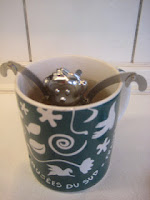
It's been a couple of weeks, but I'll try to keep it succinct. Let's start with getting ourselves settled with a nice cup of tea, preferably made with a Tea Monkey Infuser.


Now that you're settled in, I've got a bunch of interesting stuff for you to read.
On the subject of writing, Ta-Nehisi Coates does it again with this meditation on U.S. Grant's memoirs, the skill of clarity, and how writing "has no real respect for credentialism," that "intelligence is so messy, that it would show itself in people we disdain or think we know."
On the subject of popular culture, Tom & Lorenzo had an inspired rant about the latest episode of Glee and the increasing victimization of its gay characters.
Also an interesting perspective on the political front from Dan Drezner on "Why I like power-hungry bureaucrats more than whistle-blowers." I don't see it as an either/or, but it's certainly thought-provoking. And a great headline, eh?
PeaceBang relates a powerful anecdote to relate from a WeightWatchers meeting. As a person (trying to) give up shame--not for Lent, but forever--this had a lot of resonance for me. At what point does our motivation devolve into shaming ourselves? And what can we do about it?
Finally, on the romance front, the Futility Closet shows us how it's done with this unique wedding proposal from Evelyn Waugh. Excerpt: "I am restless & moody and misanthropic & lazy & have no money except what I earn and if I got ill you would starve. In fact it’s a lousy proposition. On the other hand I think I could do a Grant and reform & become quite strict about not getting drunk and I am pretty sure I should be faithful." Who would even think of refusing?


Although as I pointed out to the blogger, Lahikmajoe, there's something a little disturbing about the fact that you put a monkey in water and the water turns brown. Still mighty cute, though. Looks like he's soaking in a hot tub. And turning it brown.
At any rate, once you've got your Golden Monkey tea, you're ready to check out the Tea and Biscuit Dunking Guide (also available as a high-resolution PDF) that tells you exactly how many seconds to leave each kind of cookie in your tea (when served between 150-160 degrees F) to prevent sogginess or the dreaded floppage!

Now that you're settled in, I've got a bunch of interesting stuff for you to read.
On the subject of writing, Ta-Nehisi Coates does it again with this meditation on U.S. Grant's memoirs, the skill of clarity, and how writing "has no real respect for credentialism," that "intelligence is so messy, that it would show itself in people we disdain or think we know."
On the subject of popular culture, Tom & Lorenzo had an inspired rant about the latest episode of Glee and the increasing victimization of its gay characters.
"Remember, my brothers? Remember that ten-year period when the mass media definition of “gay man” was “noble, diseased victim?” Is this new trope of gays as noble, weepy, child victims really a step in the right direction? Because just as in the eighties and nineties, when the majority of gay men were not dying of AIDS; the majority of young gay people today are doing relatively okay for themselves."It's a very interesting perspective.
Also an interesting perspective on the political front from Dan Drezner on "Why I like power-hungry bureaucrats more than whistle-blowers." I don't see it as an either/or, but it's certainly thought-provoking. And a great headline, eh?
PeaceBang relates a powerful anecdote to relate from a WeightWatchers meeting. As a person (trying to) give up shame--not for Lent, but forever--this had a lot of resonance for me. At what point does our motivation devolve into shaming ourselves? And what can we do about it?
Finally, on the romance front, the Futility Closet shows us how it's done with this unique wedding proposal from Evelyn Waugh. Excerpt: "I am restless & moody and misanthropic & lazy & have no money except what I earn and if I got ill you would starve. In fact it’s a lousy proposition. On the other hand I think I could do a Grant and reform & become quite strict about not getting drunk and I am pretty sure I should be faithful." Who would even think of refusing?
Subscribe to:
Posts (Atom)