Showing posts with label Historical figures. Show all posts

Saturday, August 4, 2012

Your Olympics/Episcopal trivia of the day

Everyone seems to be talking about Ethelbert Talbot these days. Well, actually, they're not talking about him by name. It's just that I saw this mention of how the Olympic Creed was inspired by a sermon. A little more digging revealed that the sermon in question was by the Rt. Rev. Ethelbert Talbot, then-Bishop of Pennsylvania, in London in 1908 for the Lambeth Conference, which happened to coincide with the Olympics.
The games were very contentious, with many American protests against British rulings. Talbot was aware of this and it concerned him. He was invited to preach at St Paul's Cathedral on July 19, a service to which athletes and officials of the games were specially invited. In his sermon, he said,
“We have just been contemplating the great Olympic Games. What does it mean? It means that young men of robust physical life have come from all parts of the world. It does mean, I think, as someone has said, that this era of internationalism as seen in the Stadium has an element of danger. Of course, it is very true, as he says, that each athlete strives not only for the sake of sport, but for the sake of his country. Thus a new rivalry is invented. If England be beaten on the river, or America outdistanced on the racing path, or that American has lost the strength which she once possessed. Well, what of it? The only safety after all lies in the lesson of the real Olympia - that the Games themselves are better than the race and the prize. St. Paul tells us how insignificant is the prize, Our prize is not corruptible, but incorruptible, and though only one may wear the laurel wreath, all may share the equal joy of the contest. All encouragement, therefore, be given to the exhilarating - I might also say soul-saving - interest that comes in active and fair and clean athletic sports.”
And from this was drawn what is now called the Olympic Creed:
The most important thing in the Olympic Games is not to win but to take part, just as the most important thing in life is not the triumph but the struggle. The essential thing is not to have conquered but to have fought well.
The good bishop, there, became Presiding Bishop, the last bishop to take the office due to seniority. There's also a fabulous story (in both senses of the word) in his Wikipedia article from his time when he was the missionary bishop of Wyoming and Idaho.
When he arrived in his see, there were only four clergy in each of the two states. In the ten years in the West, he established 38 churches and built St. Matthew's Cathedral in Laramie, Wyoming. This was still the Old West and the story is told of his encounter with bandits while riding in a stage coach,
“Surely you wouldn’t rob a poor bishop?” said Talbot.
“Did you say you were a bishop?” asked the bandit.
“Yes, just a poor bishop.”
“What church?”
“The Episcopal.”
“The hell you are! Why that’s the church I belong to! Go along, driver.”
And with that, I'm going to watch the women's triathlon which I recorded from early this morning. Fight well.

Sunday, February 19, 2012

Lent Madness update: Lentsanity!

One of the things about being away: I didn't keep up with the pandemonium, the maelstrom, the--oh, what's the word I'm looking for? Let's just go with "hype", shall we? swirling around Lent Madness, for which I am one of the celebrity bloggers.  Or, as Scott Gunn and Tim Schenck explain in this video, a "celebrity" blogger.  And don't think I won't remember the scare quotes when awards season comes around again.  I will cut you.  Though I have to say I'm mighty grateful that you pronounced my last name correctly in your last Monday Madness video! Impressive! (If you're wondering how to say it yourself, it is mentioned at about 9:30 on the video. Although as a true celebrity, I am first referred to simply as Laura, no last name required.)

 
Monday Madness -- February 13, 2012 from Forward Movement on Vimeo.

I am also looking forward to drinking a great deal of tea from a fabulous Lent Madness mug.

So don't forget: Lent Madness begins this Thursday!  Check out the bracket and place your picks for the Final Four.  Who do you think will win the it-would-be-coveted-if-coveting-were-not-a-sin Golden Halo? There's a strong group of 19th century American frontier types in the bracket; I'll be interested to see how they do.  Frankly, knowing Kenyon College folks, I think Philander Chase has a good chance to go far.

You can keep up with the madness by signing up to receive notifications of new posts by email. You can also like Lent Madness on Facebook. Check it out!

Friday, June 17, 2011

Inspiring obituaries

The past couple of weeks have offered several inspiring obituaries, and I don't want to gloss over them in a Various and Sundry post.

As I did last week when I highlighted the obituary for Albertina Sisulu, the mother of the anti-apartheid movement. If you didn't read the obituary then, well, I commend it to you again.

This obituary was shortly followed by one for Clara Luper, the woman who, along with the youth of the NAACP, staged lunchcounter sit-ins in Oklahoma City, 18 months before the more famous ones in Greensboro, SC.

As often happens, the obit ends with a punch:

"[Her father] used to tell us that someday he would take us to dinner and to parks and zoos,” she said. “And when I asked him when was someday, he would always say, ‘Someday will be real soon,’ as tears ran down his cheeks.”
What an amazing gift she gave her father, to help bring that about.

Finally, another inspiring obit for someone I'd never heard of: Mietek Pemper who "typed up the list which helped Oskar Schindler save 1,200 Jews from the Nazis." Well, it was more than that, actually.
In the summer of 1944, as the war turned against them, Pemper found out that the Nazis were intending to close any factories which were not dedicated to the war effort. Realising that this would probably result in the Jews at Plaszow being transferred to Auschwitz, at great personal risk he persuaded Schindler to switch to making anti-tank grenades, and together the two men laid plans to secure a transfer of the enterprise, with as many Jewish workers as possible, away from the camp at Plaszow to a new factory in Bruennlitz in Czechoslovakia. It was Pemper who compiled the famous typed list of 1,200 Jews to be recruited for work “decisive for the Nazi war effort” and transferred to the new factory.
All of which tells me that no great act of justice is done by a single superhero. Nelson Mandela, Martin Luther King Jr., Oskar Schindler were not able to do the work they did on their own.

The Pemper obit makes this point as well, again with a punch at the end:
Pemper’s role was played down in the film, but he did not seem to mind, arguing that the “crucial accomplishment’’ was not the list itself but “the multifarious acts of resistance that, like tiny stones being placed into a mosaic one by one, had made the whole process possible.’’
What stone do you have to offer?

Friday, February 25, 2011

Various and Sundry, February 25

Anyone else having trouble keeping up with the news? Where to focus: Wisconsin union workers, protests and violence in Libya, the lack of defense of the Defense of Marriage Act, the moves to defund Planned Parenthood... Certainly they require more than my brief and ill-informed opinions and reflections. And lots of other people have lots of stuff to say about it.

Here's the one thing I'll say about all of this: I'm trying to keep an open mind, listening to arguments that don't already support my point of view and hammering out my own opinions. That is hard, hard work, so I'm taking my time. Mostly I try to keep my mouth shut until I have a clear thought in my head. Doesn't always work. One of the reasons I like Andrew Sullivan's blog is because he allows for the debate and the presentation of the strongest arguments on all sides of an issue. Be warned, though: if you go there, you will be inundated with ideas, many of which you won't agree with.

So let's go with some lighter fare, such as the "oatmeal" at McDonalds. I appreciate Ta-Nehisi Coates' response to the editorial in the Times (which said how it's just as easy to make oatmeal at home as to buy it at Mickey D's):

I think what Bittman urges in his writing is is consciousness. He wants people to think hard about what they're eating. I strongly suspect that people go to McDonald's for the exact opposite reason--to get unconscious. Understanding why that it is, goes beyond our food. It's about how we live.

I'm seeing the food curriculum everywhere!

Those fabulous and classy women at Dirty Sexy Ministry have posted a great entry on The Ballad of Booger Joe and Honey Butt. I can't summarize, but it's got great advice for living.

On the other hand, if you're looking for some thoughts on dying, you might want to check out this card game. "It’s a deck of 36 playing cards designed “to give you an easy, even entertaining way to think and talk about how you want to be treated” as you’re about to die." And it actually sounds very helpful. Created by the Coda Alliance, the cards go way beyond the "I don't want to be a vegetable" to help people sort through their values, priorities, and options.

In obituary news, I did love this obit for Chris Dale: "Chris Dale, who has died aged 49, was a 6ft 6in mountaineer with a passion for solo climbs among the hardest peaks of Scotland, Wales and the Alps. He was also an equally enthusiastic cross-dresser who went by the name of Crystal." Talk about larger than life!

And in other cross-dressing news, loved this historical snippet from the also-classy Futility Closet about Count Carlos Balmori in Mexico. I daren't reveal the secret.

Enjoy!

Thursday, August 26, 2010

The tricky act of demanding rights

Today is the 90th anniversary of the 19th Amendment being made the law of the land:

The right of citizens of the United States to vote shall not be denied or abridged by the United States or by any State on account of sex.

Congress shall have power to enforce this article by appropriate legislation.
Through a series of clicks, I found this article in the Washington Post which suggests that Elizabeth Cady Stanton was for many years largely forgotten as a mover and shaker of the women's suffrage movement because she was critical of organized religion as one of the forces behind women's oppression, while Susan B. Anthony "held her tongue for fear of driving away women of faith from the suffragist cause and offending religious men who had the power to continue to deny women the vote."

(I know a certain historian who reads this blog who I hope will chime in here.)

For me this raises the question: if you are trying to acquire right A, but to do so you must be circumspect about proclaiming truth B (or what you think is truth B), what do you do? How much is too much to ask for? How long is too long to wait? What action is beyond the scope of the goal you hope to accomplish? How do you reconcile using the help and resource of people with whom you violently disagree in order to reach the goal you desire?

From what little I know of the suffragist movement, it was long, it was hard, it was complicated, it was violent, and it was full of compromise. How do you come out of something like that with your integrity intact?

Something I need to consider as the struggle for human rights continues--and no doubt will never end. For today, I am so grateful to the many, many women who made it possible for me to vote.  It's a right and a privilege I take most seriously.

Thursday, July 8, 2010

Four reasons why Holy Women, Holy Men bugs the heck out of me

I mentioned a couple of days ago that my reaction after a year of looking at the new people added to the Episcopal Church calendar was, by and large, "bleah." The complete list of recognized people, along with collects of the day (no last names and all), and recommended readings has been compiled into a book called Holy Women, Holy Men: Celebrating the Saints (hereafter HWHM).

Yesterday, I received a press release from Church Publishing, announcing that "a formal, quantitative [online] survey will be available for users of the new resource to record their impressions of this expanded collection of commemorations. The survey... is designed to be used on a daily or frequent basis. Survey participants can comment on every collect and chosen scripture passage for each commemoration in the entire 800-page publication."

You can bet I will be a frequent contributor. And if you're as obsessed and peculiar as I am, I hope you will contribute too.

I had some initial reactions to the new proposed calendar a year ago before I had a chance to explore it. My worry was that we were "claiming people for our calendar to make us feel better about ourselves." I don't think that was a bad first call. But there are some other things that have become disturbing to me over the year.

1) It seems that "saint" has come to mean "people who did good things" Take, for example, William W. Mayo, Charles Menninger and their sons: Pioneers in Medicine. No doubt worthy of remembrance. I don't argue against that. But what does it actually mean to be a saint? Does it have something to do with the church at all? I'm not saying that every saint has to be doing churchy things. Just that many of these feasts seem based primarily on their historical importance or contribution rather than their witness of faith.

2) A number of those remembered were just doing what was normal for the time in which they lived One which stood out for me in this regard was the Pioneers of the Episcopal Anglican Church of Brazil. "In 1890, Lucien Lee Kinsolving and James Watson Morris were sent as Episcopal missionaries to Brazil. The following year, they were joined by three other American missionaries. [They] are now celebrated as the founders of the Episcopal Anglican Church of Brazil." Well, whoopididoo. Were they loving? Did they show any special grace? Given the history of missionary work, I need something a little more than this.

3) A number of those remembered would hate to be considered a saint Poor John Calvin. I have trouble recognizing as a saint those who would object to the notion of sainthood. It seems to offend the very people we want to honor.

4) It's so damn trendy This is just my personal feeling, and it's a tough call. But one of the things I appreciated about the commemoration of Jan Hus is that time shows his extraordinary faith in much sharper relief. There's nothing trendy about it. I worry that some of those included are simply there due to trends in faith: multiculturalism, inclusion of women and minorities--not that there's anything wrong with any of those things. It just seems to be done indiscriminately. Were you decent to Indians? You're in!

The upshot is, I don't think we gave enough thought to what we mean when we say someone is a saint. I'm not sure I can define it. I can tell you, though, that what we have now just doesn't sit right with me.

I welcome your thoughts and feedback and will continue to ponder this question myself.

Friday, August 21, 2009

Blaise Pascal

I titled this so blithely as if I could possibly write a blog entry that says anything about Blaise Pascal. But I learned that he is remembered today, though he died on August 19, in 1662.

He's best known for Pascal's wager, the logical proposition that if you don't know if there is a God, but act as if there is, then if there is a God, you're golden, and if there isn't, well, no harm done. (Boy, am I oversimplifying!) That's the coldly rational mathematician side of his faith.

But I am more drawn to his understanding that rationality doesn't explain everything. "The heart has its reasons of which reason knows nothing," he said in his Pensees. I am not even going to try to unpack that. I am so far out of my depth here, I don't want to presume to explain Pascal.

It did, however, remind me of the story from last Sunday's lectionary when Solomon asks God for wisdom. In my prep, I learned that when Solomon asks for an understanding mind is elsewhere translated "a hearing heart." I liked that a lot: that the heart's response not just a "this feels good to me" reaction to the world, but an interactive one, hearing as well as feeling. Something akin to reason, with both input and analysis, but in its own heartlike way.

Thursday, August 13, 2009

Florence Nightingale, data babe

Yesterday was the feast of Florence Nightingale, but today is the actual anniversary of her death 99 years ago and so it still seems appropriate to write about her. Not that it would stop me anyway, because she is amazing!

I had no idea how amazing until I started reading some biographical sketches yesterday.

Did you know, for example, that she was a mathematician? And that she invented the "polar-area diagram," better known to us as the pie chart? She did! And do you know how she used the polar area diagram? Why, she collected data on deaths due to various causes in the Crimean war and through that graphic representation of data created social change and reform that reduced casualty deaths from 42.7 percent to 2.2 percent! Here is her Diagram of the Causes of Mortality:


Is that not so cool? I am practically hyperventilating over her, here. I don't know about you, but I had this picture of sweet nurse Florence, tending patients. No, my friends. DATA! Data in the service of health and welfare, alongside the care and tending of souls. Oh, she is so my hero.

Saturday, August 8, 2009

Quote of the Day

This is what he said. This is what Abraham Lincoln said.

I don’t like to hear cut and dried sermons. No—when I hear a man preach, I like to see him act as if he were fighting bees!

Found this courtesy of Andrew Sullivan, who found it in this review of a new biography of Lincoln.

I'm off to get ready for my bee fight.

Saturday, April 18, 2009

Happy 75 birthday, East Bay Regional Parks!


No one claimed private ownership of any possessions, but everything they owned was held in common. Acts 4:32

I am mighty grateful for the farsighted folks who came up with the idea of a Regional Park District back in the 1930's. Keeper is even more grateful, what with all the off-leash trails. And cow pies.

I'm particularly mindful of this as Earth Day approaches next Wednesday. The thing I was thinking about Earth Day is that we tend to get all woo-woo about the beauties of the earth as if that was separate from the way that we use, manage, and take care of it. Yes, the earth is beautiful on its own. Yes, nature is powerful and dynamic.

But it's also clear to me that we need to think about taking care of the earth for the long haul, not just about what's pretty and useful today. And not just for us. Which is one reason why I think this 75th anniversary is so wonderful, is to see how the foresight of these folks during the depression have enriched my life so much. (And Keeper's life, he wishes me to add.)

Check out their schedule of activities here.

Saturday, October 4, 2008

Cardinal Newman's practical joke

I don't know if you've heard about this, but back in July, the Vatican asked to exhume the remains of Cardinal John Henry Newman. Their plan was to move the remains to the oratory in Birmingham, thus (so they say) making it easier for pilgrims to venerate him as he moves forward in the canonization process.

This was big news (well, OK, that's a relative term) for a lot of reasons. For one thing, Cardinal Newman was a convert from the Anglican Church to Roman Catholicism after being a leading light of the Oxford movement (aka Anglo Catholic high-churchmanship), so there was some turf scuffling, there.

For another, Cardinal Newman's own request was that he be buried with his "lifelong friend" (I am quoting here from an article in the Daily Mail) Ambrose St. John. "He wrote the following just weeks before his death in the summer of 1890. 'I wish, with all my heart, to be buried in Father Ambrose St John's grave... I give this as my last, my imperative will.'"

Hmmm...could it be perhaps that the Vatican didn't want to canonize someone deading openly with a person of the same sex? Naaaah.

All of this makes today's news so much more fun. Because on Thursday, they dug up the tomb and nothing was there. Here's the bulk of a lovely update by Ruth Gledhill in the London Times:
On Thursday, having won the battle to exhume Cardinal John Henry Newman's body for its transfer to the Oratory in Birmingham, those paying their respects at the graveside had a bit of a shock. There was no body to exhume, nothing at all. Not a trace of bone, hair, human remains or anything except this plate. It means that he was not buried in the lead coffin that many supposed he had been but a simple wooden affair. It is not apparently unusual for remains to disintegrate totally in this fashion. A few fragments of hair preserved elsewhere will now be placed in a casket for veneration in the Birmingham Oratory, but of course there can be no 'lying in state' for a real body.... As the spokesman for the Cause, Peter Jennings , has just told me, rarely can there have been a more vivid reminder of the truth of what the priest says at the Ash Wednesday Mass: 'Remember Man, thou art dust and unto dust thou shalt return.' As our capitalist world crumbles about us, it seems that Newman is a saint for our times in more ways than we could previously have imagined.
Good on you, Cardinal.

Monday, September 22, 2008

A very important day

I bet you don't know what today is. Today is the feast of Philander Chase! Who was Philander Chase? I'm so glad you asked...cue music:
Philander Chase

The first of Kenyon's goodly race
Was that great man Philander Chase;
He climbed the Hill and said a prayer,
And founded Kenyon College there.
He climbed the Hill and said a prayer,
And founded Kenyon College there.

He dug up stones, he chopped down trees,
He sailed across the stormy seas,
And begged at every noble's door,
And also that of Hannah More.
And begged at every noble's door,
And also that of Hannah More.

The King, the Queen, the Lords, the Earls,
They gave their crowns, they gave their pearls
Until Philander had enough
And hurried homeward with the stuff.
Until Philander had enough
And hurried homeward with the stuff.

He built the College, built the dam
He milked the cow, he smoked the ham,
He taught the classes, rang the bell,
And spanked the naughty freshmen well.
He taught the classes, rang the bell,
And spanked the naughty freshmen well.

And thus he worked with all his might
For Kenyon College, day and night;
And Kenyon's heart still holds a place
Of love for Old Philander Chase.
And Kenyon's heart still holds a place
Of love for Old Philander Chase.

Tuesday, September 16, 2008

Vague thoughts on right, wrong and Henry Clay


I read an interesting story this morning on a sermon prep website. I doubt I'll be able to use the story in the sermon I'm preparing, but I thought I'd share it here.

It purports to be a true story about a "people experiment" done by a Virginia Theological Seminary professor named Reuel Howe.

At this particular lab, the group was given a piece of wood, and told to reach some agreement about its length, without measuring it in any way – purely an eyeball estimate. Then they were to gather as many others as possible who agreed.

One person had been told beforehand the exact length, but he was not allowed to reveal the source of his knowledge. As far as the rest were concerned, he was guessing just as much as they were.

The estimates varied widely. The only agreement was that no one agreed with the one person who had the correct answer. He tried to gather several groups but couldn't get other people to agree with him.

So eventually, he joined a group who advocated the wrong answer.
When he was asked, at the end of the exercise, why he would throw his lot in with a wrong answer, when he knew the right one, he replied, “I’d rather be wrong than alone.”
As I said, I don't know if this is true, but I find it at least possible to believe. It's such a human story: so sad, and so sweet.

"I'd rather be wrong than alone" reminded me of the quote "I'd rather be right than president," which I tracked down (thank you, Google!) as a line from Henry Clay who was defeated in his presidential bid four times. Here's Wikipedia's take on the phrase: "When Clay was warned not to take a stance against slavery or be so strong for the American System [i.e. high tariffs, anti-free-market economy, if I understand it correctly], he was quoted as saying, 'I'd rather be right than be President!' This remark has been quoted or paraphrased by several presidential candidates since, as a statement of principle over ambition."

I suspect that even if the first story didn't actually happen, there's a lot of truth in it; it's often so much more comfortable to be wrong than to be alone. And, oh, how familiar it sounds in our own current presidential race. Wouldn't you rather be right and be president? If you had to choose one or the other, which would you choose?

Picture is of Henry Clay speaking in the Senate.

Sunday, August 17, 2008

Who you callin' heretic? - or - Meditations for Women who Blog Too Much

As many of you know from reading this blog, I am an Anglican blog-o-holic. Which is one reason why I was so amused to read this today (names removed to prevent early disclosure of source).

The bishop is severely ravaging and persecuting us and moving against us with every evil. Thus he drives us out of every city like godless men, since we will not agree with his public statements...

Since E. and T... and all those in the East say [this], they have been condemned, except for P. and H. and M., unlearned heretics.... We are not able to listen to these kinds of impieties, even if the heretics threaten us with ten thousand deaths. But what do we say and think and what have we previously taught and do we presently teach?

This is a very familiar sounding rant for anyone who reads blogs too much, which is why it made me laugh.

The author of this letter is Arius, writing to Eusebius of Nicomodia in the year 318. (You can read the whole thing here, if you're a church history geek like me.) Arius is the central figure in the heresy known as Arianism, a belief that says that Jesus is not co-eternal with the father, "But we are persecuted because we have said the Son has a beginning but God has no beginning. We are persecuted because of that and for saying he came from non-being. But we said this since he is not a portion of God nor of anything in existence. That is why we are persecuted; you know the rest."

These horrible heretics of whom Arius writes are the party we have long considered "orthodox," the ones who made sure the Nicene creed stated that Jesus was "of one being with the father."

God from God, light from light, true God from true God, begotten, not made.

A position I happen to hold. In some ways I find it very comforting to know that this belief, too, was once and by some considered heretical. In other ways, I find it disturbing to be accused, even at this great distance of time and space, of persecution.

Wednesday, July 30, 2008

Feast of William Wilberforce

Today is the feast of William Wilberforce, a hero of mine and the focal point of the movie "Amazing Grace" that I saw just one year ago at Chautauqua while I was the chaplain there. Then I got to give a homily on him for the morning service. The thing that I found odd about the movie is that they actually made the job of ending the slave trade sound EASIER than it really was. What was that about? I can't remember the particulars, but as I recall, the movie suggested it was FEWER years than it really was.

The movie suggested that Wilberforce got to see the fruits of his labors when in fact he died one month (!) before Parliament abolished slavery in Britain and its extended domains. One month! I'm sure he knew about it, though. What the movie showed was the end of the slave trade, abolished in 1807; what it doesn't show is that Wilberforce was in Parliament another 18 years, trying to end slavery; and he died 8 years after that. That's another 25+ years--in addition to the 27 years Wilberforce was in Parliament (beginning in 1780) before he saw the slave trade ended.

The thing I draw from William Wilberforce is that the task of righteousness is not impossible, but that I shouldn't be under the delusion that it might be anything less than very, very, very difficult. Difficult, long, and painful is not the same as impossible.

"Let your continual mercy, O Lord, kindle in your Church the never-failing gift of love, that, following the example of your servant William Wilberforce, we may have grace to defend the poor, and maintain the cause of those who have no helper; for the sake of him who gave his life for us, your Son our Savior Jesus Christ, who lives and reigns with you and the Holy Spirit, one God, now and for ever. Amen."

Friday, June 20, 2008

For Heresies

Yes, I am playing off Irenaeus' "Against Heresies," and, yes, I am being obnoxious in referring to Irenaeus in my blog. But I'm working on an adult education lesson talking about heresies and found all sorts of wonderful quotations today that I would like to share, starting with my personal favorite:

“There are no heresies in a dead religion.” Andre Suares, French poet (1868-1948)

I have no idea who Andre Suares was aside from this quotation. Born exactly 100 years before I was, which worries me. Will I die in 2048? In any event, I do love this statement, which rings true to me. Any living faith will struggle with heresies; it's a sign that it is still alive.

“A virtuous heretic will be saved before a wicked Christian.” Benjamin Franklin

Oh, Ben! Mr. Pith himself, encapsulating the debate between orthodoxy and orthopraxy (another obnoxious drop-in, but it's a great word). But I believe that belief plays out in action. No right belief can truly co-exist with wicked behavior.

“A man may be a heretic in the truth; and if he believe things only because his pastor says so, or the assembly so determines, without knowing other reason, though his belief be true, yet the very truth he holds becomes his heresy.” John Milton

Which goes very well with

“Heresy is another word for freedom of thought.” Graham Greene

I think that one from GG is a bit flippant, but it's worth a moment to consider.

Another lovely matched pair:

"The heresy of one age becomes the orthodoxy of the next." Helen Keller

"The difference between heresy and prophecy is often one of sequence. Heresy often turns out to have been prophecy when properly aged." Hubert H. Humphrey

Hubert Humphrey, who'd've thought? And Helen Keller the only woman of the bunch. Are women less concerned with heresy, perhaps? Or merely less quoted?

Here's to good heresy. Long and well may it age.

Monday, October 1, 2007

Talk about eating to live or living to eat!


I'm reading this fabulous book called "Paris in the Fifties" by Stanley Kurnow who has a chapter on Curnonsky, The Prince of Gastronomes, who literally wrote the book on French cooking, "France Gastronomique, which ultimately appeared in twenty-eight volumes late in the 1920's."

"He ate only one full meal a day, always in a restaurant except when he was required to attend a function. Following dinner, he would work at his littered desk until dawn, then bathe, go to sleep, awake at three or four in the afternoon, breakfast on a boiled egg and a glass of warm milk, receive visitors and wait for his acolytes to appear for the nightly ritual."

Alas, eventually by the mid-50's, "His health, once so robust, was failing, and he had been forbidden everything but toast and milk. In 1956, depressed by the gloomy diet, he jumped to his death from his apartment window. Addressing a suicide note to a friend, he cautioned, 'Avoid the left leg of the partridge, since it perches on that limb, which makes the blood circulation sluggish.'"

Now, that is FRENCH!

Friday, May 25, 2007

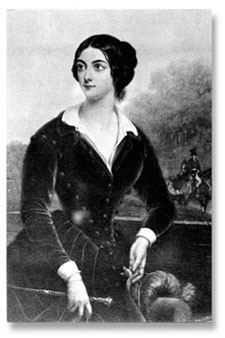
More on Lola Montez


Heavens to Betsy! Who knew? Born in Ireland in 1821 (christened Eliza Rosanna Gilbert); moved to India as a child; eloped with a soldier at age 16--and that's the boring bit.

Then there's the part with Franz Liszt, and Ludwig I of Bavaria (who eventually abdicated).

And she died at age 40 of pneumonia. Packed a lot in before that, though.

http://www.zpub.com/sf/history/lola.html

Lola Montez

I cannot resist any longer, but must share this quote from the 1939 American Guide series on California, regarding a renowned citizen of Grass Valley:

"At the corner of Mill and Walsh Sts. is the Home of Lola Montez, to which the famous beauty, who was born Maria Dolores Porris Gilbert and lived to become Countess of Lansfeld, returned from her triumphs in Europe and America. Here she lived in retirement from 1852 to 1854, with a pet bear, some dogs, and a husband. The husband she later divorced because he killed her bear when it clawed and bit him. The beautiful and daring Lola brought with her a reputation that made her the talk of two continents, fame for public performances of the Spider Dance, and friendships with the great. In her modest cottage--since altered by the addition of a second story--she entertained at soirees, held mainly for the benefit of the younger miners, that became the talk of the Mother Lode."

Now I'm going to have to find out more about Lola Montez, Countess of Lansfeld.